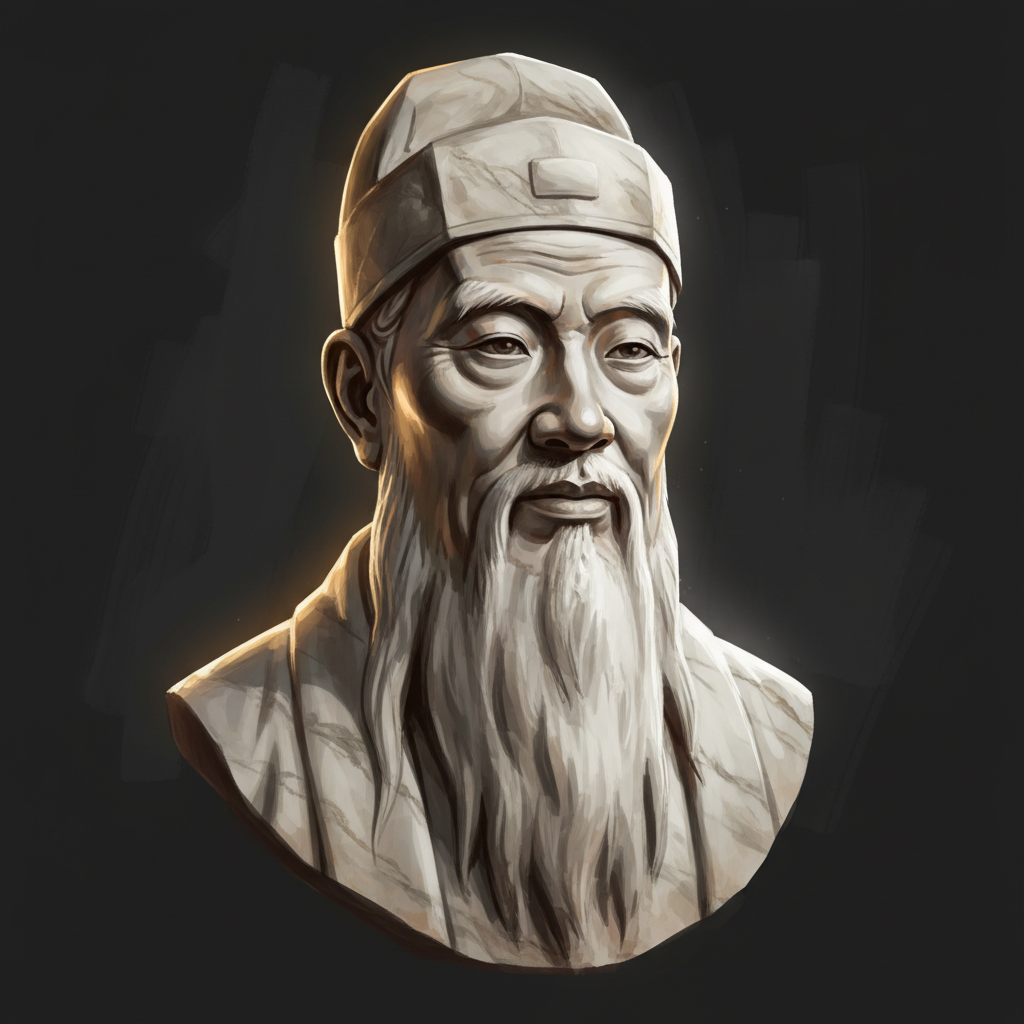
Confucius — "The Master said, 'The superior man is not an implement.'"
The Master said, 'The superior man is not an implement.'
The Master said, 'The superior man is not an implement.'
Click any product to generate a realistic preview. Up to 3 at a time.
* Initial load can take up to 90 seconds — revising the preview in another color is nearly instant.
"The superior man has a proper pride, but is not proud."
"You cannot open a book without learning something."
"It does not matter how slowly you go as long as you do not stop."
"Is humanity far away? Whenever I want the virtue of humanity, it comes at once."
"The Master said, 'What I want to avoid is fixed ideas, obstinacy, narrow-mindedness, and egoism.'"
Chinese philosopher and teacher whose teachings (compiled by his students in the Analects) became the foundational ethical framework of East Asian civilization for 2,500 years. Closely associated with Mencius (his most-influential follower a century later). For an intellectual contrast, see Laozi, near-contemporary Chinese sage and Tao Te Ching author — Confucius systematized social order through ritual and family hierarchy; Laozi's Taoist effortless-action philosophy argued such systems were the disease, not the cure. The two founding poles of Chinese moral philosophy — every East Asian moral tradition since has positioned itself between them.
The standard scholarly entry points to Confucius's work: Philip J. Ivanhoe (Georgetown, Chinese philosophy) — Confucian Moral Self Cultivation (2000); Edward Slingerland (UBC, Asian Studies) — Effortless Action: Wu-wei as Conceptual Metaphor (2003); Tu Weiming (Harvard, Confucian scholar) — Confucian Thought: Selfhood as Creative Transformation (1985). These are the works graduate seminars cite when teaching Confucius.
Found in 1 providers: grok
1 source checked
A truly developed person is not a narrow tool built for one job. Unlike an implement that serves a single function, a person of character cultivates broad wisdom, moral judgment, and adaptability. They are not reducible to a specialty or a role someone else assigns them. Their worth lies in who they are across any situation, not in a single skill or use they can be plugged into for a task.
Confucius spent his life training students for government service but refused to treat them as mere functionaries. He himself held minor posts, was dismissed, and wandered seeking rulers willing to listen. His ideal, the junzi, cultivated ren (humaneness), li (ritual propriety), and yi (righteousness) across every domain. This saying captures his conviction that education produces whole moral persons capable of judgment, not specialists hired to execute tasks without conscience.
Confucius lived during the late Spring and Autumn period (551-479 BCE), when the Zhou dynasty was collapsing and warring states prized officials as useful instruments for gaining power. Rulers wanted specialists: military tacticians, tax collectors, diplomats. Against this backdrop, Confucius insisted that genuine officials must be morally cultivated generalists who could refuse unjust orders. His teaching challenged the era's treatment of educated men as disposable tools serving any ambitious warlord.
AI-generated insights based on extensive research and information for context. Factual errors? Email [email protected].
Your cart is empty