Confucius — "The Master said, 'What I want to avoid is fixed ideas, obstinacy, narrow-mindedn…"
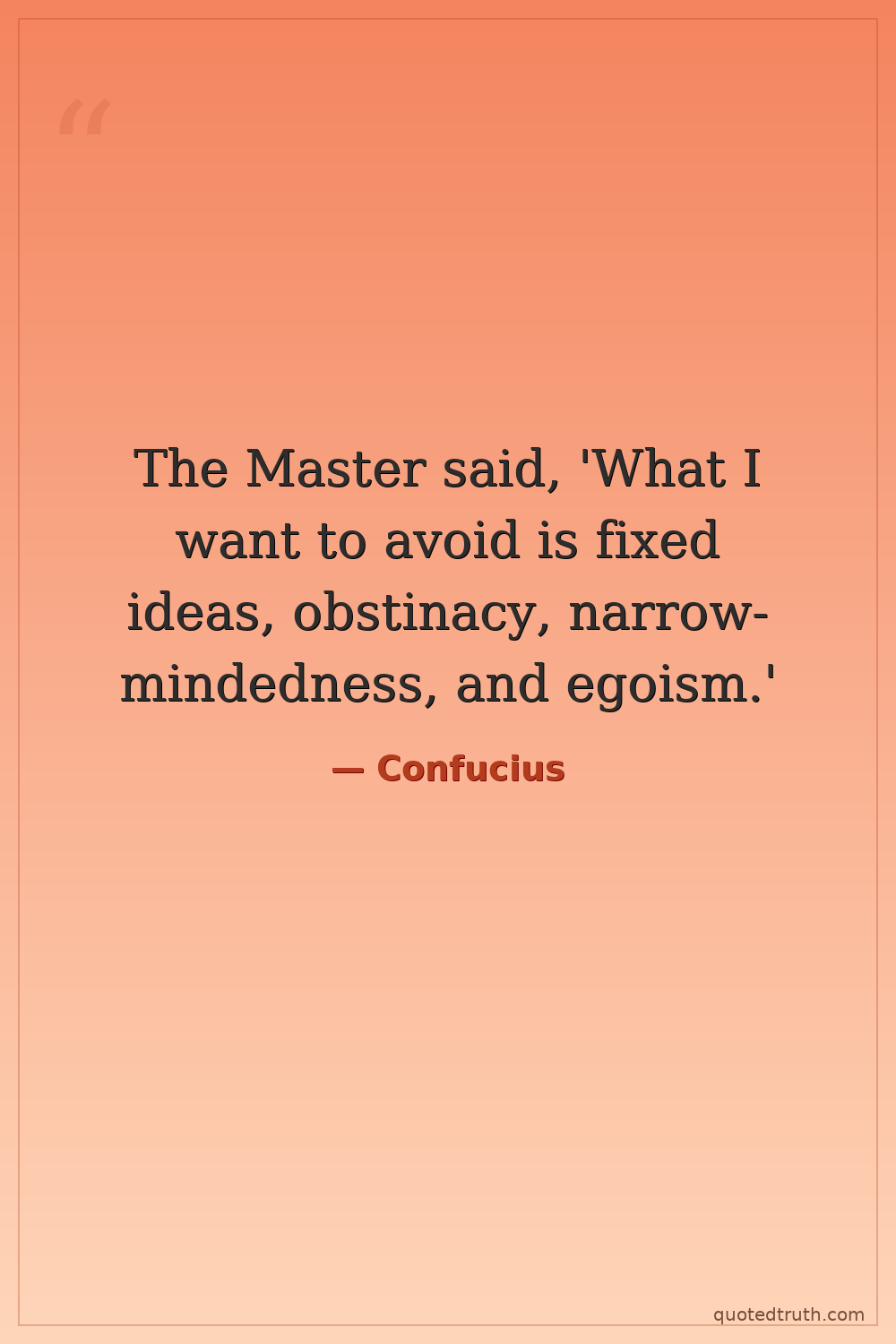
The Master said, 'What I want to avoid is fixed ideas, obstinacy, narrow-mindedness, and egoism.'
The Master said, 'What I want to avoid is fixed ideas, obstinacy, narrow-mindedness, and egoism.'
Click any product to generate a realistic preview. Up to 3 at a time.
* Initial load can take up to 90 seconds — revising the preview in another color is nearly instant.
"The superior man is modest in his speech, but exceeds in his actions."
"The Master said, 'To see what is right, and not to do it, is want of courage.'"
"The noble-minded are calm and steady. Little people are forever fussing and fretting."
"The faults of a man are characteristic of his class. It is by observing a man's faults that one may know his virtue."
"The superior man is distressed by his lack of ability, not by the failure of others to recognize him."
Chinese philosopher and teacher whose teachings (compiled by his students in the Analects) became the foundational ethical framework of East Asian civilization for 2,500 years. Closely associated with Mencius (his most-influential follower a century later). For an intellectual contrast, see Laozi, near-contemporary Chinese sage and Tao Te Ching author — Confucius systematized social order through ritual and family hierarchy; Laozi's Taoist effortless-action philosophy argued such systems were the disease, not the cure. The two founding poles of Chinese moral philosophy — every East Asian moral tradition since has positioned itself between them.
The standard scholarly entry points to Confucius's work: Philip J. Ivanhoe (Georgetown, Chinese philosophy) — Confucian Moral Self Cultivation (2000); Edward Slingerland (UBC, Asian Studies) — Effortless Action: Wu-wei as Conceptual Metaphor (2003); Tu Weiming (Harvard, Confucian scholar) — Confucian Thought: Selfhood as Creative Transformation (1985). These are the works graduate seminars cite when teaching Confucius.
Found in 1 providers: grok
1 source checked
The speaker names four mental traps he tries to keep out of his own thinking: locking onto a single opinion before the facts are in, refusing to budge once challenged, shrinking his view to only what is familiar, and making himself the measure of everything. He is describing the habits that prevent clear judgment and honest learning, and committing to stay free of them.
Confucius spent his career as a wandering teacher advising rulers across competing states, which demanded constant reassessment of people and policies. He prized lifelong learning, ritual humility, and listening to others, and criticized officials who clung to privilege or dogma. This self-description matches his recorded method of questioning students, revising his own views, and refusing to claim the title of sage, embodying the open-minded ren he taught.
Confucius lived during the late Spring and Autumn period (roughly 551-479 BCE), when the Zhou dynasty's authority had fractured and rival states fought for dominance. Competing schools, from Legalists to early Daoists, pushed rigid doctrines, and court officials often rose by flattery or hereditary rank. Against this backdrop of ideological hardening and self-interested rule, a public commitment to flexibility, humility, and setting aside the ego was both a moral stance and a pointed political critique.
AI-generated insights based on extensive research and information for context. Factual errors? Email [email protected].
Your cart is empty