Leonardo da Vinci — "The memory of all that is past is as nothing in comparison with the knowledge of…"
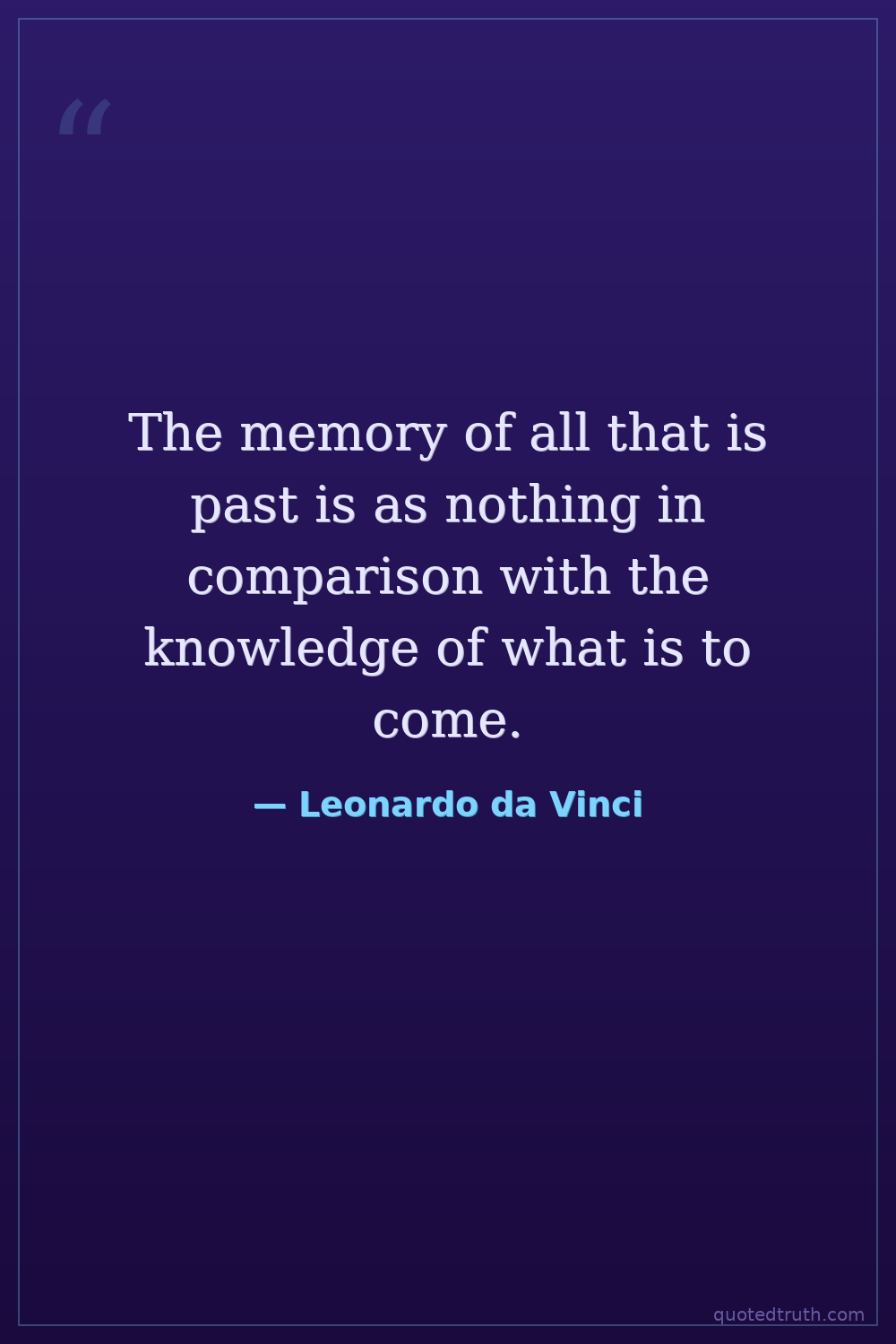
The memory of all that is past is as nothing in comparison with the knowledge of what is to come.
The memory of all that is past is as nothing in comparison with the knowledge of what is to come.
Click any product to generate a realistic preview. Up to 3 at a time.
* Initial load can take up to 90 seconds — revising the preview in another color is nearly instant.
"Birds, being provided with wings, can always fly where they wish, and so can men, if they have wings."
"Simplicity is the ultimate sophistication."
"The greatest pleasure and the greatest knowledge is to understand how we are born."
"He who loves practice without theory is like the sailor who boards ship without a rudder and compass and never knows where he may cast."
"Life well spent is long."
Found in 1 providers: grok
1 source checked
Remembering the past holds far less value than grasping what is yet to come. Memory is static — it records but cannot transform. Knowledge of the future enables action, invention, and progress. The real prize is predictive understanding: the capacity to anticipate, model, and shape events before they arrive. History is prologue; what lies ahead is where purpose and power actually reside.
Leonardo spent his life reaching toward what did not yet exist — designing flying machines, studying human anatomy before imaging technology, envisioning submarines and solar concentrators centuries ahead of realization. His thousands of notebook pages overflow with forward-facing questions, not historical chronicles. As painter, engineer, and anatomist, he embodied this conviction: tradition was a starting point, not a destination, and discovery of the unknown was the only work worth doing.
The Italian Renaissance was overturning centuries of backward-looking medieval scholarship. Gutenberg's press was spreading new ideas rapidly; Columbus had just reached the Americas; Copernicus was rewriting cosmology. European thinkers were shifting from reverence for ancient authority — Aristotle, scripture, tradition — toward empirical observation and forward projection. In this context, Leonardo's claim was almost radical: the future, not accumulated wisdom of antiquity, was the true measure of knowledge.
AI-generated insights based on extensive research and information for context. Factual errors? Email [email protected].
Your cart is empty