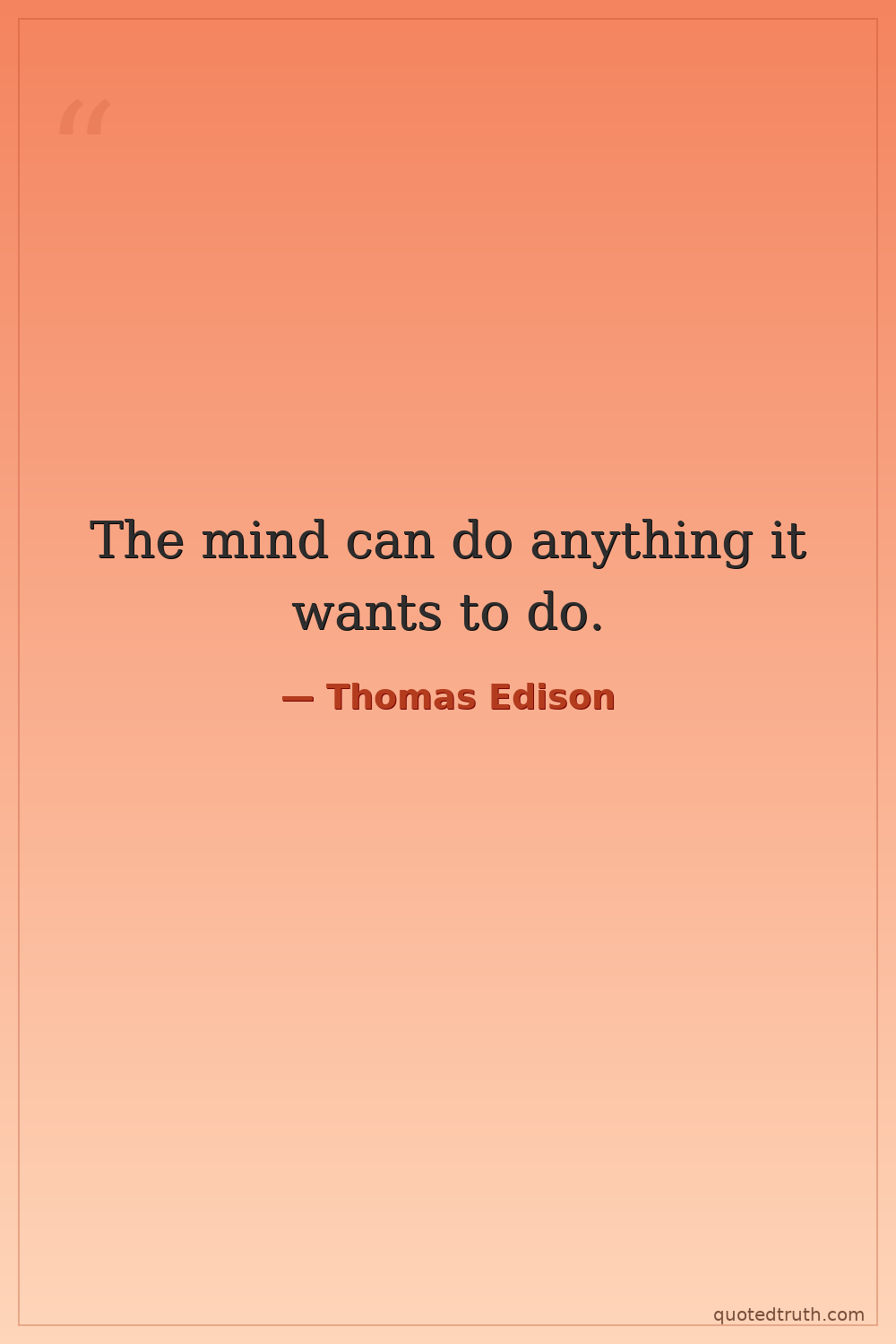
Thomas Edison — "The mind can do anything it wants to do."
The mind can do anything it wants to do.
The mind can do anything it wants to do.
Click any product to generate a realistic preview. Up to 3 at a time.
* Initial load can take up to 90 seconds — revising the preview in another color is nearly instant.
"I have more respect for the man who is trying to get somewhere than for the man who has gotten somewhere and is resting on his laurels."
"I am not a spiritualist, but I am a firm believer in the fact that we can communicate with the beyond."
"I have not failed. I've just found 10,000 ways that won't work."
"I am not discouraged, because every wrong attempt discarded is another step forward."
"Opportunity is missed by most people because it is dressed in overalls and looks like work."
Found in 1 providers: grok
1 source checked
This statement argues that human willpower and focused thought have essentially no limits when truly applied. If you decide on a goal and commit your mental energy to it, your mind can figure out how to make it happen. Intelligence, creativity, and persistence are framed as choices rather than fixed traits. The barrier between wanting something and achieving it is mostly internal resistance, not outside difficulty.
Edison embodied this through relentless iteration, famously testing thousands of filament materials before perfecting the incandescent bulb. He held 1,093 US patents, worked grueling hours at Menlo Park, and credited success to '1% inspiration, 99% perspiration.' For a man who left school early and was called addled by a teacher, the idea that the mind could overpower any obstacle was not philosophy but lived daily practice across the phonograph, motion picture, and electrical grid.
Edison worked through the late 1800s and early 1900s, a period when American industrialization rewarded self-made inventors and the patent system turned ideas into fortunes. Electricity was transforming factories, homes, and cities, while figures like Tesla, Westinghouse, and Ford competed to shape the modern world. Self-help philosophy, rugged individualism, and faith in human progress dominated the culture, making a statement about unlimited mental power both personally credible and broadly resonant with a nation reinventing itself.
AI-generated insights based on extensive research and information for context. Factual errors? Email [email protected].
Your cart is empty