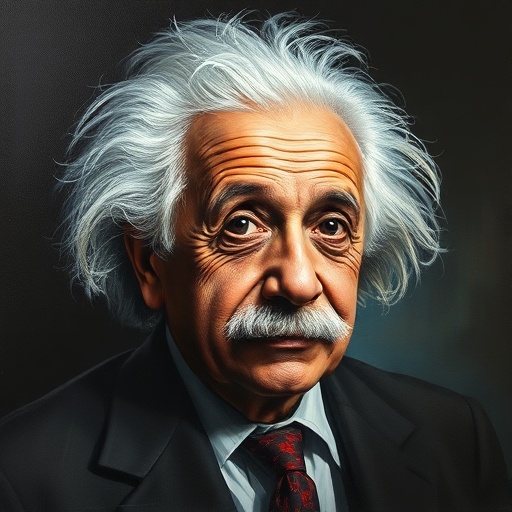
Albert Einstein — "The more I learn, the more I realize how much I don't know."
The more I learn, the more I realize how much I don't know.
The more I learn, the more I realize how much I don't know.
Click any product to generate a realistic preview. Up to 3 at a time.
* Initial load can take up to 90 seconds — revising the preview in another color is nearly instant.
"Gravitation cannot be held responsible for people falling in love."
"Falling in love is not at all the most stupid thing that people do-but gravitation cannot be held responsible for it."
"I see only with deep regret that God punishes so many of His children for their numerous stupidities."
"The important thing is not to stop questioning. Curiosity has its own reason for existence. One cannot help but be in awe when one contemplates the mysteries of eternity, of life, of the marvelous str…"
"If I were not a physicist, I would probably be a musician. I often think in music. I live my daydreams in music."
Widely attributed, but definitive primary source is elusive. Reflects a common sentiment among scientists.
Date: Uncertain
Self-DeprecatingFound in 1 providers: grok
1 source checked
True learning breeds humility. The deeper you go into any subject, the more you discover how vast and complex it actually is. Someone who knows little feels confident because they cannot see the edges of their ignorance. Someone who studies seriously confronts how much territory remains unexplored. Expertise reveals the scale of what you still lack, not what you have mastered.
Einstein spent decades developing relativity and quantum mechanics, yet remained openly uncertain about foundational physics questions. He famously wrestled with quantum mechanics until his death, writing that God does not play dice while acknowledging he could not reconcile it with relativity. A Nobel laureate and century-defining genius, he consistently described himself as a curious student rather than a finished authority.
Einstein worked through the early twentieth century, when physics underwent revolutionary upheaval. Classical Newtonian certainty collapsed under relativity, quantum theory, and atomic discoveries. Scientists who believed physics was nearly complete in 1900 watched their frameworks shatter within decades. This era proved that confident scientific consensus could be overturned entirely, making intellectual humility not just a virtue but a professional necessity for serious researchers.
AI-generated insights based on extensive research and information for context. Factual errors? Email [email protected].
Your cart is empty