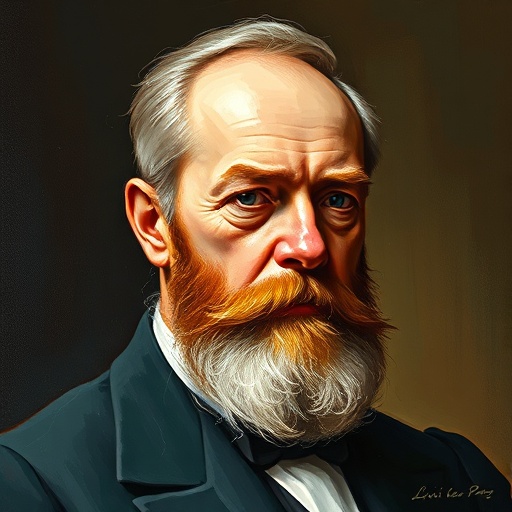
Louis Pasteur — "The more progress physical sciences make, the more they give us cause to believe…"
The more progress physical sciences make, the more they give us cause to believe that all phenomena are reducible to molecular forces.
The more progress physical sciences make, the more they give us cause to believe that all phenomena are reducible to molecular forces.
Click any product to generate a realistic preview. Up to 3 at a time.
* Initial load can take up to 90 seconds — revising the preview in another color is nearly instant.
"The greatest discovery of my life has been finding God."
"I am convinced that a day will come when every disease will have its specific remedy."
"The scientist has to be a poet in his heart and a logician in his mind."
"I am convinced that I have found the cause of fermentation."
"Messieurs, c'est les microbes qui auront le dernier mot. (Gentlemen, it is the microbes who will have the last word.)"
Attributed, reflecting his mechanistic view of nature.
Date: Late 19th Century (approx.)
EducationalFound in 1 providers: grok
1 source checked
As science advances, we keep discovering that everything around us, from life to disease to chemistry, can ultimately be explained by interactions happening at the tiniest scale between molecules. What looks mysterious or complex on the surface turns out to be the result of small physical and chemical forces acting in predictable ways. The deeper we look, the more the universe seems built from these microscopic building blocks working together.
Pasteur spent his career proving invisible microscopic agents shaped visible outcomes, whether souring milk, fermenting wine, or causing rabies. His work on germ theory and pasteurization depended on the conviction that molecular-scale causes drive large-scale phenomena. As a trained chemist who pivoted to biology, he repeatedly showed that crystal structure, fermentation, and infection all came back to tiny particles, making this belief the foundation of his life's research.
Pasteur worked during the 1800s scientific revolution, when chemistry, physics, and biology were rapidly merging. Atomic theory was gaining traction, the microscope was revealing new worlds, and researchers like Maxwell and Mendeleev were mapping molecular and elemental behavior. Disease was still widely blamed on bad air or spontaneous generation. Pasteur's era was the moment science began replacing mysticism with measurable, molecular explanations, setting the stage for modern medicine and microbiology.
AI-generated insights based on extensive research and information for context. Factual errors? Email [email protected].
Your cart is empty