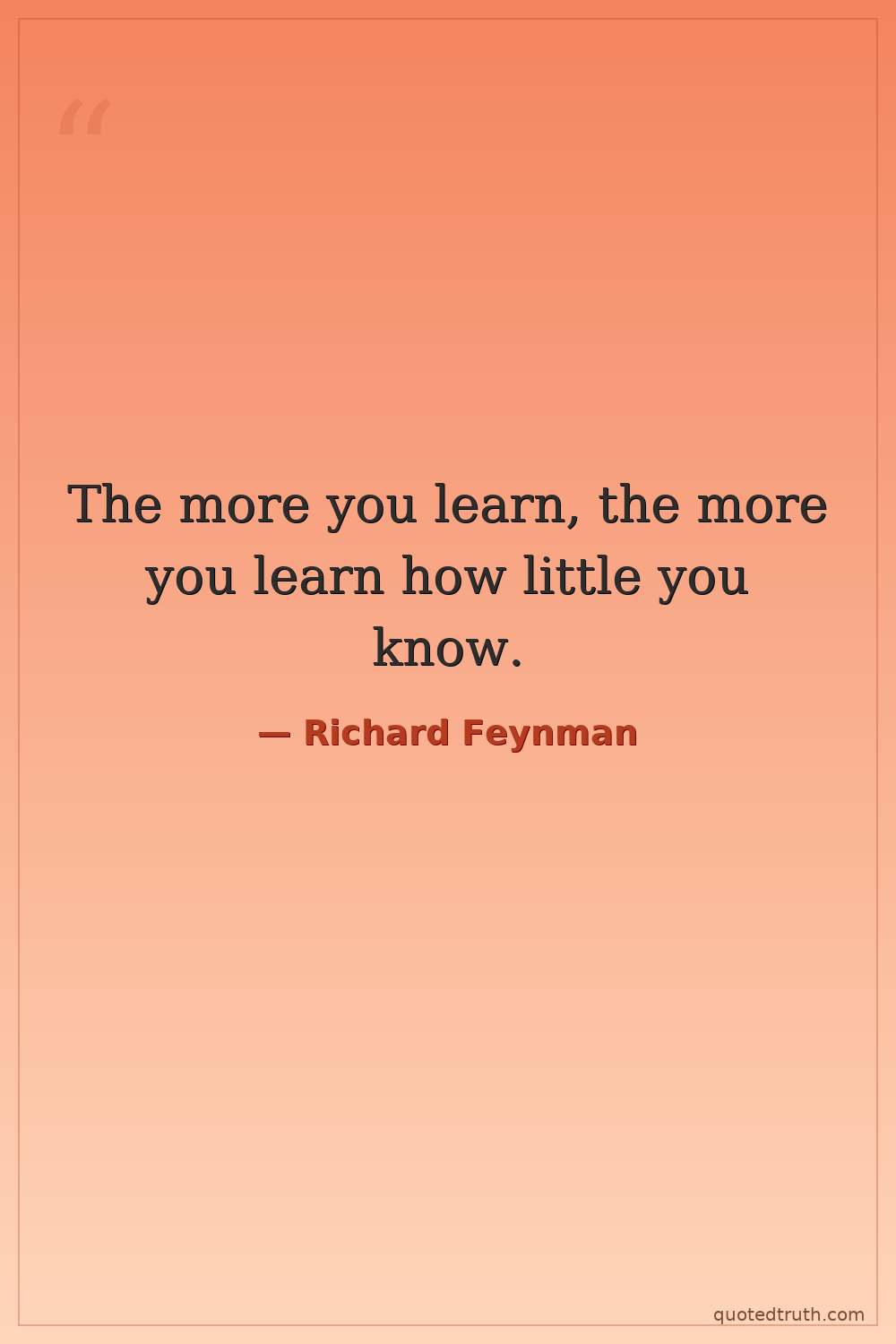
Richard Feynman — "The more you learn, the more you learn how little you know."
The more you learn, the more you learn how little you know.
The more you learn, the more you learn how little you know.
Click any product to generate a realistic preview. Up to 3 at a time.
* Initial load can take up to 90 seconds — revising the preview in another color is nearly instant.
"I'm not interested in science for the sake of science. I'm interested in science for the sake of understanding the world."
"People would often think I'm a faker, but I'm usually honest, in a certain way- in such a way that often nobody believes me!"
"Mathematics is not a science, but a language. It's a tool for science."
"There is no harm in doubt and skepticism, for it is through these that new discoveries are made."
"I don't care what you think. I care what's true."
American theoretical physicist who shared the 1965 Nobel for QED, developed Feynman diagrams, and wrote the Feynman Lectures on Physics. Closely associated with Julian Schwinger (co-Nobelist for QED) and Murray Gell-Mann (Caltech rival and Eightfold-Way physicist). For an intellectual contrast, see Deepak Chopra, physician and quantum-mysticism author — Feynman's Caltech 'cargo cult science' commencement address is the precise template for what he saw as misuse of physics terminology — Chopra-style appropriation of quantum vocabulary for metaphysical claims is the canonical example of what Feynman called 'fooling yourself'.
Found in 1 providers: grok
1 source checked
Gaining knowledge doesn't fill you with certainty — it reveals the boundaries of your understanding. Every answered question uncovers ten more unanswered ones. True learning breeds intellectual humility: the deeper you explore any subject, the clearer it becomes how complex reality is and how much remains unknown. This isn't discouraging — it's the mechanism of genuine curiosity and the reason experts stay students their whole lives.
Feynman won the 1965 Nobel Prize in Physics for quantum electrodynamics yet famously insisted he didn't understand things he hadn't personally rederived. He once declared nobody truly understands quantum mechanics — including himself. His celebrated Feynman Lectures and his self-named learning technique both start from admitted ignorance. Enormously accomplished and endlessly curious, he treated his own knowledge gaps as invitations, not embarrassments.
Feynman worked during physics' most explosive expansion — from the Manhattan Project in the 1940s through the Standard Model's development in the 1960s and 70s. Each decade exposed new layers of reality: quarks, weak force unification, quantum field theory. Science was simultaneously celebrated as civilization's great problem-solver and confronted with questions it couldn't yet answer. The more physicists mapped the universe, the stranger and vaster it appeared.
AI-generated insights based on extensive research and information for context. Factual errors? Email [email protected].
Your cart is empty