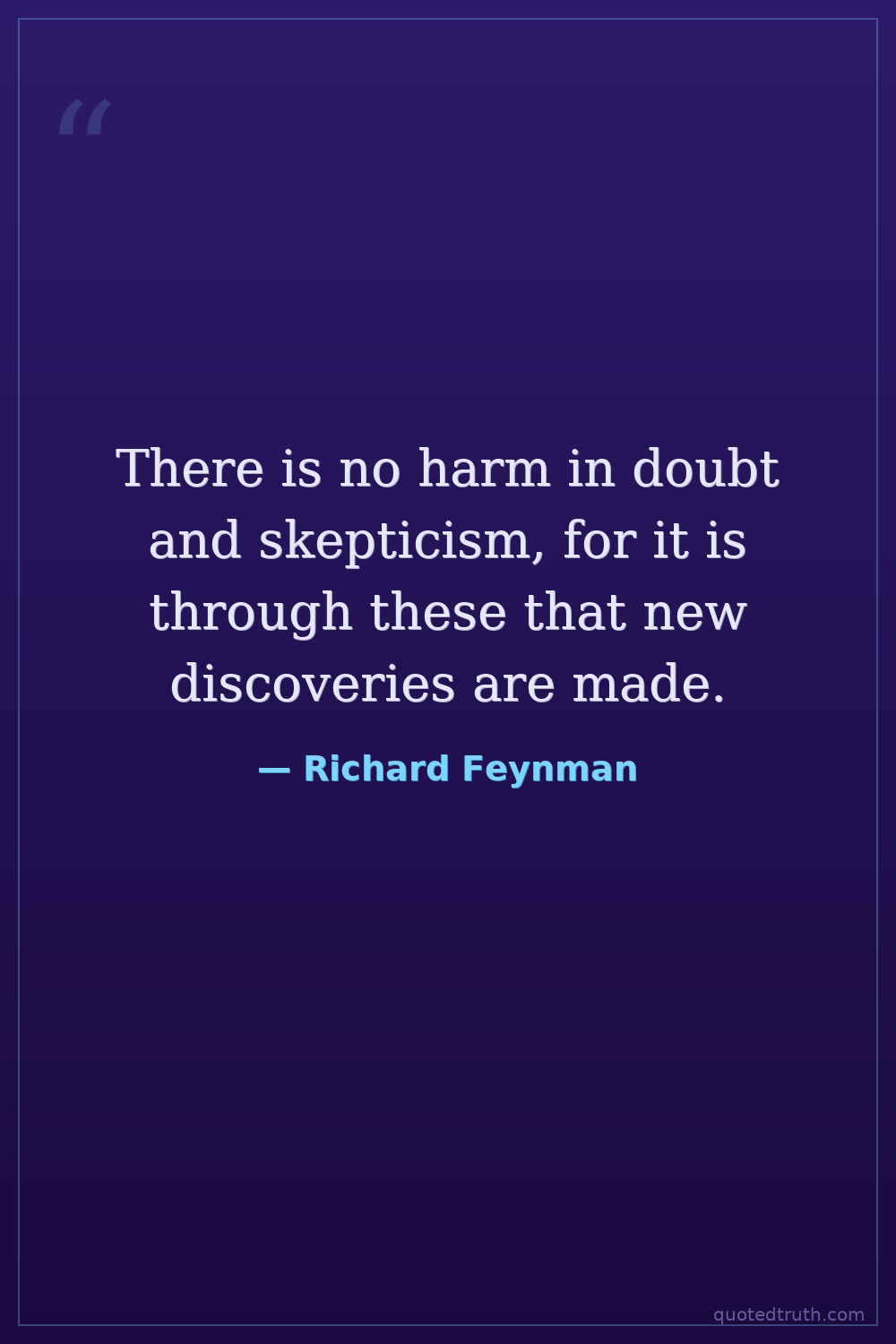
Richard Feynman — "There is no harm in doubt and skepticism, for it is through these that new disco…"
There is no harm in doubt and skepticism, for it is through these that new discoveries are made.
There is no harm in doubt and skepticism, for it is through these that new discoveries are made.
Click any product to generate a realistic preview. Up to 3 at a time.
* Initial load can take up to 90 seconds — revising the preview in another color is nearly instant.
"I don't like to be called 'Professor Feynman.' I like to be called 'Dick.'"
"If you think you understand quantum mechanics, you don't understand quantum mechanics."
"When we know how to do something, we don't call it research anymore."
"I don't like to be called a genius. I just like to think."
"The thing about science is that it's all about trying to prove yourself wrong."
American theoretical physicist who shared the 1965 Nobel for QED, developed Feynman diagrams, and wrote the Feynman Lectures on Physics. Closely associated with Julian Schwinger (co-Nobelist for QED) and Murray Gell-Mann (Caltech rival and Eightfold-Way physicist). For an intellectual contrast, see Deepak Chopra, physician and quantum-mysticism author — Feynman's Caltech 'cargo cult science' commencement address is the precise template for what he saw as misuse of physics terminology — Chopra-style appropriation of quantum vocabulary for metaphysical claims is the canonical example of what Feynman called 'fooling yourself'.
From a lecture or interview, exact source difficult to pinpoint but widely attributed.
Date: Unknown
EducationalFound in 1 providers: grok
1 source checked
Doubt and skepticism are not weaknesses or obstacles — they are essential engines of intellectual progress. When you question accepted truths rather than accepting them on faith, you create the possibility of finding something better. Intellectual uncertainty is not something to apologize for or suppress; it is the very mechanism by which human understanding advances and surprises itself with genuinely new knowledge.
Feynman built his career on refusing comfortable authority. He dismantled NASA's Challenger investigation consensus by dipping an O-ring in ice water. His Cargo Cult Science lecture attacked scientists who imitated rigor without practicing it. His QED breakthroughs required abandoning conventional field theory approaches. He insisted students derive equations themselves rather than memorize them. Skepticism was not a philosophy for Feynman — it was his daily working method.
Feynman's career spanned the Manhattan Project through Cold War conformity pressures. Postwar America increasingly invoked scientific authority to justify government and military decisions — nuclear testing, NASA's infallibility narrative, Vietnam-era weapons research. Institutional science demanded deference, and McCarthyism broadly punished intellectual nonconformity. Against this backdrop, Feynman's defense of doubt was genuinely countercultural, asserting that science's power came precisely from its willingness to question everything, including itself.
AI-generated insights based on extensive research and information for context. Factual errors? Email [email protected].
Your cart is empty