Laozi — "The more you prohibit, the more evil there will be."
The more you prohibit, the more evil there will be.
The more you prohibit, the more evil there will be.
Click any product to generate a realistic preview. Up to 3 at a time.
* Initial load can take up to 90 seconds — revising the preview in another color is nearly instant.
"The sage puts his own person last, and yet is found in the foremost place."
"If you are depressed you are living in the past. If you are anxious you are living in the future. If you are at peace you are living in the present."
"The uncarved block, though small, is nowhere in the world inferior. If princes and kings could but hold on to it, all creatures would submit to them."
"The more laws and ordinances are promulgated, the more thieves and bandits there will be."
"If you realize that all things change, there is nothing you will try to hold on to. If you are not afraid of dying, there is nothing you cannot achieve."
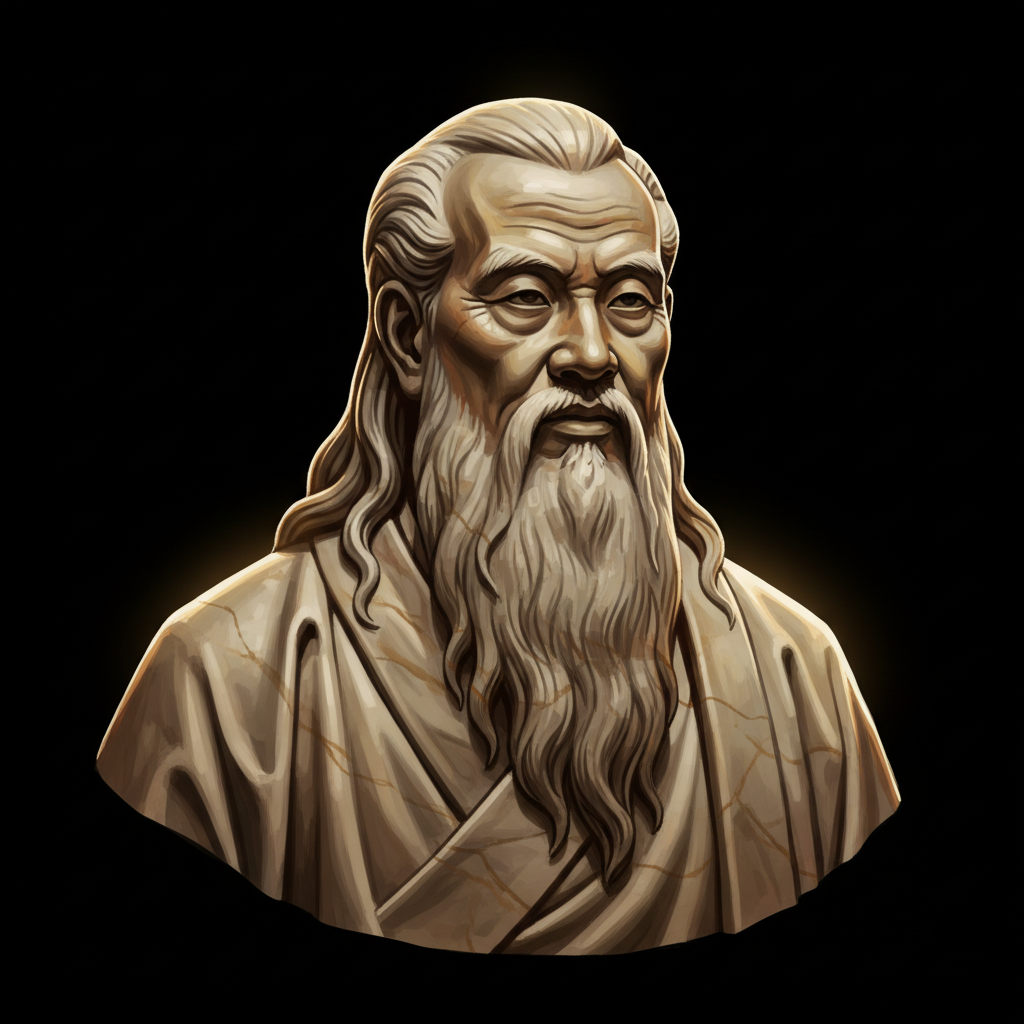
Reputed founder of Taoism and author of the Tao Te Ching, whose wu wei (effortless action) shaped East Asian philosophy. Closely associated with Zhuangzi (later Taoist who extended Laozi's framework). For an intellectual contrast, see Confucius, near-contemporary Chinese sage of social ritual and duty — Confucius systematized social order through ritual and hierarchy; Laozi argued that all such systems were the disease, not the cure — the two founding poles of Chinese moral philosophy.
Found in 1 providers: gemini
1 source checked
Heavy-handed rules and bans tend to create more misconduct, not less. When authorities pile on prohibitions, people grow resentful, resourceful at evasion, and criminalized for ordinary acts. Laws multiply crimes by definition, and each new restriction generates black markets, corruption, and desperate workarounds. The harder you clamp down, the more ingenious the violations become. Genuine order comes from fewer, lighter rules that people can actually live with, rather than an ever-expanding code of forbidden behaviors.
Laozi served as an archivist in the Zhou royal court, watching rulers enforce elaborate codes while their kingdoms fractured. His philosophy of wu wei, effortless non-action, held that the sage governs least and trusts the natural flow of things. He distrusted Confucian ritual and legalist control, believing imposed virtue breeds hypocrisy. This saying distills his core conviction: the Dao cannot be legislated, and rulers who grasp tightest lose most, which is why he reputedly left civilization entirely.
Laozi lived during the late Zhou dynasty, roughly the 6th century BCE, as centralized authority collapsed into the Spring and Autumn period of warring states. Competing rulers imposed ever-stricter legal codes, conscription, and taxation to squeeze advantage from their populations. Legalist thinkers championed harsh punishment as statecraft, while Confucians pushed rigid ritual. Against this backdrop of intensifying control producing intensifying chaos, Laozi's observation was empirical commentary: the more feudal lords prohibited, the more banditry, rebellion, and war consumed the age.
AI-generated insights based on extensive research and information for context. Factual errors? Email [email protected].
Your cart is empty