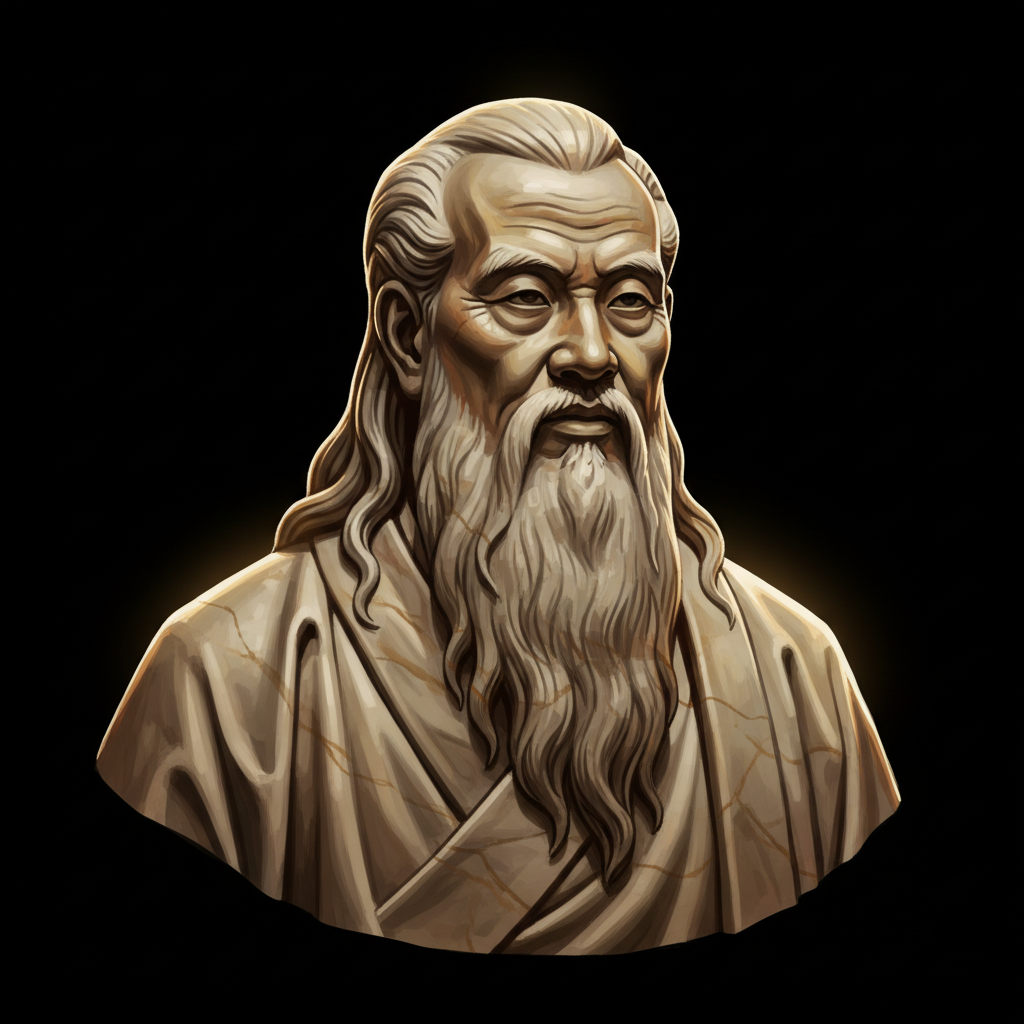
Laozi — "The sage puts his own person last, and yet is found in the foremost place."
The sage puts his own person last, and yet is found in the foremost place.
The sage puts his own person last, and yet is found in the foremost place.
Click any product to generate a realistic preview. Up to 3 at a time.
* Initial load can take up to 90 seconds — revising the preview in another color is nearly instant.
"He who knows does not speak. He who speaks does not know."
"The value of teaching without words and accomplishing without action is understood by few in the world."
"The people are hungry: it is because those in authority eat up too much in taxes."
"The sage is sharp but does not cut, pointed but does not pierce, forthright but does not offend, bright but does not dazzle."
"Muddy water is best cleared by leaving it alone."
Reputed founder of Taoism and author of the Tao Te Ching, whose wu wei (effortless action) shaped East Asian philosophy. Closely associated with Zhuangzi (later Taoist who extended Laozi's framework). For an intellectual contrast, see Confucius, near-contemporary Chinese sage of social ritual and duty — Confucius systematized social order through ritual and hierarchy; Laozi argued that all such systems were the disease, not the cure — the two founding poles of Chinese moral philosophy.
Found in 1 providers: grok
1 source checked
Stepping back from self-promotion and refusing to push yourself ahead actually tends to elevate you. When you stop competing for recognition, serve others first, and let your work speak, people naturally look to you for leadership. The person chasing the front of the line often gets resented and blocked; the one who defers genuinely ends up trusted and positioned ahead anyway. Humility is practical strategy, not just virtue.
Laozi reportedly worked as an archivist in the Zhou royal court, a quiet record-keeper rather than a minister seeking influence. Legend says he left the court unnoticed, writing the Tao Te Ching only when pressed by a gatekeeper. His entire philosophy centers on wu wei, effortless non-striving, and yielding like water. This saying captures his conviction that retreating from ego and ambition paradoxically produces the authority aggressive seekers never secure.
Laozi lived during the late Zhou dynasty, around the 6th century BCE, as centralized power fractured into the Spring and Autumn period. Warlords, ambitious ministers, and scheming courtiers jostled brutally for rank, and advisors routinely lost their heads for overreach. Against that backdrop of deadly striving, counseling a sage to place himself last was not mystical poetry but survival wisdom, and a sharp rebuke of the Confucian emphasis on active social climbing and ritual status.
AI-generated insights based on extensive research and information for context. Factual errors? Email [email protected].
Your cart is empty