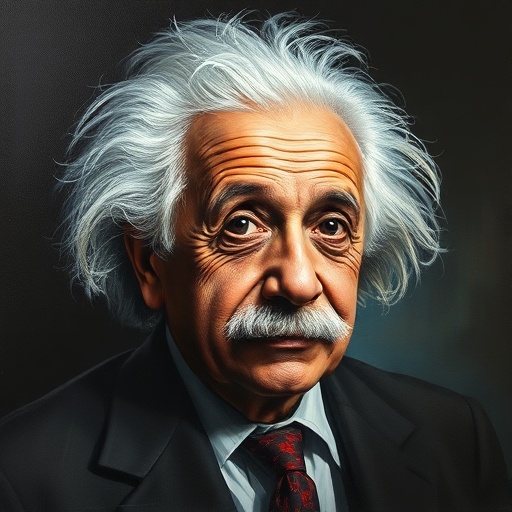
Albert Einstein — "The most beautiful experience we can have is the mysterious. It is the fundament…"
The most beautiful experience we can have is the mysterious. It is the fundamental emotion which stands at the cradle of true art and true science.
The most beautiful experience we can have is the mysterious. It is the fundamental emotion which stands at the cradle of true art and true science.
Click any product to generate a realistic preview. Up to 3 at a time.
* Initial load can take up to 90 seconds — revising the preview in another color is nearly instant.
"Peace cannot be kept by force; it can only be achieved by understanding."
"The value of a man should be seen in what he gives and not in what he is able to receive."
"Falling in love is not at all the most stupid thing that people do-but gravitation cannot be held responsible for it."
"The only way to escape the corrupting influence of praise is to go on working."
"Gravitation cannot be held responsible for people falling in love."
Found in 1 providers: grok
1 source checked
Encountering the unknown and feeling its pull is the most profound human experience available to us. That sensation of awe before something we cannot fully explain isn't weakness or ignorance—it's the emotional engine behind every great painting, symphony, and scientific breakthrough. Without the capacity to feel genuinely puzzled and thrilled by existence, neither artists nor scientists would have reason to create or investigate anything.
Einstein described his scientific drive as rooted in what he called 'cosmic religious feeling'—a deep reverence for the universe's unknowable order. His thought experiments began with childlike wonder: imagining riding alongside a light beam at age 16 sparked relativity. He played violin throughout his life, seeing music and physics as parallel pursuits of hidden beauty. He distrusted purely mechanistic science, insisting mystery and imagination mattered more than pure calculation.
Einstein expressed this during the early 20th century, when logical positivism and rapid industrialization pushed culture toward cold rationalism. Quantum mechanics was simultaneously dismantling Newtonian certainties, leaving scientists confronting the genuinely inexplicable. Modernist art movements—Cubism, Surrealism—were fragmenting traditional forms driven by similar restlessness. Einstein's insistence that wonder underpins knowledge directly challenged the era's dominant assumption that science would eventually explain everything away.
AI-generated insights based on extensive research and information for context. Factual errors? Email [email protected].
Your cart is empty