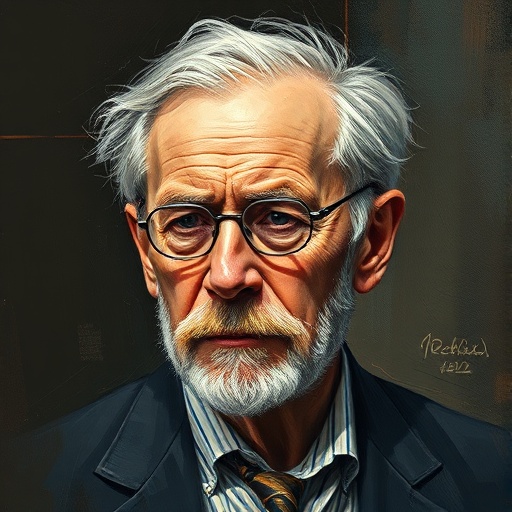
Erwin Schrodinger — "The most beautiful thing we can experience is the mysterious."
The most beautiful thing we can experience is the mysterious.
The most beautiful thing we can experience is the mysterious.
Click any product to generate a realistic preview. Up to 3 at a time.
* Initial load can take up to 90 seconds — revising the preview in another color is nearly instant.
"If we were bees, ants, or Lacedaemonian warriors, to whom personal fear does not exist and cowardice is the most shameful thing in the world, warring would go on forever. But luckily we are only men —…"
"If you ask a theoretical physicist today, ‘What is an electron?’ he will probably say, ‘It is a symbol in the wave equation.’ We have got so far from the concrete picture of nature."
"The world is not a machine, but a living organism."
"Science without religion is lame, religion without science is blind."
"Quantum mechanics has taught us that the world is not as solid and substantial as we thought."
Austrian physicist who shared the 1933 Nobel for the wave equation that bears his name and the famous cat thought-experiment. Closely associated with Werner Heisenberg (matrix-mechanics rival who reached the same physics by different math) and Albert Einstein (his pen-pal on quantum interpretation). For an intellectual contrast, see Niels Bohr, Danish physicist and architect of the Copenhagen interpretation — Schrödinger's cat thought-experiment was specifically designed to ridicule Bohr's 'observer-dependent reality' reading of quantum mechanics — Schrödinger thought the Copenhagen interpretation was absurd; the cat was meant as reductio ad absurdum.
Found in 1 providers: grok
1 source checked
The quote asserts that encountering what lies beyond our understanding — the inexplicable, the unknowable — is life's most profound experience. Mystery is not a problem to eliminate but something to cherish. It rejects certainty and full explanation as the highest goods, placing wonder at the center of a meaningful life. The unknown becomes not a deficiency in human knowledge but the very source of beauty and engagement with the world.
Schrödinger built his career on quantum mystery. His wave equation described particles as probability amplitudes — fundamentally unknowable until observed. His famous cat thought experiment didn't resolve quantum weirdness; it dramatized it deliberately. He wrote 'What is Life?' probing consciousness and biological order as deep unsolved puzzles. He also studied Vedanta philosophy, which treats the unknowable as ultimate reality — revealing a lifelong attraction to irreducible mystery rather than discomfort with it.
Schrödinger worked during the quantum revolution of the 1920s–1950s, when physics dismantled classical certainty. Heisenberg's uncertainty principle, Bohr's complementarity, and Schrödinger's wave mechanics revealed a universe where observation disturbs reality and particles exist in superposition. Classical determinism collapsed entirely. Scientists faced the uncomfortable truth that nature at its deepest level resists intuitive understanding — making the embrace of mystery not mere poetic sentiment but a hard-won scientific and philosophical necessity of the era.
AI-generated insights based on extensive research and information for context. Factual errors? Email [email protected].
Your cart is empty