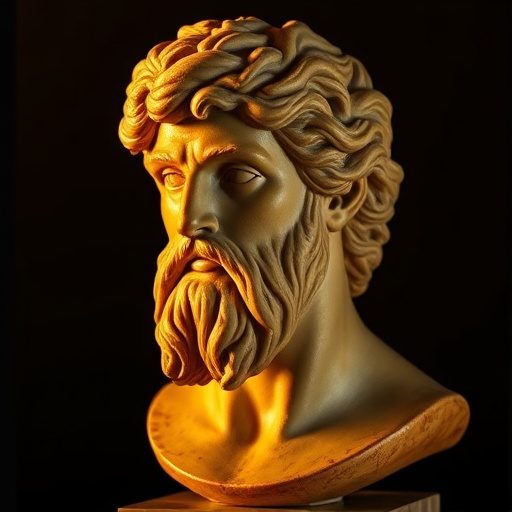
Pythagoras — "The most difficult thing in life is to know yourself."
The most difficult thing in life is to know yourself.
The most difficult thing in life is to know yourself.
Click any product to generate a realistic preview. Up to 3 at a time.
* Initial load can take up to 90 seconds — revising the preview in another color is nearly instant.
"A man is never free unless he is master of himself."
"Declining from the public ways, walk in unfrequented paths."
"Learn to be silent. Let your quiet mind listen and absorb."
"There is nothing so easy but that it becomes difficult when you do it reluctantly."
"The wise man should be prepared for everything that does not lie within his power."
Greek philosopher and mathematician whose school in Croton combined geometry (the Pythagorean theorem), number-mysticism, and a religious-vegetarian way of life. Closely associated with Thales of Miletus (earlier pre-Socratic and the first philosopher). For an intellectual contrast, see Heraclitus, pre-Socratic Greek philosopher of flux — Heraclitus called Pythagoras 'the chief of swindlers' — among the founding insults of the philosophical-rivalry tradition. Their 'all is flux' vs 'all is number' poles still organize the philosophy of mathematics today (Platonist vs anti-realist).
Found in 1 providers: deepseek
1 source checked
Self-knowledge sounds simple but requires confronting uncomfortable truths about your motives, fears, and limitations. Most people see themselves through flattering distortions — believing they're more rational, generous, or capable than they are. Genuine self-understanding means stripping away ego and social performance to see your actual drives. It demands the kind of honest, dispassionate examination most people spend their lives avoiding.
Pythagoras founded a disciplined philosophical community in Croton where members underwent rigorous self-examination as spiritual practice. His belief in metempsychosis — the soul's reincarnation across lives — made self-knowledge essential: only a soul that understood its nature could progress toward purity. His mathematical worldview demanded exactness over assumption, mirroring the intellectual honesty required for true self-knowledge. He embodied the idea that wisdom begins with honest inner inquiry, not external achievement.
In 6th-century BCE Greece, the Delphic Oracle's inscription 'Know Thyself' anchored an entire civilization's philosophy, suggesting self-ignorance was a cultural failing. Greek society's competitive honor culture made genuine self-assessment rare and threatening. Simultaneously, Orphic mystery cults taught that the soul needed purification through self-understanding. As philosophy shifted from mythological to rational frameworks, thinkers like Pythagoras placed inner examination at civilization's moral core — arguing wisdom and virtue depended on understanding one's own nature.
AI-generated insights based on extensive research and information for context. Factual errors? Email [email protected].
Your cart is empty