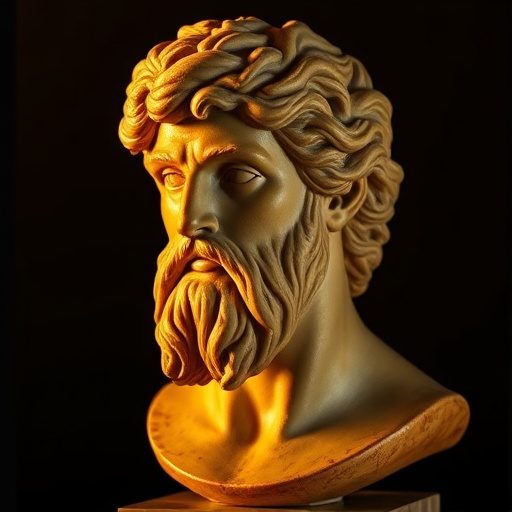
Pythagoras — "Declining from the public ways, walk in unfrequented paths."
Declining from the public ways, walk in unfrequented paths.
Declining from the public ways, walk in unfrequented paths.
Click any product to generate a realistic preview. Up to 3 at a time.
* Initial load can take up to 90 seconds — revising the preview in another color is nearly instant.
"The strangest (and sexiest) of the legends surrounding the aura of Pythagoras is that he had a golden thigh that he would show to impress people he wanted to join his cult."
"The wise man should be prepared for everything that does not lie within his power."
"There is geometry in the humming of the strings."
"The square of the hypotenuse of a right-angled triangle is equal to the sum of the squares of the other two sides."
"If you're asked: What is the silence? Respond: It is the first stone of the Wisdom's temple."
Greek philosopher and mathematician whose school in Croton combined geometry (the Pythagorean theorem), number-mysticism, and a religious-vegetarian way of life. Closely associated with Thales of Miletus (earlier pre-Socratic and the first philosopher). For an intellectual contrast, see Heraclitus, pre-Socratic Greek philosopher of flux — Heraclitus called Pythagoras 'the chief of swindlers' — among the founding insults of the philosophical-rivalry tradition. Their 'all is flux' vs 'all is number' poles still organize the philosophy of mathematics today (Platonist vs anti-realist).
An encouragement for independent thought and forging one's own intellectual or spiritual path.
Date: c. 5th Century BCE
PhilosophicalFound in 1 providers: gemini
1 source checked
Avoid the well-trodden routes that everyone else follows and instead take quieter, less-traveled paths. The advice urges independence of thought and action, warning against conforming to popular opinion or crowd behavior. True understanding and personal growth come from stepping off the main road, questioning common assumptions, and exploring territory others overlook rather than drifting along with mainstream habits.
Pythagoras founded a secretive brotherhood in Croton whose members followed strict rules of silence, vegetarianism, and private study apart from ordinary Greek life. He prized contemplation, mathematical reasoning, and disciplined solitude over public politics or marketplace debate. Urging disciples away from crowded roads matches his monastic style, his esoteric teachings reserved for initiates, and his conviction that numerical and philosophical truth required withdrawal from everyday distraction.
In 6th-century BCE Greece, civic life revolved around the agora, public assemblies, and communal religious festivals where identity was forged in the crowd. Sophists competed loudly for students and influence. Against that backdrop, counseling withdrawal into unfrequented paths was radical: it rejected the polis-centered ideal and anticipated later monastic, ascetic, and philosophical schools that separated seekers of wisdom from ordinary civic traffic and popular belief.
AI-generated insights based on extensive research and information for context. Factual errors? Email [email protected].
Your cart is empty