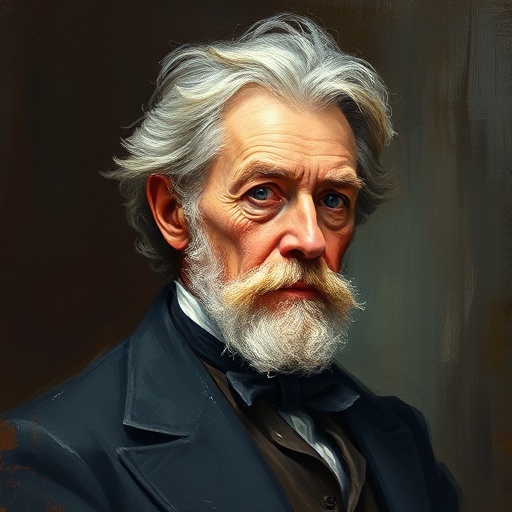
Michael Faraday — "The most important instrument a scientist has is his own mind."
The most important instrument a scientist has is his own mind.
The most important instrument a scientist has is his own mind.
Click any product to generate a realistic preview. Up to 3 at a time.
* Initial load can take up to 90 seconds — revising the preview in another color is nearly instant.
"The lecturer should give the audience full reason to believe that all his powers have been exerted for their pleasure and instruction."
"I have far more confidence in the one man who works mentally and bodily at a matter than in the six who merely talk about it."
"Nothing is too wonderful to be true, if it be consistent with the laws of nature; and in such things as these, experiment is the best test of consistency."
"The true measure of a man is not what he has, but what he gives."
"I have been working for some time on the subject of electricity and magnetism, and I think I have made some discoveries."
Attributed, emphasizing the intellectual aspect of scientific work.
Date: Mid 19th Century (approx.)
WisdomFound in 1 providers: grok
1 source checked
Tools, equipment, and data matter, but the real engine of discovery is the thinking person using them. Instruments only measure what someone has the insight to ask about. Curiosity, careful reasoning, imagination, and the discipline to question assumptions are what turn observations into understanding. No apparatus, however advanced, can substitute for a prepared and thoughtful mind capable of interpreting what it sees and pushing past the obvious.
Faraday had almost no formal schooling, starting as a bookbinder's apprentice before entering the Royal Institution. He taught himself mathematics poorly yet still uncovered electromagnetic induction, electrolysis laws, and field theory through patient experiment and vivid mental imagery. Lacking the mathematical toolkit of his peers, he relied on intuition, visualization, and relentless questioning, proving that a disciplined mind could outperform formal credentials and expensive gear in producing foundational physics.
Faraday worked in early-to-mid 1800s Britain, when science was professionalizing and instruments like galvanometers, voltaic piles, and improved optics were transforming laboratories. Industrial Revolution workshops prized apparatus, and gentleman-scientists often equated discovery with equipment. Meanwhile formal university training in mathematics was becoming the expected credential. Faraday's remark pushed back against both trends, reminding a gadget-obsessed, credential-conscious age that empirical progress still depended on the reasoning, imagination, and character of the investigator.
AI-generated insights based on extensive research and information for context. Factual errors? Email [email protected].
Your cart is empty