What it means
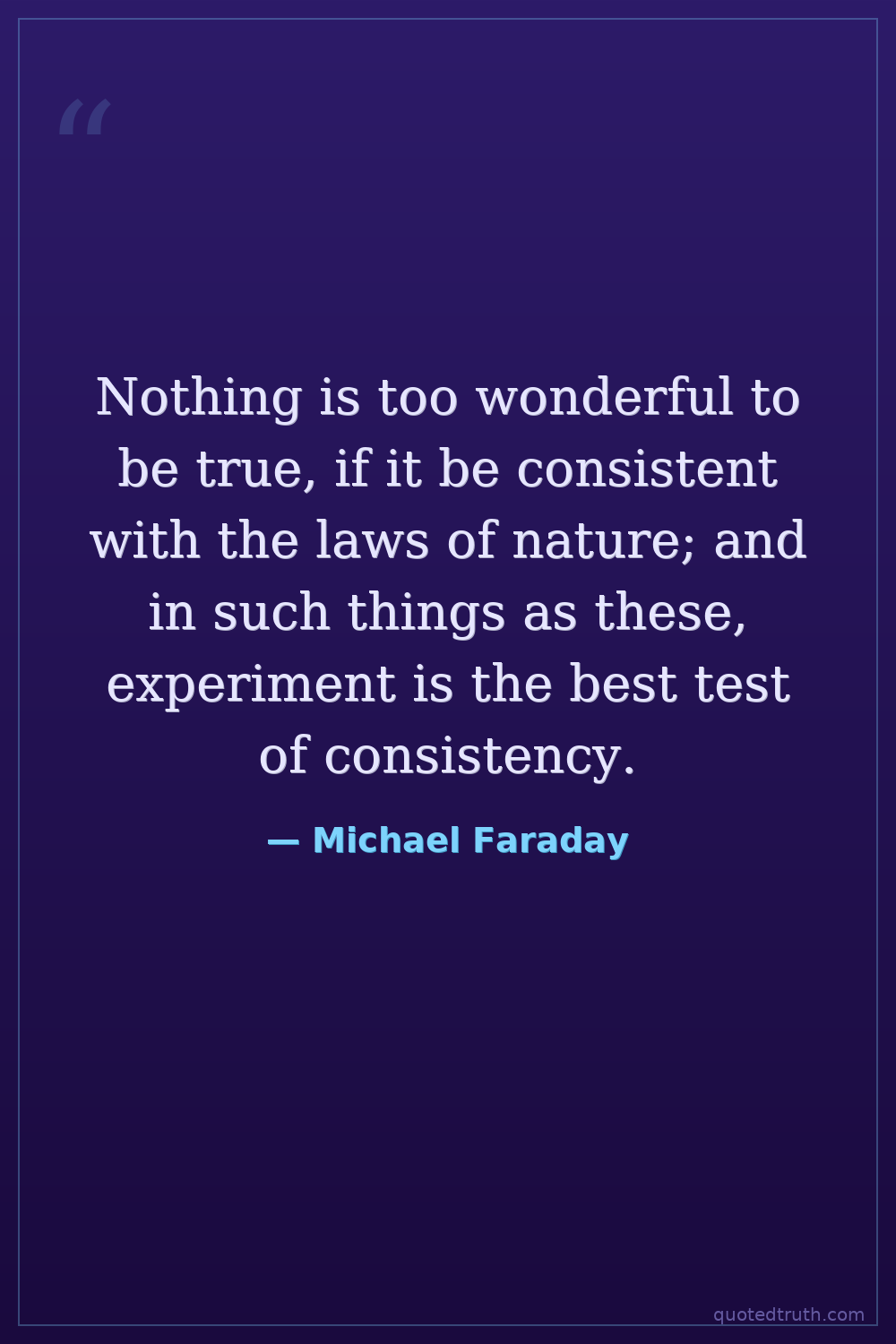
Faraday argues that no phenomenon should be dismissed as impossible simply because it seems astonishing, provided it does not violate natural laws. The real arbiter of whether something is genuine is not prior belief, tradition, or intuition, but careful experiment. If a result can be reproduced and tested, its strangeness is no objection. Wonder and truth are compatible, and experimentation is what separates real discovery from fantasy.
Relevance to Michael Faraday
Faraday was a self-taught bookbinder's apprentice who became one of history's greatest experimental scientists, discovering electromagnetic induction, diamagnetism, and the laws of electrolysis. Lacking advanced mathematics, he relied entirely on meticulous laboratory work and notebooks to probe invisible forces. His devout Sandemanian faith coexisted with rigorous empiricism, so he saw no conflict between wonder and evidence. This quote captures his lifelong method: trust nature, distrust assumption, and let the bench decide.
The era
Faraday worked in early-to-mid 19th-century Britain, when electricity and magnetism were mysterious novelties and science was still shaking off natural philosophy's speculative habits. The Royal Institution, where he lectured, was popularizing experimental demonstration for public audiences. Industrial Britain hungered for practical power, yet pseudoscience like mesmerism and table-turning flourished alongside genuine discovery. Faraday's insistence on experimental testing helped define modern scientific method and drew a firm line between marvelous-but-real phenomena and fashionable superstition.
AI-generated insights based on extensive research and information for context. Factual errors? Email [email protected].