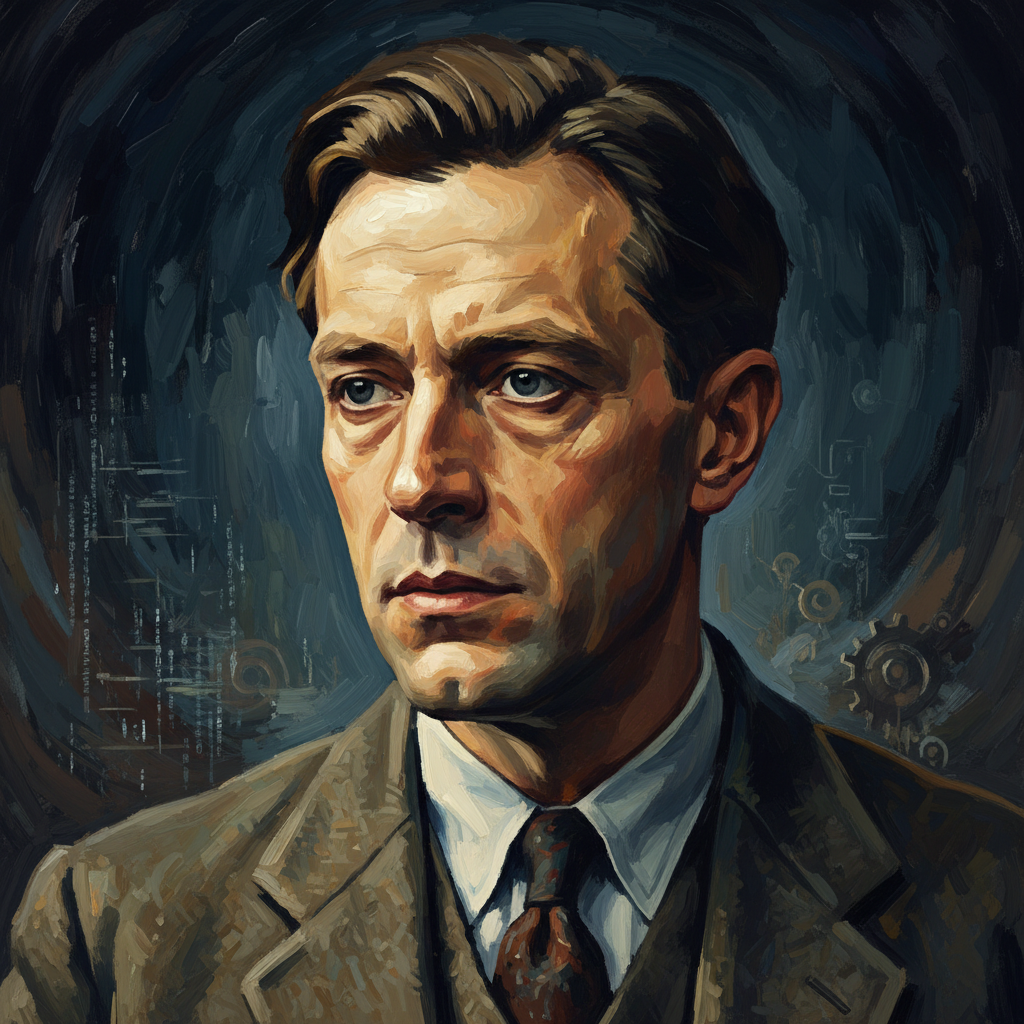
Alan Turing — "The most important thing for a mathematician is intuition."
The most important thing for a mathematician is intuition.
The most important thing for a mathematician is intuition.
Click any product to generate a realistic preview. Up to 3 at a time.
* Initial load can take up to 90 seconds — revising the preview in another color is nearly instant.
"Possibly a machine might be made to enjoy this delicious dish, but any attempt to make one do so would be idiotic."
"The future of computing is in artificial intelligence."
"The popular view is that the brain is a kind of telephone exchange. I believe that it is not quite as simple as that."
"Science is a differential equation. Religion is a boundary condition."
"The extent to which we regard mind as an attribute of the body, or something separable from it, is largely a matter of convenience."
Found in 1 providers: grok
1 source checked
Mathematical progress isn't just rule-following or grinding through proofs. Intuition is the ability to sense which problems matter, which approaches might work, and where truth likely lies before formal proof confirms it. Great mathematicians don't merely calculate—they perceive patterns and make imaginative leaps. This values that inner sense of mathematical direction over mechanical procedure, arguing it is the essential spark driving real discovery rather than something that follows from it.
Turing's landmark breakthroughs—formalizing computation in 1936, breaking Nazi Enigma ciphers at Bletchley Park—began as intuitive leaps made rigorous only afterward. His universal machine concept existed as an imaginative construct before hardware validated it. His later morphogenesis research and artificial intelligence work further demonstrated intuitive thinking about biological patterns and machine minds. His Turing Test itself was an intuitive thought experiment, not a derived theorem, about what intelligence fundamentally is.
Turing worked amid fierce debate between formalism and intuition in mathematics. Hilbert sought to fully mechanize mathematical truth; Gödel's 1931 incompleteness theorems proved formal systems couldn't capture everything. During WWII, Bletchley Park codebreaking required intuitive leaps under life-or-death pressure, validating instinct over procedure. The dawn of computing then sharpened the question: could machines ever replace the intuitive mathematical insight Turing believed was irreducibly human?
AI-generated insights based on extensive research and information for context. Factual errors? Email [email protected].
Your cart is empty