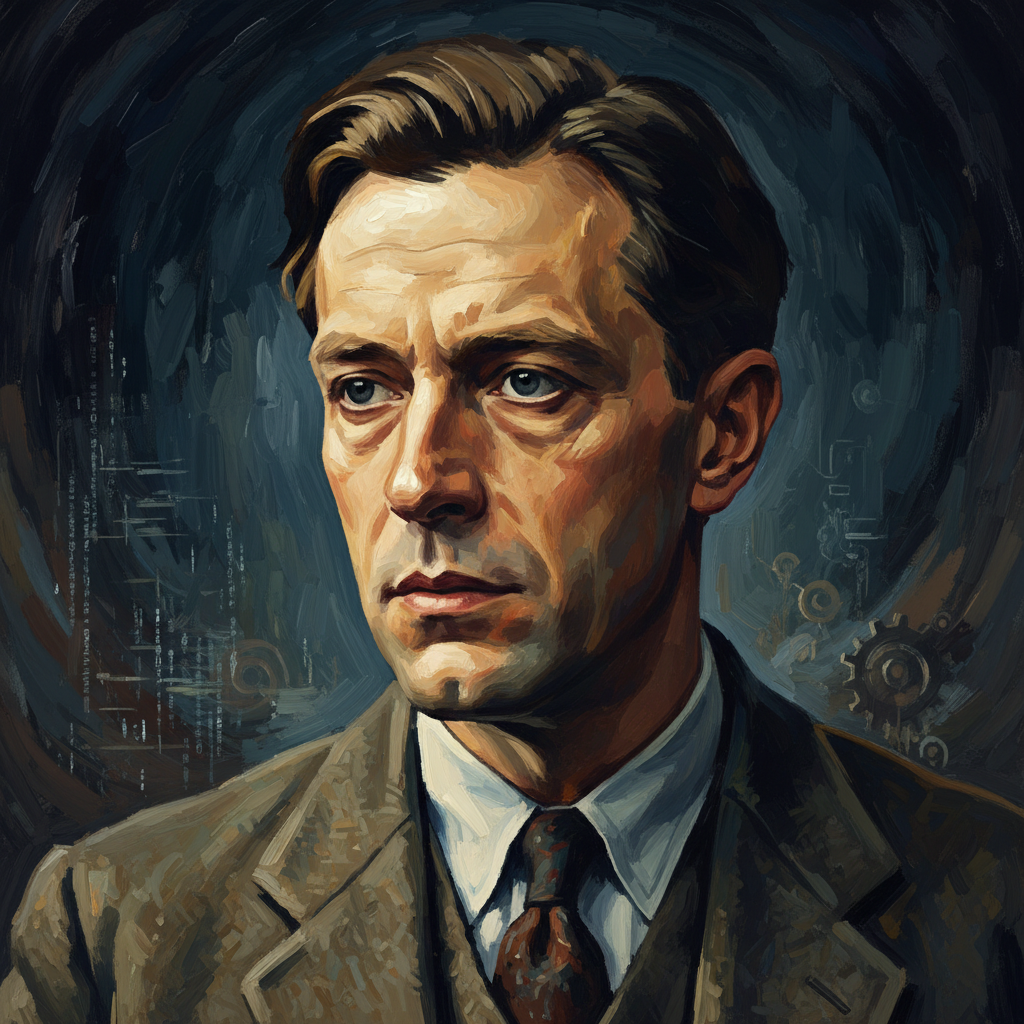
Alan Turing — "The future of computing is in artificial intelligence."
The future of computing is in artificial intelligence.
The future of computing is in artificial intelligence.
Click any product to generate a realistic preview. Up to 3 at a time.
* Initial load can take up to 90 seconds — revising the preview in another color is nearly instant.
"No, I'm not interested in developing a powerful brain. All I'm interested in is a moderately trained brain. The kind that would be useful in daily life."
"Mother has been staying here, and we seem to be getting on a good deal better. I have been subjecting her to a good deal of sexual enlightenment and she seems to have stood up to it very well. There w…"
"Machines take me by surprise very often."
"The question is not whether machines can think, but whether they can do something that we would call thinking."
"The human brain is a biological computer."
Attributed, general implication from his pioneering work, but exact quote is elusive.
Date: Approx. 1950s
ShockingFound in 1 providers: grok
1 source checked
Machines are more than fast calculators — their real destiny is to think. This claim argues that computing's true frontier isn't faster arithmetic or larger storage, but intelligence itself: the capacity to reason, learn, and adapt. The lasting value of computers won't come from executing fixed instructions but from systems that can tackle open-ended problems the way human minds do.
Turing founded the theoretical basis for AI. His 1950 paper "Computing Machinery and Intelligence" introduced the Turing Test, asking whether machines can truly think. At Bletchley Park he built the Bombe to crack Nazi Enigma codes — proving machines could solve problems once thought to require human judgment. AI wasn't peripheral to his work; it was his defining intellectual preoccupation and career culmination.
In the late 1940s and early 1950s, the first stored-program computers — ENIAC, Manchester Baby, EDVAC — were just emerging. Cold War pressures accelerated computing investment, but most scientists saw machines as giant arithmetic engines. Turing was writing at this inflection point, when calling a machine "intelligent" was a radical and contested idea. His vision reframed what computers were ultimately built for.
AI-generated insights based on extensive research and information for context. Factual errors? Email [email protected].
Your cart is empty