What it means
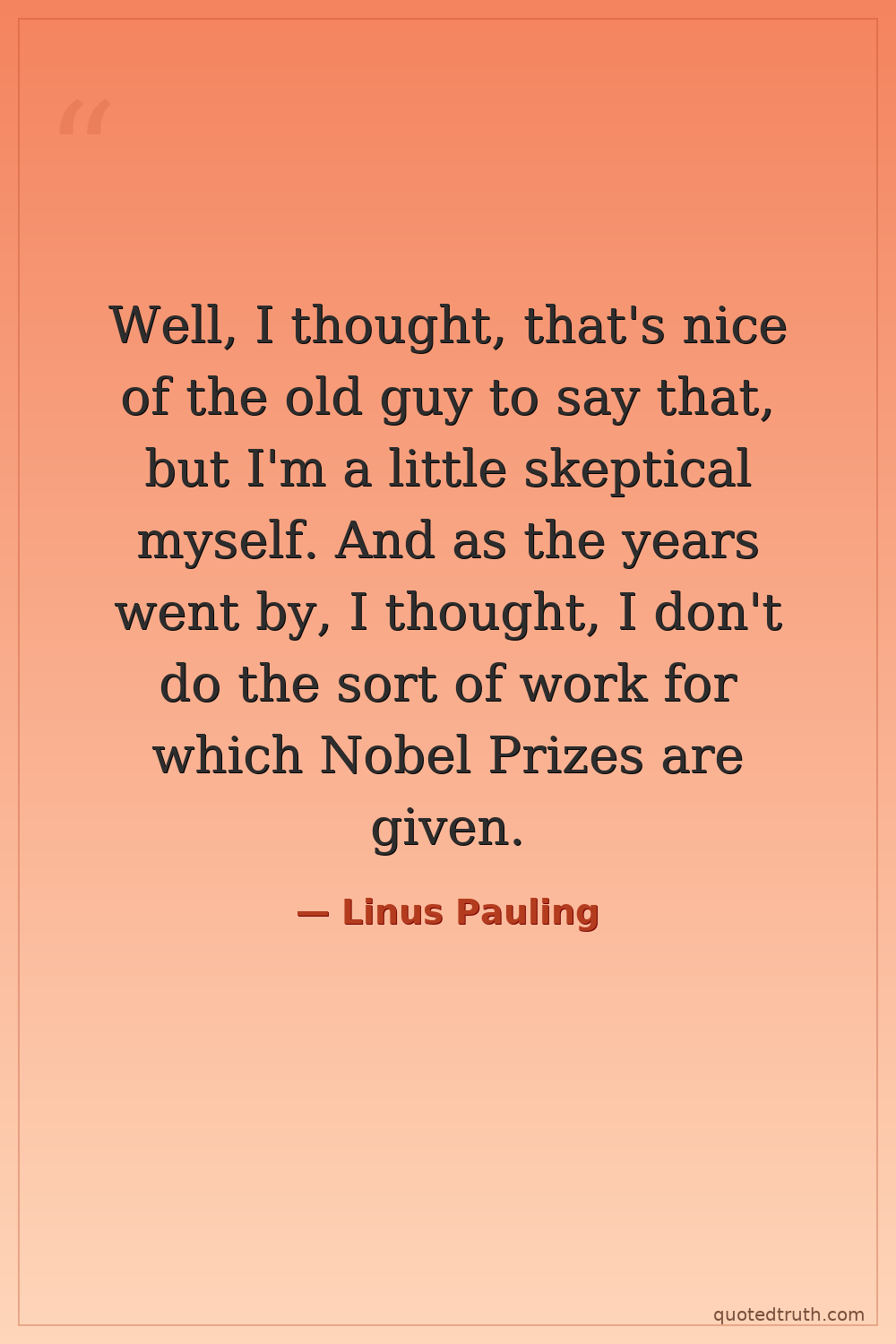
A frank admission of self-doubt wrapped in self-deprecating humor. Someone predicted Pauling would win a Nobel, and he brushed it off as polite flattery. As years passed, he convinced himself his work wasn't prize-caliber. The twist: he won not one but two Nobel Prizes—Chemistry in 1954 and Peace in 1962—making this a striking reminder that even transformative thinkers routinely misjudge the significance of their own contributions.
Relevance to Linus Pauling
Pauling's modesty reflects someone who worked at the edge of disciplines—applying quantum mechanics to molecular structure—in ways that felt theoretical rather than celebrated. His chemical bond work rewired how chemists understood matter, and his anti-nuclear activism made him a political dissident. He remains the only person to win two unshared Nobel Prizes, yet this quote shows he genuinely doubted his work matched the prize's prestige, a dissonance that defined his restless, self-critical character.
The era
Pauling's career stretched from the 1920s through the Cold War, a period when the Nobel Prize in Science was hardening into its modern mythology. Post-Hiroshima, scientists faced new pressure to justify their moral relevance alongside their discoveries. Pauling's anti-nuclear testing campaign in the late 1950s was deeply controversial—the U.S. government revoked his passport. Winning the Peace Prize in 1962, the year the Limited Test Ban Treaty was signed, validated a stance many colleagues had considered career suicide.
AI-generated insights based on extensive research and information for context. Factual errors? Email [email protected].