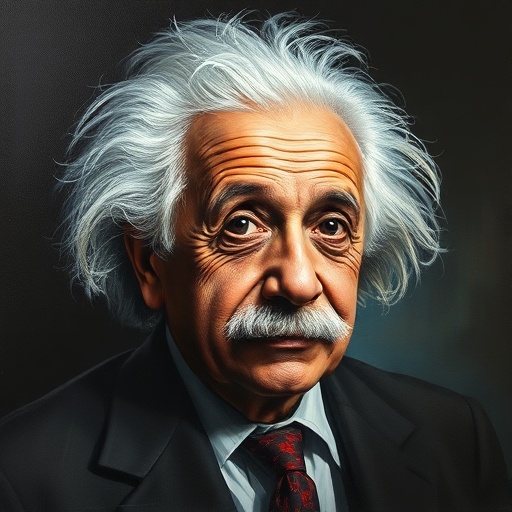
Albert Einstein — "The most incomprehensible thing about the world is that it is comprehensible."
The most incomprehensible thing about the world is that it is comprehensible.
The most incomprehensible thing about the world is that it is comprehensible.
Click any product to generate a realistic preview. Up to 3 at a time.
* Initial load can take up to 90 seconds — revising the preview in another color is nearly instant.
"My passion for social justice has often brought me into conflict with people, as has my aversion to all kinds of authority."
"The difference between stupidity and genius is that genius has its limits."
"I do not believe in the God of theology who rewards good and punishes evil."
"I have no special talents. I am only passionately curious."
"If I were not a physicist, I would probably be a musician. I often think in music. I live my daydreams in music."
Philosophical reflection on the order and understandability of the universe.
Date: Approximate
WisdomFound in 2 providers: gemini,grok
2 sources checked
The universe is vast, chaotic, and has no obligation to make sense to human minds. Yet it does — physical reality follows mathematical laws we can discover, test, and use. Einstein is pointing out that this correspondence between the human mind and the cosmos is itself the strangest fact of all. We spend our lives puzzling over what we don't understand, but the real miracle is that we understand anything.
Einstein's career was built on the assumption that nature is rational and discoverable — special relativity (1905), general relativity (1915), the photoelectric effect. He worked through pure mathematical reasoning, not just experiment. His thought experiments depended on the belief that a human mind could intuit physical truth. Yet he never took this for granted; he considered the mathematical intelligibility of nature a profound, almost religious mystery, not a foregone conclusion.
Early 20th century physics was in crisis — quantum mechanics showed particles behaved randomly at the subatomic level, undermining classical determinism. Meanwhile, World War I and later WWII suggested civilization itself was irrational. Many intellectuals embraced nihilism or relativism. Against this backdrop, Einstein's claim that the universe is fundamentally comprehensible was almost a radical act of faith — insisting that mathematical order underlies apparent chaos, at a moment when chaos seemed to win.
AI-generated insights based on extensive research and information for context. Factual errors? Email [email protected].
Your cart is empty