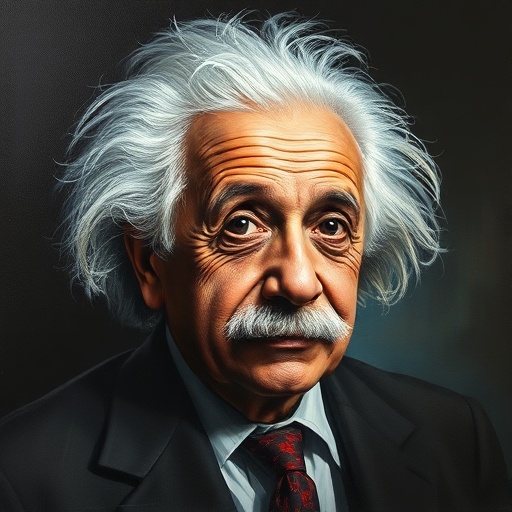
Albert Einstein — "I have no special talents. I am only passionately curious."
I have no special talents. I am only passionately curious.
I have no special talents. I am only passionately curious.
Click any product to generate a realistic preview. Up to 3 at a time.
* Initial load can take up to 90 seconds — revising the preview in another color is nearly instant.
"The Germans as a whole are guilty of these mass murders and must be punished as a people..."
"Try not to become a man of success, but rather try to become a man of value."
"Falling in love is not at all the most stupid thing that people do-but gravitation cannot be held responsible for it."
"I am enough of an artist to draw freely upon my imagination. Imagination is more important than knowledge. Knowledge is limited. Imagination encircles the world."
"I do not believe in the God of theology who rewards good and punishes evil."
Found in 2 providers: grok,deepseek
2 sources checked
Genuine achievement comes not from innate genius but from relentless curiosity and deep engagement with questions. Einstein deflects credit from raw talent, arguing that passionate, sustained wondering about the world drives discovery more than any fixed intellectual gift. Curiosity is democratic — anyone can cultivate it — making this both a humble self-assessment and an implicit invitation to others to explore without feeling unqualified.
Einstein dropped out of formal schooling, failed his polytechnic entrance exam, and worked as a patent clerk when he published his four landmark 1905 papers. He repeatedly described himself as a slow thinker who simply refused to stop asking questions others considered settled. His lifelong obsession with thought experiments — imagining riding alongside a light beam at age sixteen — exemplifies the curiosity he credited above talent.
Einstein worked during the early twentieth century, when classical Newtonian physics seemed complete and academic gatekeeping was rigid. The professional scientific establishment valued credentialed expertise over outsider questioning. His breakthroughs arrived amid two world wars, rapid industrialization, and a crisis in deterministic science — a moment when radically curious minds willing to challenge consensus reshaped humanity's understanding of space, time, and matter.
AI-generated insights based on extensive research and information for context. Factual errors? Email [email protected].
Your cart is empty