William Harvey — "The motion of the blood is in a circle, and is in truth perpetual."
The motion of the blood is in a circle, and is in truth perpetual.
The motion of the blood is in a circle, and is in truth perpetual.
Click any product to generate a realistic preview. Up to 3 at a time.
* Initial load can take up to 90 seconds — revising the preview in another color is nearly instant.
"The blood is the very bond of the soul, and the soul itself."
"Nature is a free and open book, to be read and understood by all who have the patience and the power to do so."
"I have been accused by some of daring to depart from the opinions of the ancients."
"I profess both to learn and to teach anatomy not from books but from dissections; not from the tenets of philosophers but from the fabric of nature."
"Nature is nowhere accustomed to exhibit herself more openly than in her failures."
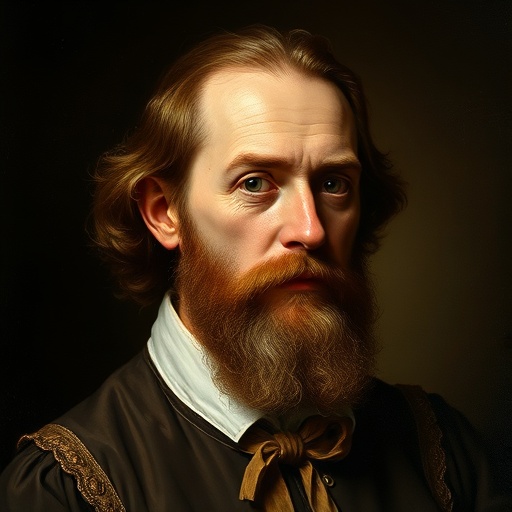
English physician whose On the Motion of the Heart and Blood in Animals (1628) demonstrated blood circulation, overturning 1,400 years of Galenic medicine. Closely associated with Francis Bacon (his contemporary in the new English empiricism). For an intellectual contrast, see Galenic medicine, the 2nd-century Greek medical tradition (humors, blood-as-consumed-fuel) — Harvey calculated that the heart pumps more blood per hour than the body could possibly produce as fuel — a single quantitative observation that demolished the entire Galenic-Aristotelian medical worldview. The cleanest example in medical history of arithmetic disproving 14 centuries of authority.
Found in 1 providers: grok
1 source checked
Blood does not simply pool or flow one way and stop — it moves continuously through the body in a closed loop, driven by the heart, without beginning or end. The same blood returns and recirculates indefinitely, meaning the heart functions as a pump sustaining life through unceasing movement rather than producing fresh blood consumed by the body.
Harvey spent decades dissecting animals and measuring heart output to prove circulation mathematically. His 1628 work De Motu Cordis staked his reputation against Galenic orthodoxy that had dominated medicine for 1,400 years. This statement encapsulates the central claim he risked professional ruin to defend — a claim grounded entirely in quantitative observation and anatomical dissection rather than inherited authority.
In the early 1600s, Galenic medicine held that the liver continuously generated new blood consumed by organs. Harvey published during the Scientific Revolution, when figures like Galileo and Kepler were displacing ancient authority with measurement and reason. Challenging Galen was career-threatening heresy, yet the era's new empiricism provided intellectual cover for replacing 1,400-year-old dogma with observable, repeatable evidence.
AI-generated insights based on extensive research and information for context. Factual errors? Email [email protected].
Your cart is empty