Guru Nanak — "The mouth that utters lies shall be filled with dust."
The mouth that utters lies shall be filled with dust.
The mouth that utters lies shall be filled with dust.
Click any product to generate a realistic preview. Up to 3 at a time.
* Initial load can take up to 90 seconds — revising the preview in another color is nearly instant.
"Dwell in peace in the home of your own being, and the Messenger of Death will not be able to touch you."
"As reflection is within the mirror, So does your Lord abide within you, Why search for him without?"
"Like the juggler, deceiving by his tricks, one is deluded by egotism, falsehood and illusion."
"False is the body that leads to lust and anger, and false are the clothes that lead to pride."
"By the grace of God, I am what I am. And what I am is really craving some pakoras right now."
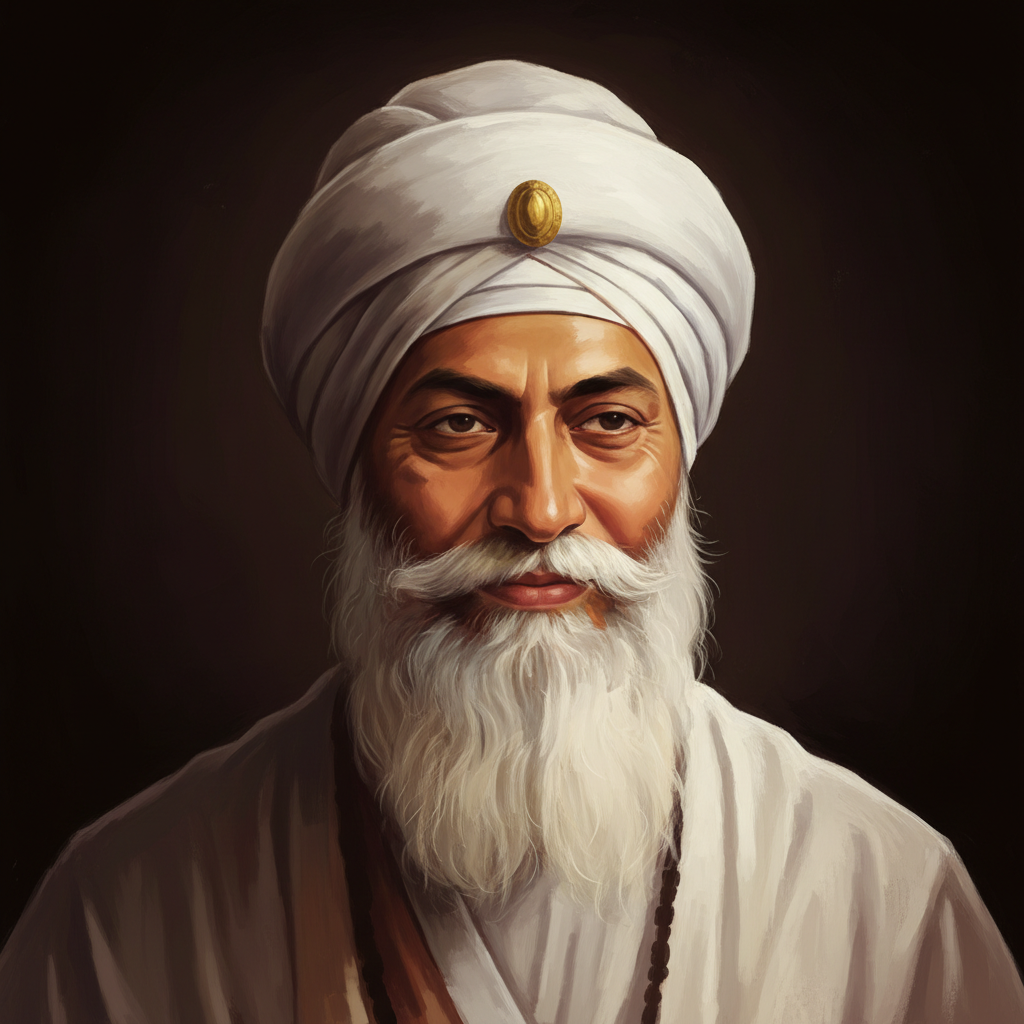
Founder of Sikhism and the first of the Ten Sikh Gurus, whose teachings of one universal God and rejection of caste shaped Punjab. Closely associated with Kabir (mystical poet whose verses appear in the Sikh Guru Granth Sahib). For an intellectual contrast, see Brahmanical orthodoxy, the Hindu caste-and-ritual establishment of his era — Sikhism was founded as a deliberate alternative to both Hindu ritual hierarchy and Islamic exclusivism — Nanak's universalism was a structural rejection of caste and priestly mediation.
Found in 1 providers: gemini
1 source checked
Lying carries its own punishment. A mouth used to deceive others loses its dignity and ends up degraded, reduced to something as worthless as dirt. The image is deliberately harsh: speech is sacred because it shapes relationships, trust, and truth itself. When someone habitually distorts reality for personal gain, they corrupt the very instrument that connects them to other people and to what is real, and they eventually reap shame, isolation, and spiritual emptiness.
Guru Nanak built Sikhism on three pillars, one being Naam Japna, honest remembrance, alongside Kirat Karni, honest labor, and Vand Chakna, honest sharing. A former accountant in Sultanpur known for scrupulous ledgers, he taught that truthful speech was inseparable from truthful living. His hymns in the Guru Granth Sahib repeatedly condemn hypocrisy among priests and rulers, insisting that ritual without honesty was worthless. This saying captures his lifelong insistence that integrity of the tongue reflects integrity of the soul.
Nanak lived 1469 to 1539 in Punjab under the Lodi Sultanate and early Mughal expansion, a period saturated with religious performance, Brahminical ritualism, and Islamic clerical politics. He witnessed Babur's brutal 1521 sack of Saidpur and denounced both Hindu and Muslim leaders for empty piety and corrupt speech. Bhakti and Sufi movements were already challenging hollow orthodoxy, and Nanak's plainspoken verses on truthfulness struck a nerve in a culture where flattery of rulers and priestly deception shaped daily survival.
AI-generated insights based on extensive research and information for context. Factual errors? Email [email protected].
Your cart is empty