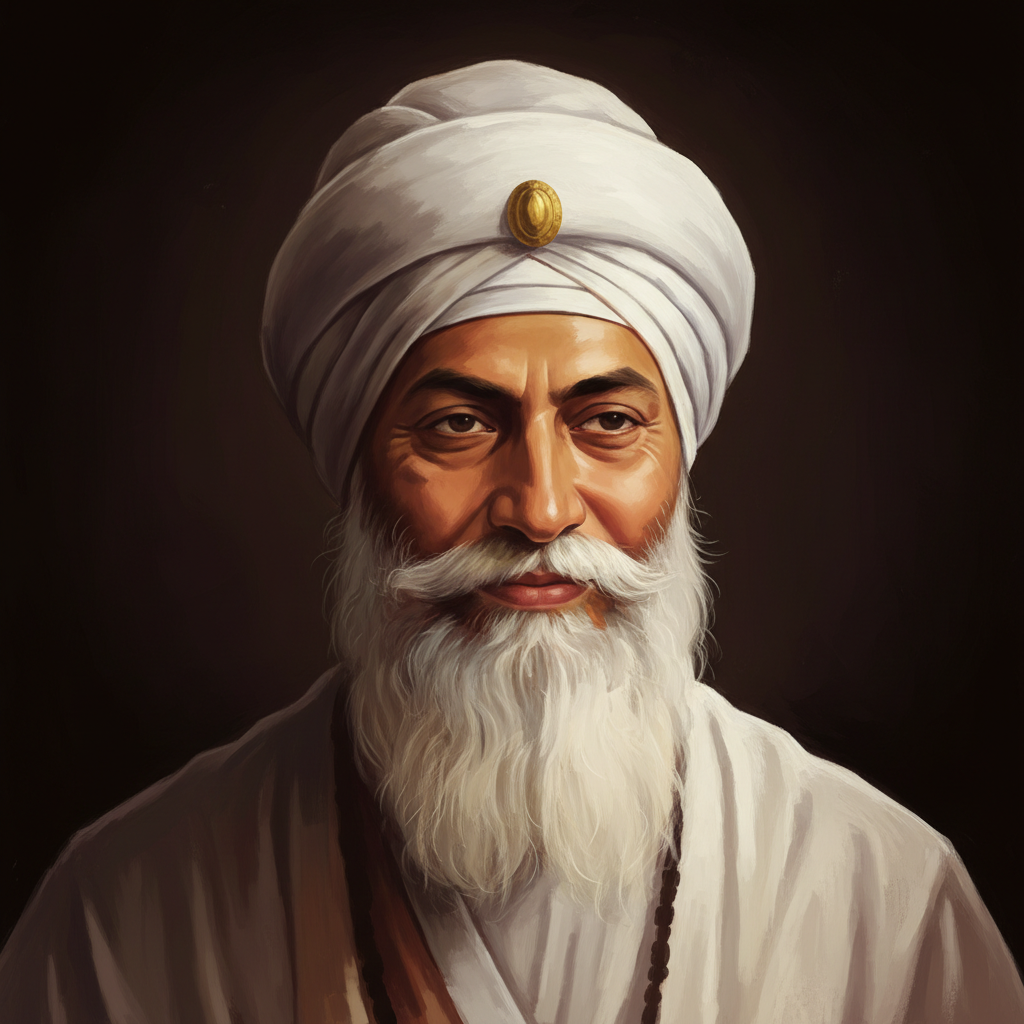
Guru Nanak — "As reflection is within the mirror, So does your Lord abide within you, Why sear…"
As reflection is within the mirror, So does your Lord abide within you, Why search for him without?
As reflection is within the mirror, So does your Lord abide within you, Why search for him without?
Click any product to generate a realistic preview. Up to 3 at a time.
* Initial load can take up to 90 seconds — revising the preview in another color is nearly instant.
"Injustice has no place in God's order because He is absolute just."
"Like the juggler, deceiving by his tricks, one is deluded by egotism, falsehood and illusion."
"If you must speak, speak only the Truth."
"The lowest among the low castes, lower than the lowliest, Nanak is with them: He envies not those with worldly greatness."
"For each and every person, our Lord and Master provides sustenance. Why are you so afraid, O mind? The flamingos fly hundreds of miles, leaving their young ones behind. Who feeds them, and who teaches…"
Founder of Sikhism and the first of the Ten Sikh Gurus, whose teachings of one universal God and rejection of caste shaped Punjab. Closely associated with Kabir (mystical poet whose verses appear in the Sikh Guru Granth Sahib). For an intellectual contrast, see Brahmanical orthodoxy, the Hindu caste-and-ritual establishment of his era — Sikhism was founded as a deliberate alternative to both Hindu ritual hierarchy and Islamic exclusivism — Nanak's universalism was a structural rejection of caste and priestly mediation.
Found in 1 providers: gemini
1 source checked
The divine is not found in temples, pilgrimages, or outward rituals — it lives inside you, as immediate and inseparable as your reflection in a mirror. Searching externally for God misses what is already present within. True spiritual connection requires turning inward through self-awareness and honest reflection rather than performing ceremonies or traveling to sacred places hoping to encounter something distant.
Guru Nanak (1469–1539) rejected both Hindu temple rituals and Islamic orthodoxy, refusing to accept that priests or institutions mediate access to God. His four great journeys across Asia paradoxically taught that God requires no travel at all. His foundational text, the Japji Sahib, opens with Ik Onkar — one universal presence — and his entire theology positioned direct inner experience over caste privilege, idol worship, or clerical gatekeeping.
Early modern South Asia was defined by sharp Hindu-Muslim tension, entrenched Brahmin ritual authority, and caste-based exclusion from worship. Babur's Mughal invasions occurred during Nanak's lifetime, bringing fresh religious upheaval. Pilgrimage to Varanasi or Mecca was the dominant path to salvation. Nanak's insistence that God already dwells within every person — low-caste, high-caste, Hindu, Muslim alike — was a radical democratizing challenge to every religious establishment of his time.
AI-generated insights based on extensive research and information for context. Factual errors? Email [email protected].
Your cart is empty