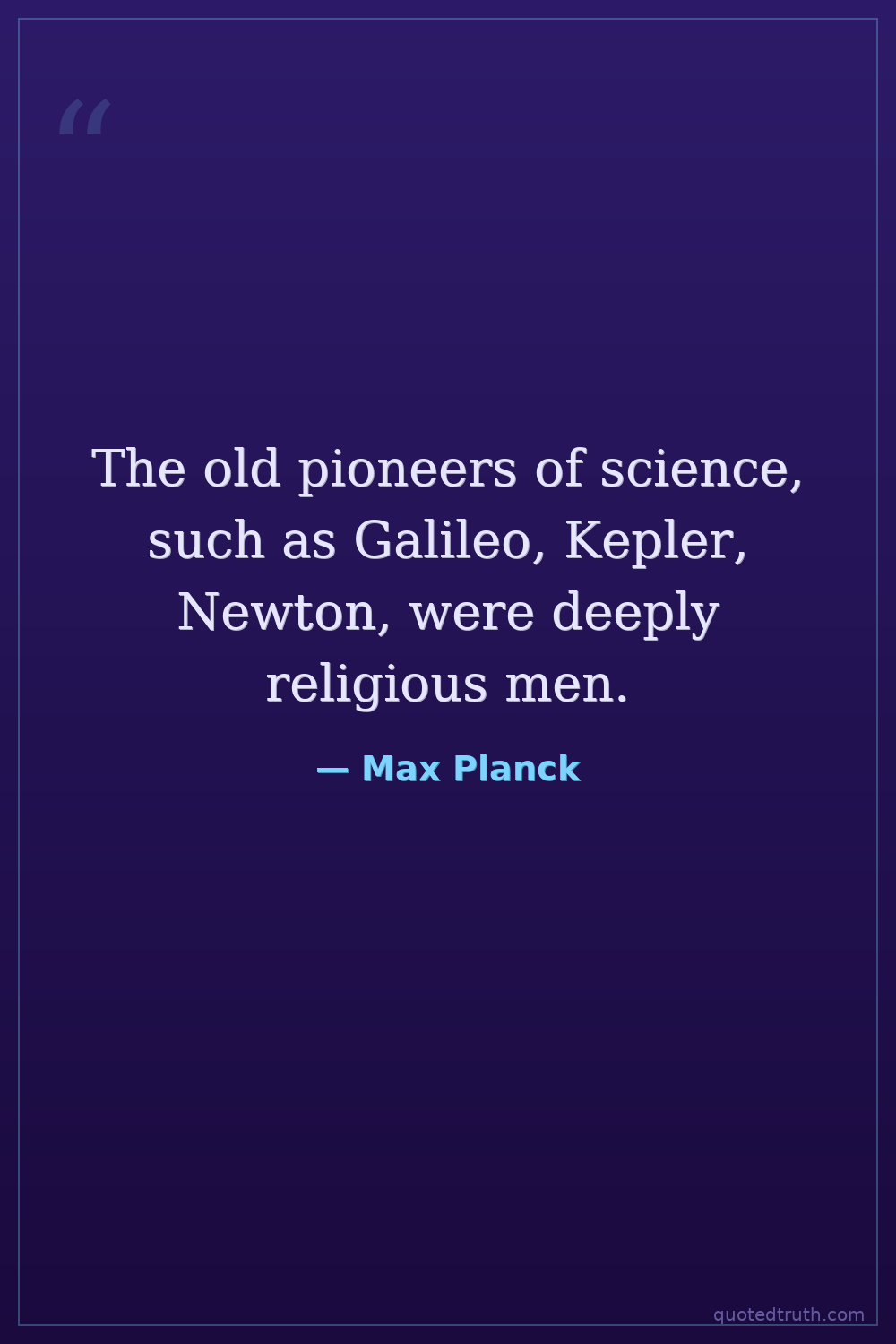
Max Planck — "The old pioneers of science, such as Galileo, Kepler, Newton, were deeply religi…"
The old pioneers of science, such as Galileo, Kepler, Newton, were deeply religious men.
The old pioneers of science, such as Galileo, Kepler, Newton, were deeply religious men.
Click any product to generate a realistic preview. Up to 3 at a time.
* Initial load can take up to 90 seconds — revising the preview in another color is nearly instant.
"It is not the truth that matters, but the search for it."
"I had to sacrifice the continuity of energy to save the second law of thermodynamics."
"When we speak of the 'reality' of the external world, we mean that it is independent of our perception of it."
"Physics is the study of nature, and nature is the manifestation of God."
"The progress of science depends on the freedom of thought."
Found in 1 providers: grok
1 source checked
Planck points out that the founders of modern science were devout believers. Their drive to understand nature came from faith that the universe was orderly and intelligible because a rational creator designed it. He rejects the idea that science and religion are natural enemies, arguing instead that rigorous investigation of reality and sincere spiritual conviction have historically fueled each other rather than standing in opposition.
Planck founded quantum theory in 1900 yet remained a committed Lutheran who served as a church elder in Berlin. He wrote essays like Religion and Natural Science arguing both pursue truth from opposite directions. Having watched colleagues weaponize science against faith, and having endured the Nazi execution of his son Erwin, Planck leaned on religious conviction. Citing Galileo, Kepler, and Newton let him defend his own unfashionable blend of rigorous physics and sincere belief.
Planck worked while logical positivism and Soviet materialism were declaring religion obsolete and incompatible with real science. Freud, Russell, and the Vienna Circle pushed secularism as the mark of a modern mind. Meanwhile relativity and quantum mechanics were dismantling classical certainties, making some scientists triumphalist. Invoking the piety of Galileo, Kepler, and Newton pushed back against that narrative, reminding interwar Europe that the scientific revolution itself grew from thinkers who saw no conflict between laboratory and chapel.
AI-generated insights based on extensive research and information for context. Factual errors? Email [email protected].
Your cart is empty