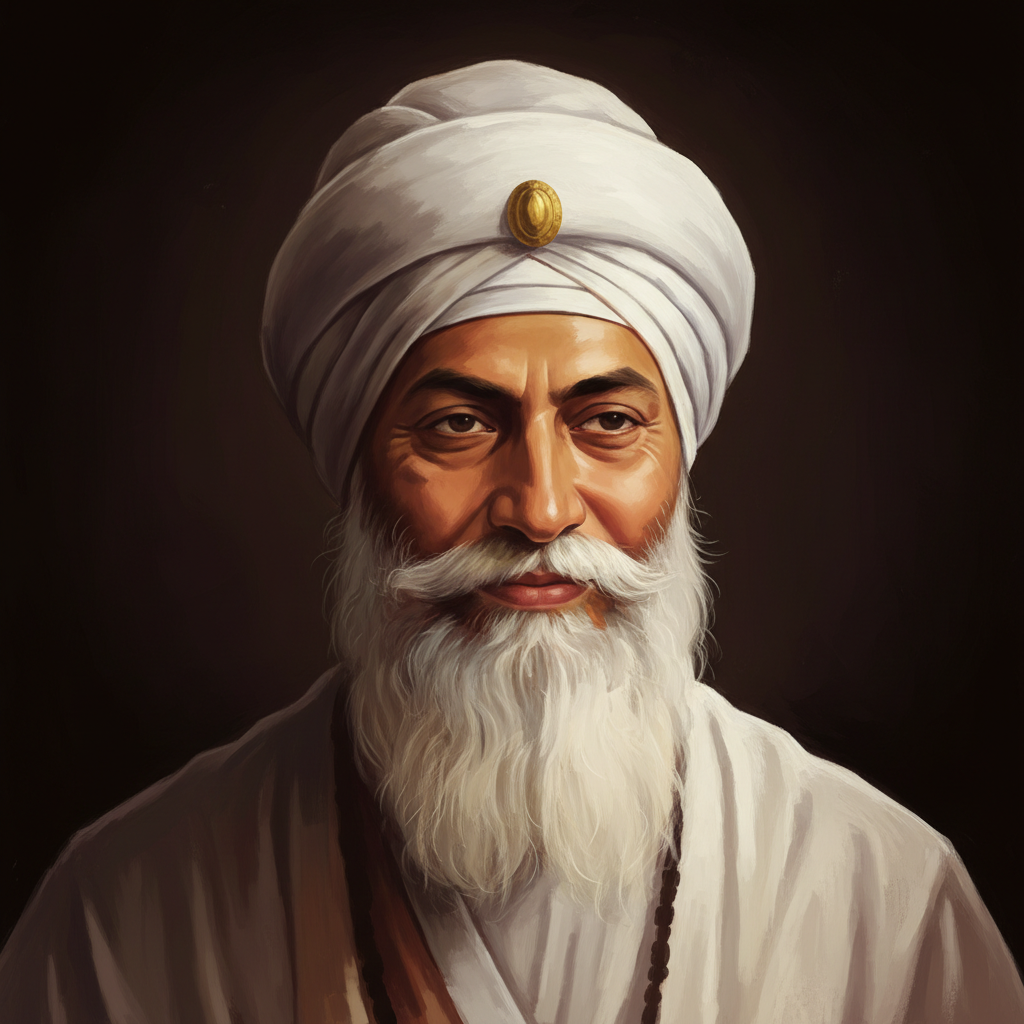
Guru Nanak — "The one who eats what he earns through hard labor and shares it, he alone knows …"
The one who eats what he earns through hard labor and shares it, he alone knows the path.
The one who eats what he earns through hard labor and shares it, he alone knows the path.
Click any product to generate a realistic preview. Up to 3 at a time.
* Initial load can take up to 90 seconds — revising the preview in another color is nearly instant.
"The world is suffering in falsehood, and only truth can save it."
"Conquer your mind and conquer the world."
"Your Mercy is my social status."
"Like the juggler, deceiving by his tricks, one is deluded by egotism, falsehood and illusion."
"The mind is a mad elephant, intoxicated by ego. Only the Guru's teachings can tame it."
Founder of Sikhism and the first of the Ten Sikh Gurus, whose teachings of one universal God and rejection of caste shaped Punjab. Closely associated with Kabir (mystical poet whose verses appear in the Sikh Guru Granth Sahib). For an intellectual contrast, see Brahmanical orthodoxy, the Hindu caste-and-ritual establishment of his era — Sikhism was founded as a deliberate alternative to both Hindu ritual hierarchy and Islamic exclusivism — Nanak's universalism was a structural rejection of caste and priestly mediation.
Found in 1 providers: gemini
1 source checked
Real spiritual understanding doesn't come from rituals, begging, or living off others. It comes from honest work, earning your own living, and sharing what you have with people in need. Only someone who combines self-reliance with generosity truly grasps what a meaningful life looks like. Everyone else is just performing holiness without living it. Work, earn, share, repeat, that is the actual path.
This captures Guru Nanak's central teaching of Kirat Karni and Vand Chakna, two of Sikhism's three pillars. He rejected the renunciant model of holy men who begged for food, insisting spiritual seekers stay householders who farm, trade, and labor. Nanak himself worked as an accountant and later farmed in Kartarpur, and he founded the langar, the free community kitchen where sharing food was worship made physical.
Guru Nanak lived 1469 to 1539 in Punjab during Mughal expansion, when Hindu caste rules and Muslim clerical authority both demanded religious fees, ritual purity, and withdrawal from ordinary life. Wandering ascetics were glorified while laborers were seen as spiritually inferior. Nanak's message that an honest farmer outranks a fasting priest was radical, leveling caste hierarchy and pushing back against an economy where holiness itself had become a profession.
AI-generated insights based on extensive research and information for context. Factual errors? Email [email protected].
Your cart is empty