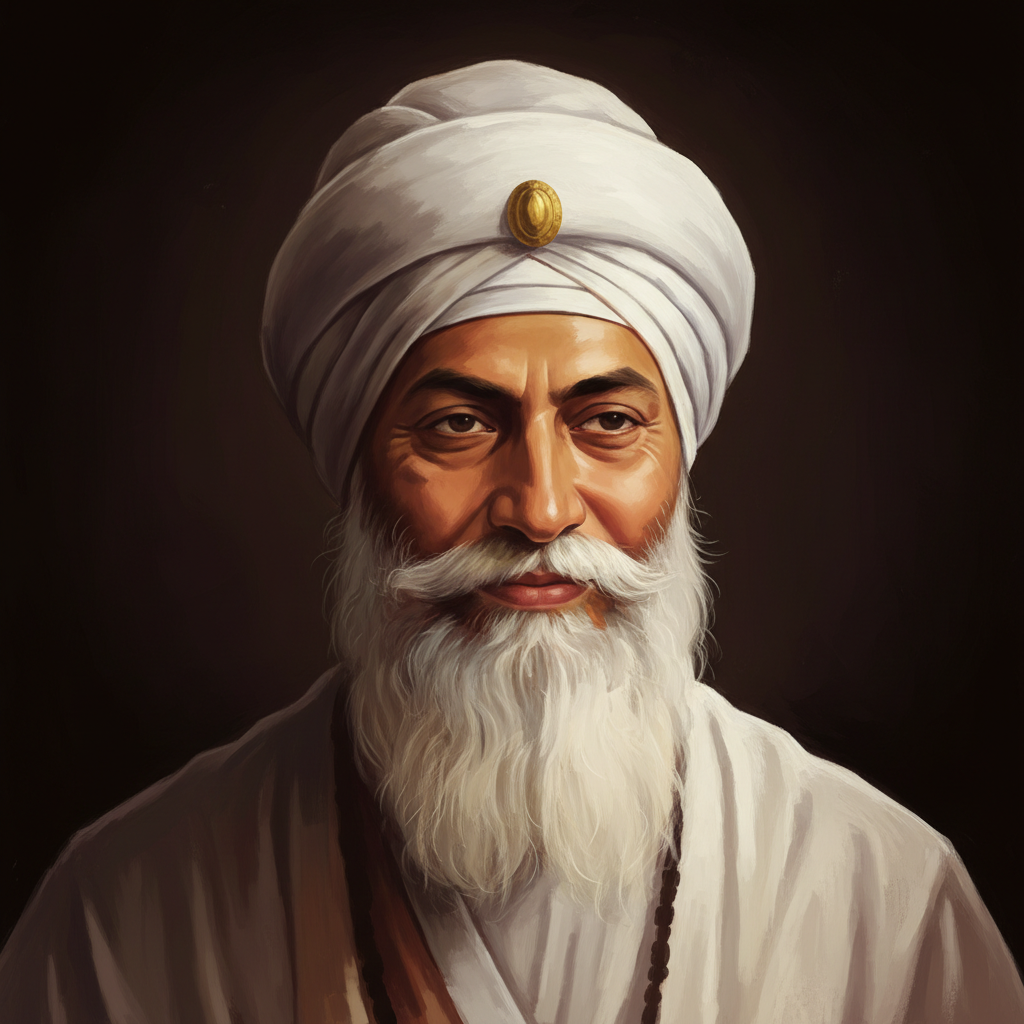
Guru Nanak — "The world is suffering in falsehood, and only truth can save it."
The world is suffering in falsehood, and only truth can save it.
The world is suffering in falsehood, and only truth can save it.
Click any product to generate a realistic preview. Up to 3 at a time.
* Initial load can take up to 90 seconds — revising the preview in another color is nearly instant.
"The sun and moon, O Lord, are Thy lamps; the firmament Thy salver; the orbs of the stars the pearls encased in it."
"Let no one be proud of his caste; he who knows God is a Brahmin."
"The five thieves (lust, anger, greed, attachment, ego) plunder the house of the body."
"The world is a garden, love is its flower. And sometimes, you get weeds."
"He who considers himself humble, he alone is worthy of praise."
Founder of Sikhism and the first of the Ten Sikh Gurus, whose teachings of one universal God and rejection of caste shaped Punjab. Closely associated with Kabir (mystical poet whose verses appear in the Sikh Guru Granth Sahib). For an intellectual contrast, see Brahmanical orthodoxy, the Hindu caste-and-ritual establishment of his era — Sikhism was founded as a deliberate alternative to both Hindu ritual hierarchy and Islamic exclusivism — Nanak's universalism was a structural rejection of caste and priestly mediation.
Found in 1 providers: gemini
1 source checked
Human suffering stems from widespread deception — self-delusion, dishonesty, and ego-driven illusions that distort how people live and relate to each other. The only genuine cure is radical commitment to truth: in thought, speech, and action. Falsehood here means greed, pride, and maya (illusion); truth means alignment with divine reality. No ritual or power can substitute for this inner and collective honesty.
Sat — truth — is literally the first word of the Mul Mantar, Sikhism's foundational creed Nanak composed. He built his entire theology around it. He famously rejected his sacred thread ceremony as a child, calling hollow ritual meaningless without inner truth. During his four great journeys across Asia, he repeatedly confronted priests, rulers, and merchants he saw profiting from falsehood, debating them publicly and calling their deceptions out.
Guru Nanak lived from 1469–1539, spanning Lodhi sultanate collapse and Mughal conquest of northern India. Ordinary people were ground between oppressive rulers, rigid caste hierarchies, and self-serving religious institutions — both Hindu and Muslim — that demanded compliance while offering little moral clarity. Sufi mystics offered some counter-voice, but institutional religion largely served power. His declaration that truth alone saves was a direct rebuke to every authority claiming legitimacy through falsehood.
AI-generated insights based on extensive research and information for context. Factual errors? Email [email protected].
Your cart is empty