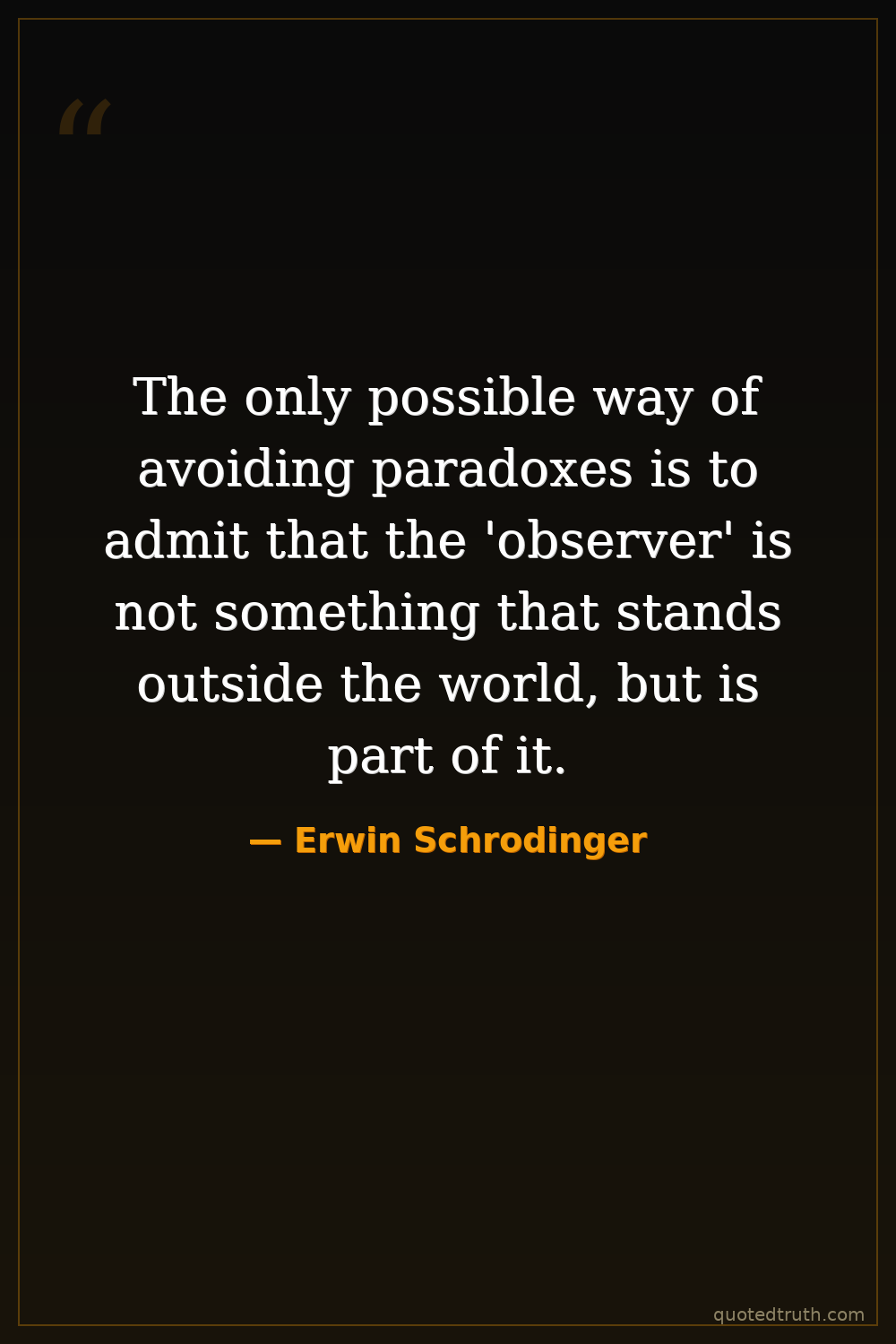
Erwin Schrodinger — "The only possible way of avoiding paradoxes is to admit that the 'observer' is n…"
The only possible way of avoiding paradoxes is to admit that the 'observer' is not something that stands outside the world, but is part of it.
The only possible way of avoiding paradoxes is to admit that the 'observer' is not something that stands outside the world, but is part of it.
Click any product to generate a realistic preview. Up to 3 at a time.
* Initial load can take up to 90 seconds — revising the preview in another color is nearly instant.
"Consciousness cannot be accounted for in physical terms. For consciousness is absolutely fundamental. It cannot be accounted for in terms of anything else."
"Logic will get you from A to B. Imagination will take you everywhere."
"The world is much stranger than we can imagine."
"If you ask a theoretical physicist today, ‘What is an electron?’ he will probably say, ‘It is a symbol in the wave equation.’ We have got so far from the concrete picture of nature."
"The world is a journey, and we are the travelers."
Austrian physicist who shared the 1933 Nobel for the wave equation that bears his name and the famous cat thought-experiment. Closely associated with Werner Heisenberg (matrix-mechanics rival who reached the same physics by different math) and Albert Einstein (his pen-pal on quantum interpretation). For an intellectual contrast, see Niels Bohr, Danish physicist and architect of the Copenhagen interpretation — Schrödinger's cat thought-experiment was specifically designed to ridicule Bohr's 'observer-dependent reality' reading of quantum mechanics — Schrödinger thought the Copenhagen interpretation was absurd; the cat was meant as reductio ad absurdum.
Attributed, general philosophical stance, hard to pinpoint exact wording/source.
Date: Approx. 1950s
ShockingFound in 1 providers: grok
1 source checked
Paradoxes arise when we pretend the observer sits outside reality, watching it neutrally. Schrödinger argues this is impossible — any observer, human or instrument, is physically embedded in the world and interacts with whatever is measured. Once you accept that participation is unavoidable, the contradiction dissolves. Reality cannot be described completely without including the thing doing the describing. Subject and object are not cleanly separable.
Schrödinger derived the wave equation in 1926 — the core tool for tracking quantum state evolution. His 1935 cat thought experiment was built precisely to expose the absurdity of treating observation as a clean external trigger for collapse. He opposed the Copenhagen interpretation's hard observer/system boundary throughout his career, and his philosophical writings, including 'What is Life?' and 'Mind and Matter,' consistently argued that consciousness is woven into physical reality, not hovering above it.
The 1920s through 1950s forced physicists to confront what observation meant at atomic scales. The Copenhagen interpretation placed the act of measurement at the heart of quantum mechanics, implying reality is indeterminate until observed — a conclusion that disturbed Einstein and Schrödinger alike. This era collapsed the Enlightenment assumption that science describes a world entirely independent of the scientist. Schrödinger's statement reflects a generation grappling with whether objectivity itself was a sustainable ideal in modern physics.
AI-generated insights based on extensive research and information for context. Factual errors? Email [email protected].
Your cart is empty