What it means
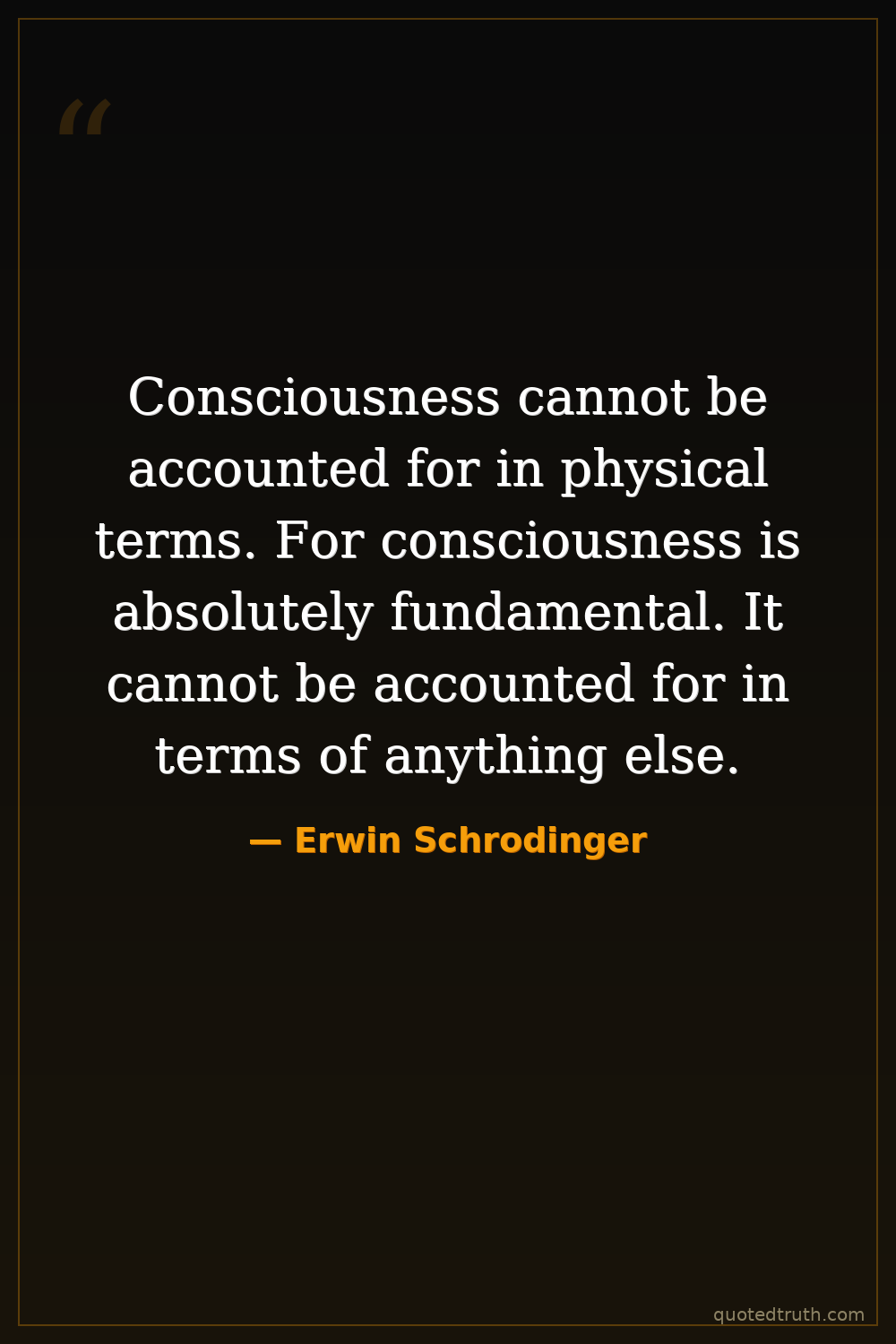
Consciousness isn't reducible to physical processes—neurons, chemistry, or physics equations can't fully explain the subjective experience of being aware. Consciousness is the most fundamental thing that exists; everything else we know about the physical world is known only through it. Rather than awareness emerging from matter, the experienced physical world may itself depend on consciousness, making it the irreducible ground of all reality, not a byproduct of it.
Relevance to Erwin Schrodinger
Schrödinger formulated wave mechanics and the famous cat thought-experiment, spending his later career at the boundary of physics and mind. His 1944 book What Is Life? and philosophical essays show he believed quantum mechanics exposed the limits of materialism. Deeply shaped by Vedanta philosophy, he held individual and universal consciousness are unified—making this statement consistent with both his wave-function work and his conviction that science had cornered something irreducibly subjective at nature's foundation.
The era
Schrödinger wrote this mid-20th century, when quantum mechanics had demolished classical determinism. The measurement problem—observation collapsing wave functions—forced physicists to confront the observer's role in physical reality. Simultaneously, logical positivism dominated philosophy, insisting only empirically measurable facts matter. Schrödinger pushed back, arguing physics itself revealed something irreducibly non-physical at its core, anticipating what philosophers now call the hard problem of consciousness decades before the term existed.
AI-generated insights based on extensive research and information for context. Factual errors? Email [email protected].