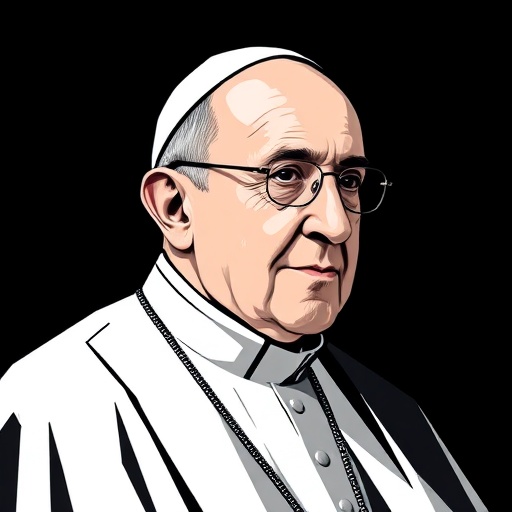
Pope Francis — "The only way to fight against hunger is to fight against the poverty that causes…"
The only way to fight against hunger is to fight against the poverty that causes it.
The only way to fight against hunger is to fight against the poverty that causes it.
Click any product to generate a realistic preview. Up to 3 at a time.
* Initial load can take up to 90 seconds — revising the preview in another color is nearly instant.
"The Church is not a supermarket. The Church is a Mother."
"If someone is gay and he searches for the Lord and has good will, who am I to judge?"
"Proselytism is solemn nonsense."
"The Church is not a museum of saints, but a hospital for sinners."
"The greatest scandal is poverty."
First Latin American and Jesuit pope (2013-), who has steered the Catholic Church toward pastoral inclusion on LGBTQ pastoral care, divorced Catholics, and climate. Closely associated with Pope John XXIII (the Vatican II reformer pope) and Cardinal Walter Kasper (his theological ally on pastoral reform). For an intellectual contrast, see Cardinal Raymond Burke, American traditionalist cardinal, former head of the Vatican Apostolic Signatura — Burke is the public face of Catholic traditionalism that views Francis's pastoral approach as doctrinally dangerous — he has formally challenged Amoris Laetitia and other Francis reforms.
Found in 1 providers: grok
1 source checked
Hunger is a symptom, not the disease. Simply distributing food addresses immediate suffering but leaves the root cause untouched. Real, lasting change requires dismantling the economic and social conditions that keep people poor — systemic inequality, lack of access to resources, exploitative labor structures, and broken safety nets. Charity alone cannot substitute for structural justice. Ending hunger permanently means ending the poverty that makes people vulnerable to it.
Born Jorge Mario Bergoglio in Buenos Aires, Francis grew up surrounded by Argentina's stark inequality. As a Jesuit priest serving impoverished communities, he was shaped by social justice theology. His encyclicals Evangelii Gaudium and Laudato Si' explicitly condemn economic systems that exclude the poor and a 'throwaway culture' that treats people as disposable. He has consistently argued that the Church's mission demands structural reform, not just charity.
Francis became Pope in 2013, after the 2008 financial crisis widened global inequality dramatically. The UN's 2015 Sustainable Development Goals placed hunger and poverty eradication at the center of international policy. Climate-driven crop failures, rising food prices, and instability in the Global South pushed hundreds of millions into food insecurity. His papacy coincided with growing worldwide demands for wealth redistribution and sharp criticism of austerity economics imposed on vulnerable nations.
AI-generated insights based on extensive research and information for context. Factual errors? Email [email protected].
Your cart is empty