What it means
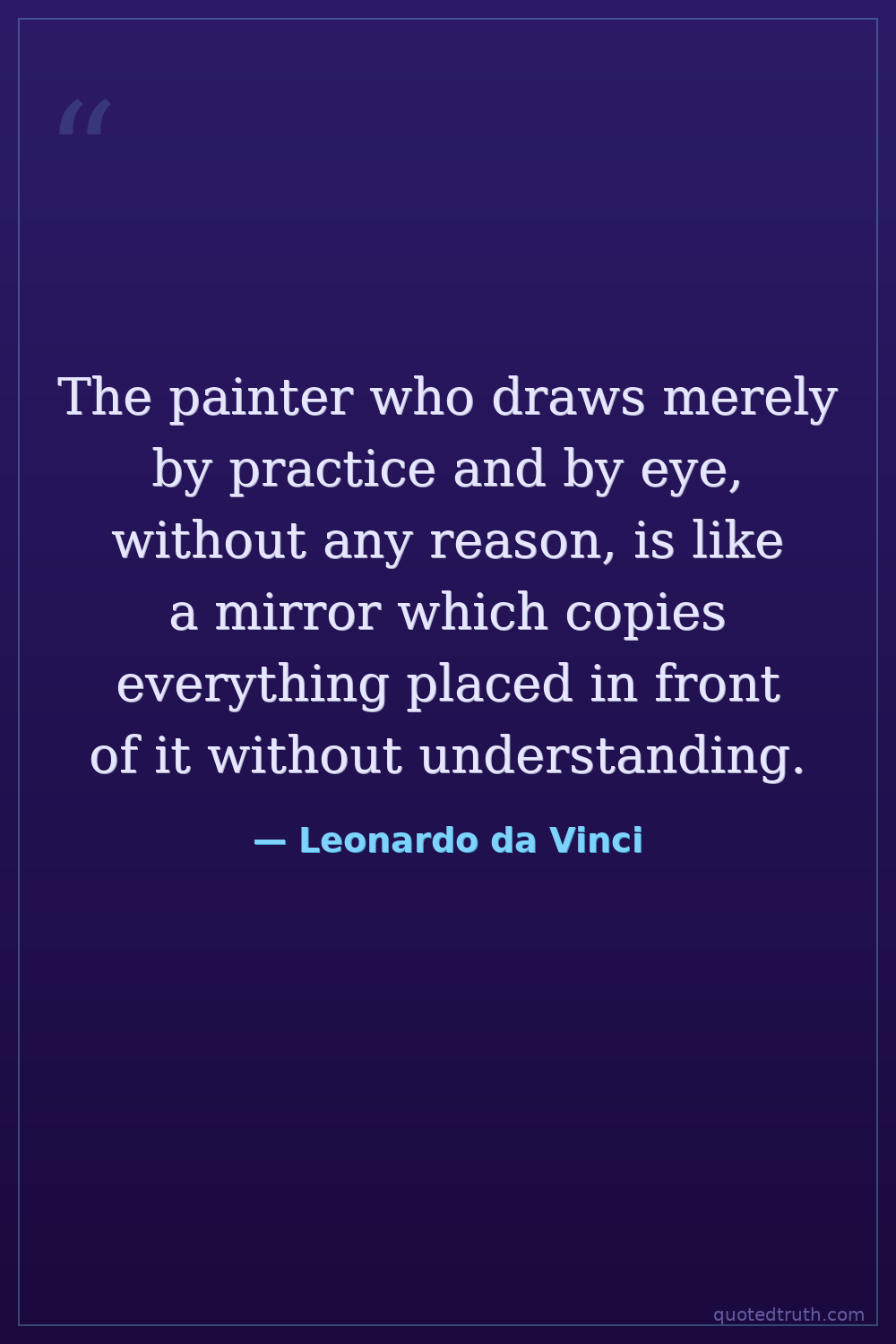
A painter who works purely by imitation, copying what they see without grasping underlying principles, produces art mechanically rather than intellectually. True mastery requires understanding why things look as they do — anatomy, light, perspective, proportion — not just reproducing surfaces. Skill without reason is mere mimicry; the mind must drive the hand, transforming observation into genuine knowledge and purposeful creation.
Relevance to Leonardo da Vinci
Da Vinci spent decades dissecting corpses to understand human anatomy, studying optics to master light, and filling thousands of notebook pages with geometric and scientific analysis — all to paint with reason, not reflex. He famously called painting a science. This quote reflects his deep conviction that art and intellect are inseparable, embodied in masterworks like the Vitruvian Man and The Last Supper.
The era
The Italian Renaissance was transforming art from medieval craft into an intellectual discipline. Humanist scholars revived classical learning, and artists like Alberti codified perspective mathematically. Painters competed for status as thinkers, not mere craftsmen. Against this backdrop, da Vinci's insistence on reason over imitation was a manifesto: elevating painting to a liberal art alongside philosophy, mathematics, and natural philosophy.
AI-generated insights based on extensive research and information for context. Factual errors? Email [email protected].