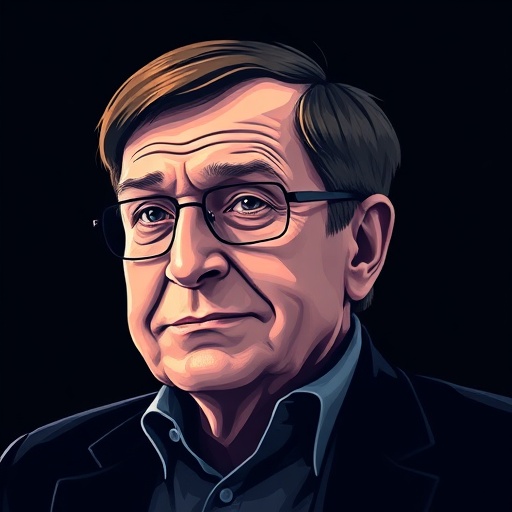
Stephen Hawking — "The past, like the future, is indefinite and exists only as a spectrum of possib…"
The past, like the future, is indefinite and exists only as a spectrum of possibilities.
The past, like the future, is indefinite and exists only as a spectrum of possibilities.
Click any product to generate a realistic preview. Up to 3 at a time.
* Initial load can take up to 90 seconds — revising the preview in another color is nearly instant.
"The greatest danger for our future is apathy."
"Intelligence is the ability to adapt to change."
"We are very, very small, but we are capable of understanding the universe."
"So my friend tried to call me the other week... but all he was getting was an automated answer."
"I would like to understand the mind of God, if there is one."
British theoretical physicist whose Hawking radiation work and A Brief History of Time (1988) brought black-hole physics to a mass audience while he lived with ALS for 55 years. Closely associated with Roger Penrose (his collaborator on singularity theorems) and Carl Sagan (fellow popularizer who wrote Brief History's foreword). For an intellectual contrast, see William Lane Craig, American philosopher of religion — Craig's Kalam cosmological argument depends on the Big Bang requiring a divine first cause; Hawking's no-boundary proposal was specifically designed to remove the moment that would require one — the cleanest cosmology-vs-natural-theology contrast in modern thought.
Found in 1 providers: grok
1 source checked
The past isn't a fixed, singular record of events — it's probabilistic, just like the future. At the quantum level, even what has already happened lacks a single definitive history. Reality doesn't consist of one clean timeline but a range of possible histories, each with different probabilities. Our certainty about the past is an illusion imposed by scale, not a fundamental property of the universe.
Hawking developed the 'sum over histories' approach with Jim Hartle, proposing the universe has no single origin but a superposition of possible beginnings. His no-boundary proposal treated time as emerging from quantum geometry. Living with ALS for 55 years, Hawking also personally confronted how the past — his diagnosis, his losses — remained open to reinterpretation rather than fixed condemnation.
Hawking worked through the late Cold War into the digital age, as physicists reconciled quantum mechanics with general relativity. The 1980s–2000s saw quantum computing emerge and decoherence theory mature, reinforcing probabilistic views of reality. Public fascination with chaos theory and complexity science made the idea of an indeterminate past culturally resonant, challenging Enlightenment assumptions about deterministic, knowable history.
AI-generated insights based on extensive research and information for context. Factual errors? Email [email protected].
Your cart is empty