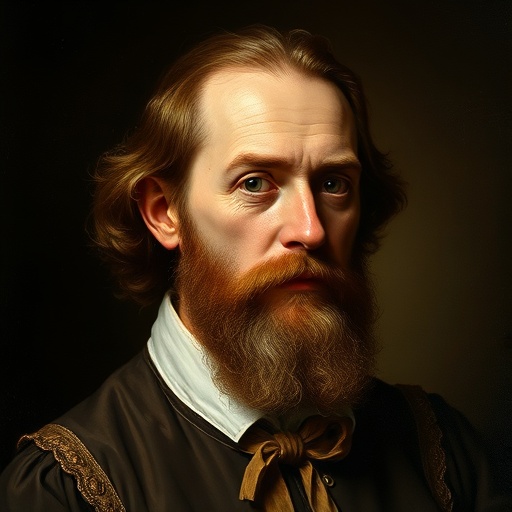
William Harvey — "The physician must be a constant student."
The physician must be a constant student.
The physician must be a constant student.
Click any product to generate a realistic preview. Up to 3 at a time.
* Initial load can take up to 90 seconds — revising the preview in another color is nearly instant.
"I have often wondered and even laughed at those who fancied that everything had been so consummately and absolutely investigated by an Aristotle or a Galen or some other mighty name, that nothing coul…"
"The causes of diseases are often hidden, and to find them requires much labor and diligence."
"Nature is nowhere accustomed more openly to display her secret mysteries than in cases where she shows tracings of her workings apart from the beaten paths; nor is there any better way to advance the …"
"The blood in the arteries is of a more florid colour than that in the veins."
"The semen is the efficient cause and the egg the material cause of generation."
English physician whose On the Motion of the Heart and Blood in Animals (1628) demonstrated blood circulation, overturning 1,400 years of Galenic medicine. Closely associated with Francis Bacon (his contemporary in the new English empiricism). For an intellectual contrast, see Galenic medicine, the 2nd-century Greek medical tradition (humors, blood-as-consumed-fuel) — Harvey calculated that the heart pumps more blood per hour than the body could possibly produce as fuel — a single quantitative observation that demolished the entire Galenic-Aristotelian medical worldview. The cleanest example in medical history of arithmetic disproving 14 centuries of authority.
Emphasizing the continuous learning required in medicine.
Date: Uncertain (attributed)
EducationalFound in 1 providers: gemini
1 source checked
A doctor cannot rely solely on what they learned during training. Medicine demands continuous learning throughout a career—new observations, new evidence, new understanding. Complacency is dangerous when human lives are at stake. Staying current means actively seeking knowledge, questioning assumptions, and remaining open to revising long-held beliefs whenever better evidence emerges.
Harvey embodied this principle by overturning 1,400 years of Galenic doctrine on blood movement through relentless experiment and observation. His discovery of systemic circulation required him to challenge received wisdom he had been taught at Padua. He spent decades refining his model before publishing in 1628, exemplifying the lifelong scholarly rigor he advocated.
The early modern period saw medicine transitioning from ancient authority toward empirical science. Harvey practiced during the Scientific Revolution, when Vesalius had recently corrected Galenic anatomy and Galileo was redefining physics. Old textbook knowledge was being dismantled rapidly. Continuous study was not merely virtuous but existentially necessary—yesterday's certainty could become tomorrow's discredited error.
AI-generated insights based on extensive research and information for context. Factual errors? Email [email protected].
Your cart is empty