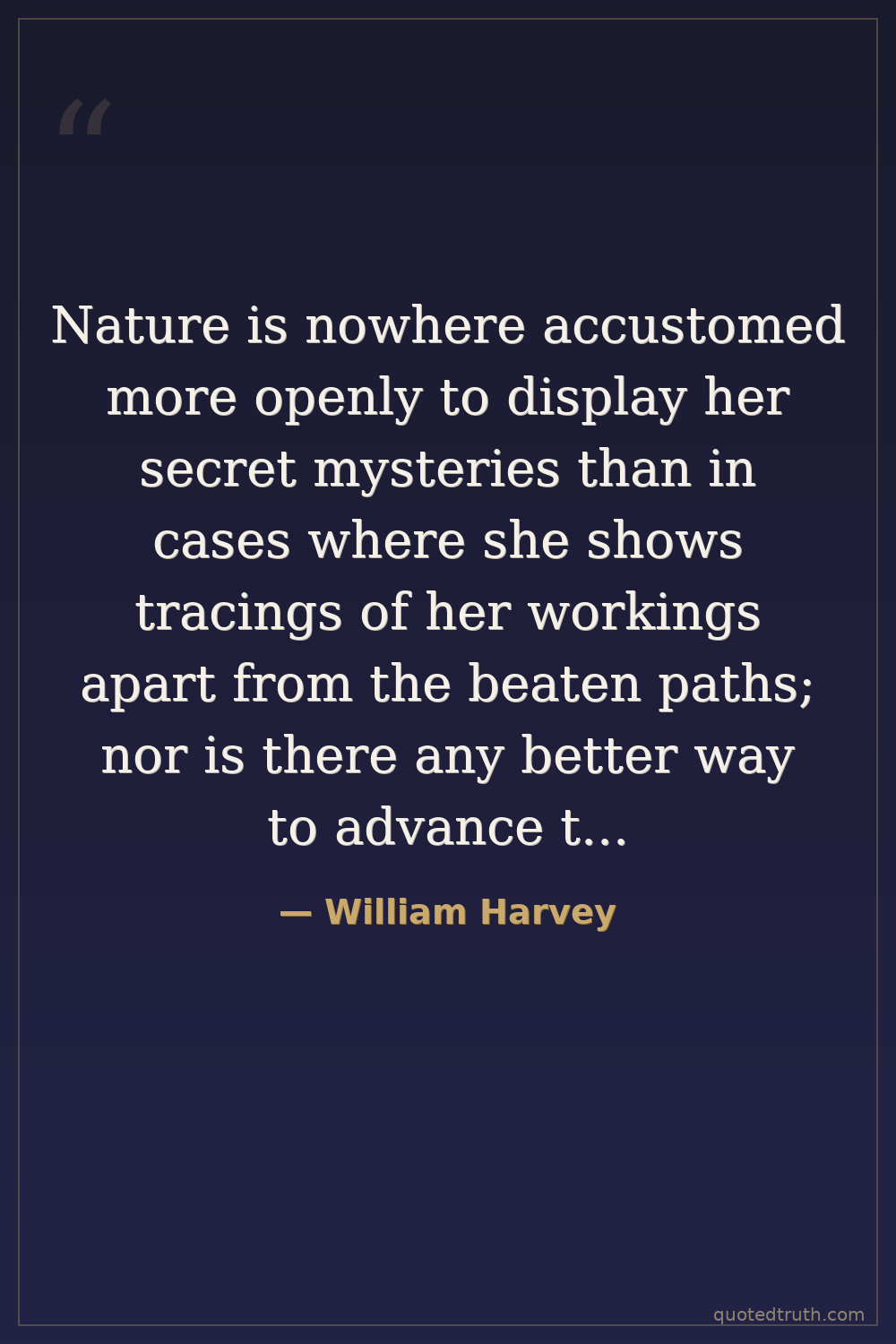
William Harvey — "Nature is nowhere accustomed more openly to display her secret mysteries than in…"

Nature is nowhere accustomed more openly to display her secret mysteries than in cases where she shows tracings of her workings apart from the beaten paths; nor is there any better way to advance the proper practice of medicine than to give our minds to the discovery of the usual law of nature, by careful investigation of cases of rarer forms of disease.
William Harvey — William Harvey Early Modern · Blood circulation

Get This Quote & Author's Image Illustrated On:

Click any product to generate a realistic preview. Up to 3 at a time.
* Initial load can take up to 90 seconds — revising the preview in another color is nearly instant.

Kitchen

Apparel

Other

About William Harvey (1578-1657)

English physician whose On the Motion of the Heart and Blood in Animals (1628) demonstrated blood circulation, overturning 1,400 years of Galenic medicine. Closely associated with Francis Bacon (his contemporary in the new English empiricism). For an intellectual contrast, see Galenic medicine, the 2nd-century Greek medical tradition (humors, blood-as-consumed-fuel) — Harvey calculated that the heart pumps more blood per hour than the body could possibly produce as fuel — a single quantitative observation that demolished the entire Galenic-Aristotelian medical worldview. The cleanest example in medical history of arithmetic disproving 14 centuries of authority.

Details

From 'De Motu Cordis' (1628), Dedication to Doctor Argent. A philosophical statement on learning from anomalies and detailed observation.

Date: 1628

Philosophical

Verification

Unverifiable

Found in 1 providers: gemini

1 source checked

Understanding this quote

What it means

Nature reveals its hidden rules most clearly through exceptions and anomalies, not through ordinary cases. To truly advance medicine, practitioners must study rare and unusual diseases with rigorous investigation, because these edge cases expose the underlying principles that govern how living things normally work.

Relevance to William Harvey

Harvey built his revolutionary discovery of blood circulation by rejecting Galenic orthodoxy and following empirical observation wherever it led. His dissections of cold-blooded animals and comparative anatomy of hearts reflected exactly this principle: rare anatomical arrangements illuminated universal biological laws he could not see in typical human subjects.

The era

In early 17th-century Europe, medicine still largely deferred to ancient Greek authorities like Galen. The Scientific Revolution was challenging received wisdom through direct observation and experiment. Harvey wrote amid this upheaval, and his 1628 Exercitatio Anatomica de Motu Cordis exemplified the new empirical approach that would eventually displace scholastic medicine entirely.

AI-generated insights based on extensive research and information for context. Factual errors? Email [email protected].
Your Cart

Your cart is empty