Hippocrates — "The physician must be able to tell the antecedents, know the present, and forete…"
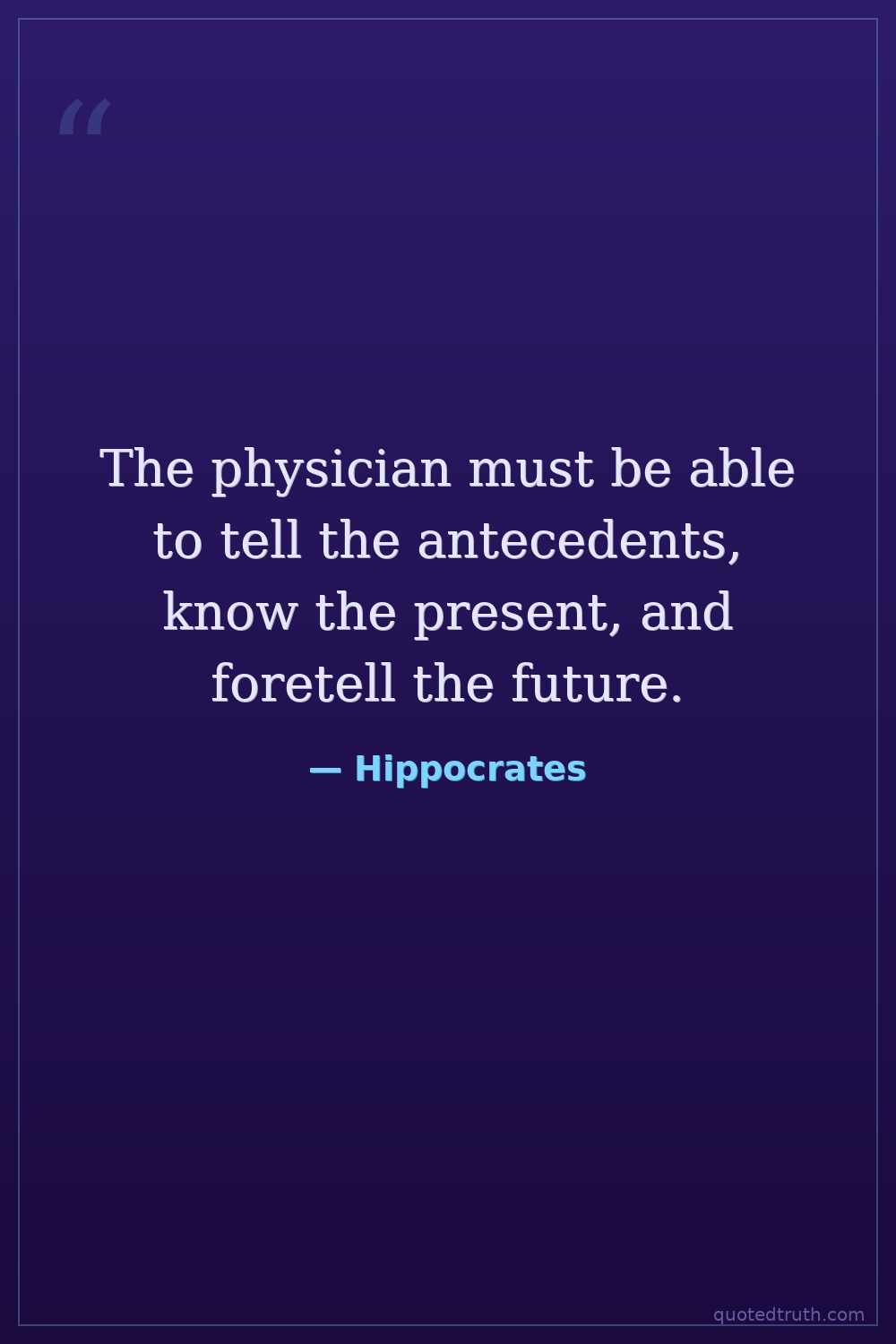
The physician must be able to tell the antecedents, know the present, and foretell the future.
The physician must be able to tell the antecedents, know the present, and foretell the future.
Click any product to generate a realistic preview. Up to 3 at a time.
* Initial load can take up to 90 seconds — revising the preview in another color is nearly instant.
"If you are in a bad mood, go for a walk. If you are still in a bad mood, go for another walk."
"Those by nature overweight, die earlier than the slim."
"The art of medicine consists in amusing the patient while nature cures the disease."
"The physician must be a friend to his patient."
"Hot diseases are cured by cold, and cold diseases by hot."
Found in 2 providers: grok,deepseek
2 sources checked
A doctor must master three dimensions of patient care: understand the medical history that led to illness, accurately assess the current condition, and predict how the disease will develop. This isn't about guesswork—it's systematic clinical reasoning. Past patterns reveal causes, present findings confirm diagnosis, and future projection guides treatment. Medicine requires thinking across time, not just reacting to immediate symptoms. This defines the complete physician.
Hippocrates built his medical school on Cos around systematic observation and documentation. He wrote Prognostic, an entire treatise devoted to predicting disease outcomes—a radical idea when illness was attributed to gods. His Epidemics books record patient cases with histories and outcomes, embodying exactly this three-part method. He separated medicine from religion by insisting doctors use reason and observed evidence rather than prayer, making prognosis a core clinical skill.
In 5th-century BCE Greece, disease was almost universally attributed to divine will or punishment from gods like Asclepius. Healing temples relied on prayer and ritual sacrifice. Simultaneously, the philosophical revolution of Socrates and the pre-Socratics demanded rational explanations for natural phenomena. Hippocrates rode this wave, insisting illness had observable natural causes and predictable progressions—this quote's demand for prognosis declared that medicine could be a rational science, not divine guesswork.
AI-generated insights based on extensive research and information for context. Factual errors? Email [email protected].
Your cart is empty