Hippocrates — "The physician must not only be prepared to do what is right himself, but also to…"
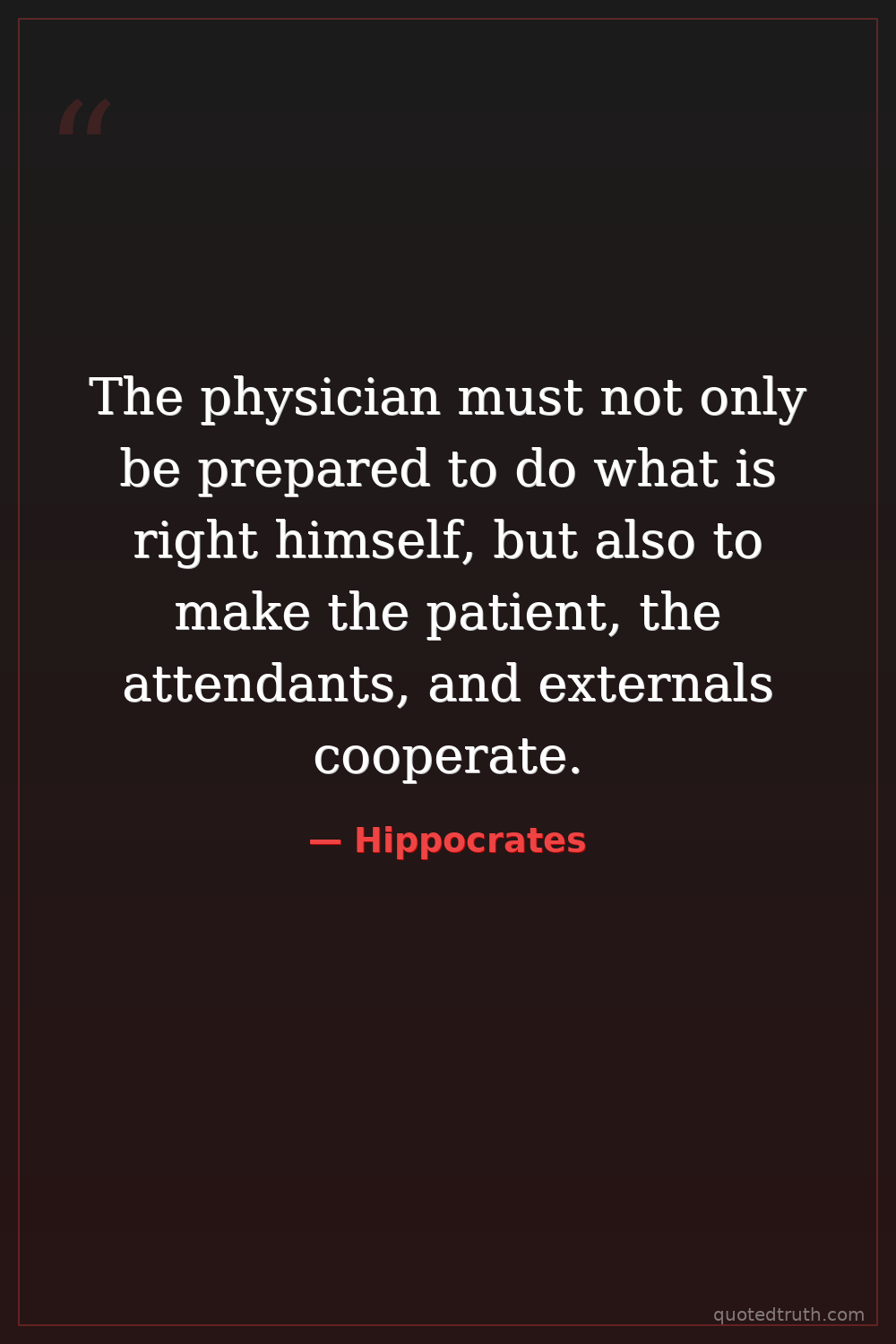
The physician must not only be prepared to do what is right himself, but also to make the patient, the attendants, and externals cooperate.
The physician must not only be prepared to do what is right himself, but also to make the patient, the attendants, and externals cooperate.
Click any product to generate a realistic preview. Up to 3 at a time.
* Initial load can take up to 90 seconds — revising the preview in another color is nearly instant.
"If you are not your own doctor, you are a fool."
"Everyone has a doctor in him or her; we just have to help it in its work."
"The best medicine is love and care."
"The healthy man does not think about his health."
"Disease is not an entity, but a fluctuating condition of the patient's body, a battle between the substance of the disease and the natural self-healing tendency of the body."
Found in 1 providers: deepseek
1 source checked
Healing isn't a solo act by the doctor. A physician must actively coordinate the whole care environment — getting patients to follow treatment, guiding caregivers and nurses properly, and managing outside factors like diet, living conditions, and lifestyle. No matter how skilled the doctor, recovery depends on everyone playing their role. This is essentially a call for holistic, team-based care and patient engagement, concepts central to modern medicine.
Hippocrates built medicine on observation and reason, not ritual. He wrote extensively about how environment, diet, and lifestyle — what he called externals — shaped health outcomes. His school on Cos trained physicians to read the whole patient situation, not just symptoms. The Hippocratic Corpus repeatedly addresses managing diet, rest, and caregiver behavior. This quote reflects his foundational belief that the physician's authority extended to orchestrating every factor surrounding the patient.
In ancient Greece, medicine was just breaking free from religious healing practices centered on temple priests of Asclepius. Physicians like Hippocrates traveled to patients' homes, where family members and household slaves served as caregivers — untrained and culturally variable. Externals meant climate, seasons, and local water. Without hospitals or formal nursing, the physician had to direct the entire household's behavior. Cooperation wasn't optional; without it, even correct diagnosis meant nothing.
AI-generated insights based on extensive research and information for context. Factual errors? Email [email protected].
Your cart is empty