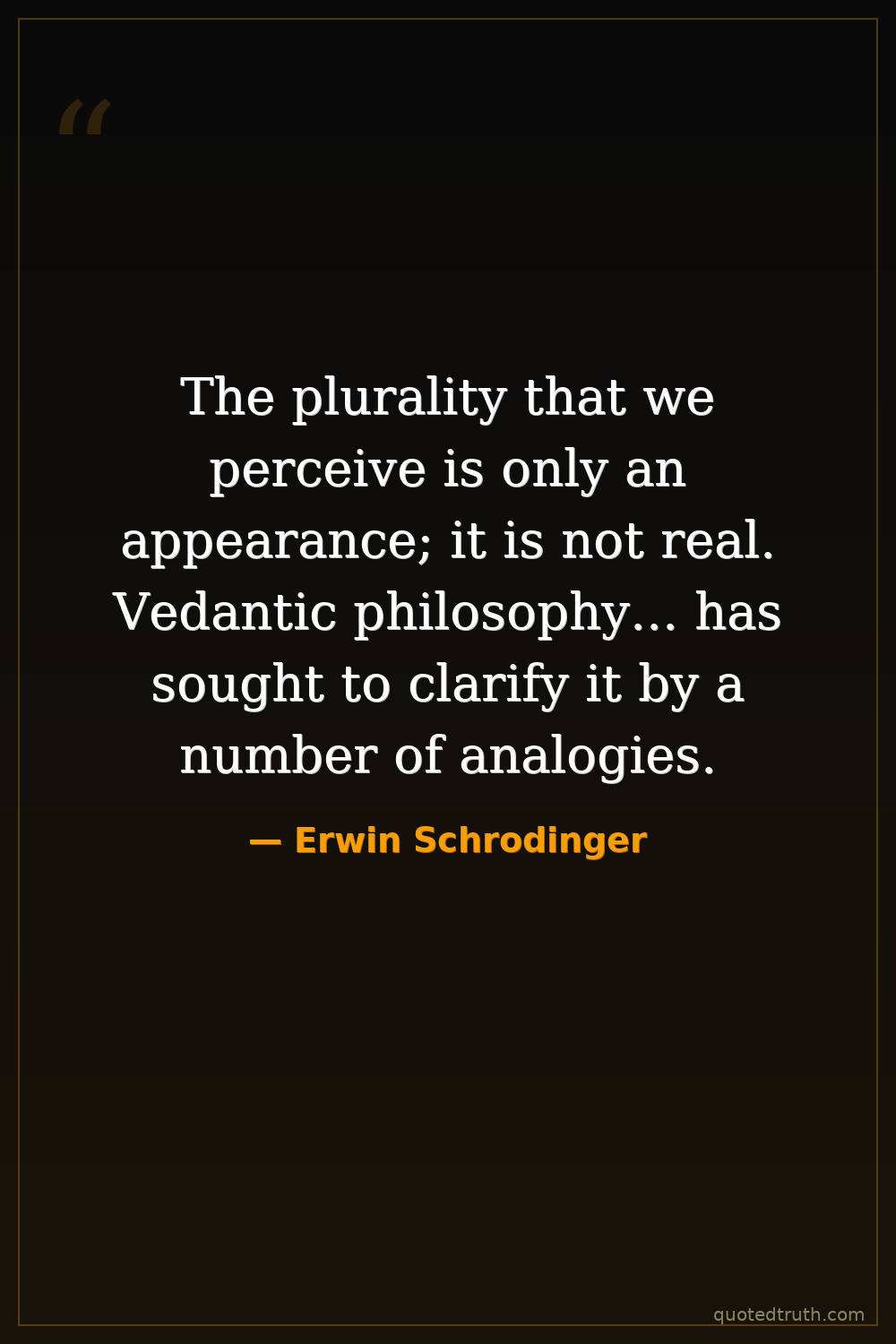
Erwin Schrodinger — "The plurality that we perceive is only an appearance; it is not real. Vedantic p…"
The plurality that we perceive is only an appearance; it is not real. Vedantic philosophy... has sought to clarify it by a number of analogies.
The plurality that we perceive is only an appearance; it is not real. Vedantic philosophy... has sought to clarify it by a number of analogies.
Click any product to generate a realistic preview. Up to 3 at a time.
* Initial load can take up to 90 seconds — revising the preview in another color is nearly instant.
"We are told such a number as the square root of 2 worried Pythagoras and his school almost to exhaustion. Being used to such queer numbers from early childhood, we must be careful not to form a low id…"
"Quantum mechanics has taught us that the world is not as solid and substantial as we thought."
"The only constant in life is change."
"Quantum mechanics is a wonderful theory. But it is not the last word."
"If we were bees, ants, or Lacedaemonian warriors, to whom personal fear does not exist and cowardice is the most shameful thing in the world, warring would go on forever. But luckily we are only men —…"
Austrian physicist who shared the 1933 Nobel for the wave equation that bears his name and the famous cat thought-experiment. Closely associated with Werner Heisenberg (matrix-mechanics rival who reached the same physics by different math) and Albert Einstein (his pen-pal on quantum interpretation). For an intellectual contrast, see Niels Bohr, Danish physicist and architect of the Copenhagen interpretation — Schrödinger's cat thought-experiment was specifically designed to ridicule Bohr's 'observer-dependent reality' reading of quantum mechanics — Schrödinger thought the Copenhagen interpretation was absurd; the cat was meant as reductio ad absurdum.
From 'What is Life?', revealing his embrace of Vedantic philosophy and its non-dualistic view of reality.
Date: 1944 (What is Life? published)
ShockingFound in 1 providers: gemini
1 source checked
What we experience as many separate things—objects, people, minds—is an illusion of perception rather than ultimate reality. Beneath apparent multiplicity lies a single unified substance. Our senses fragment what is fundamentally one. This challenges the commonsense view that the world is made of distinct, independent entities and suggests that division is a construct of consciousness, not a feature of existence itself.
Schrödinger, architect of quantum wave mechanics, spent decades troubled by the measurement problem and the apparent split between observer and observed in quantum theory. He studied Vedanta seriously, believing its non-dualist framework—one consciousness underlying all phenomena—offered a deeper resolution to quantum paradoxes than Western materialism. His book 'What is Life?' and philosophical essays directly engage Hindu metaphysics as scientific insight, not mere mysticism.
Mid-20th century physics had shattered classical certainty: quantum superposition, entanglement, and the observer effect suggested reality behaved radically differently at small scales. Western science struggled to interpret these findings within materialist frameworks. Simultaneously, Eastern philosophy gained scholarly attention in Europe. Schrödinger wrote amid this crisis of foundations, when physicists genuinely debated whether consciousness itself was fundamental to physical reality.
AI-generated insights based on extensive research and information for context. Factual errors? Email [email protected].
Your cart is empty