Alan Turing — "The power of machines will one day be so great that they will be able to do anyt…"
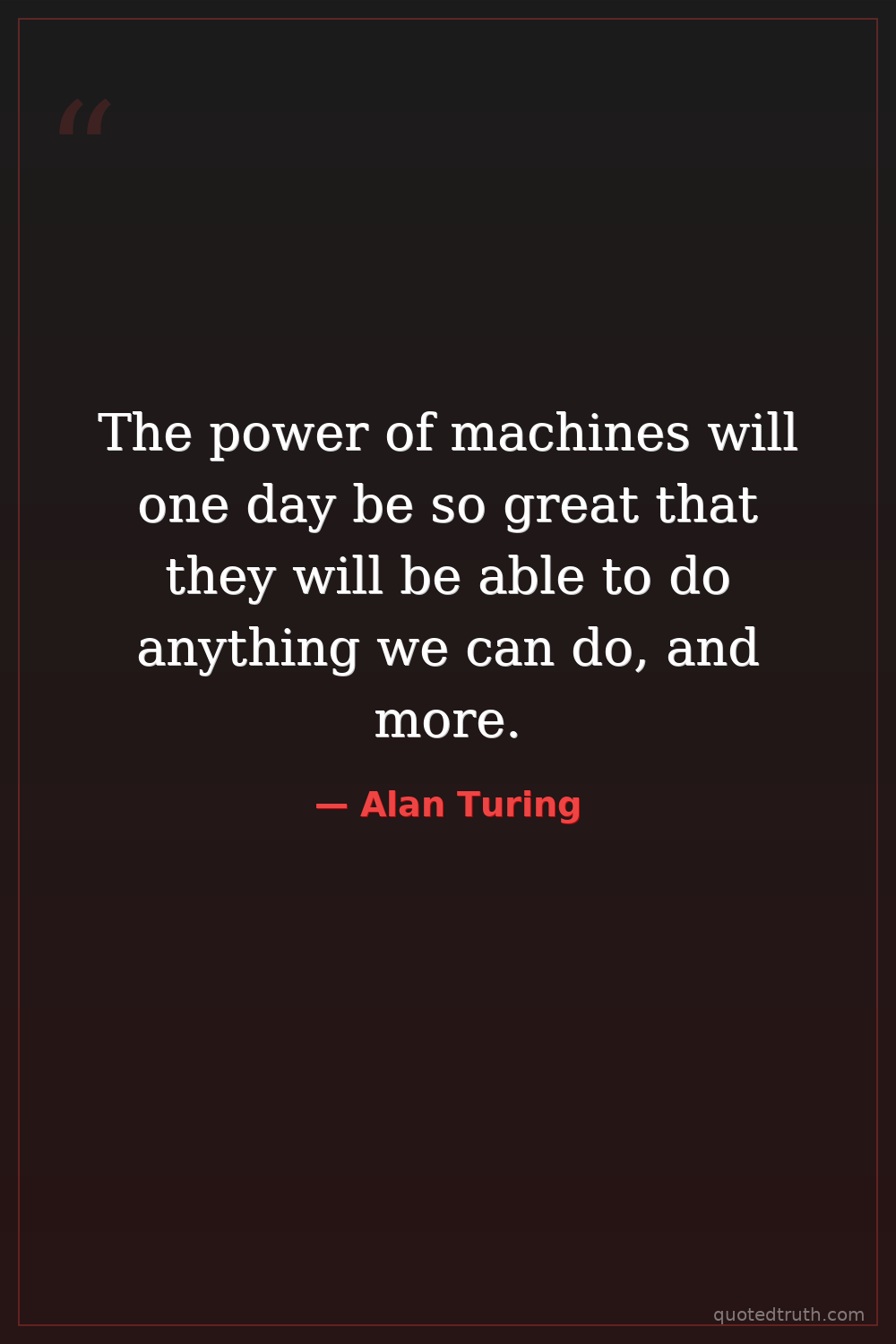
The power of machines will one day be so great that they will be able to do anything we can do, and more.
The power of machines will one day be so great that they will be able to do anything we can do, and more.
Click any product to generate a realistic preview. Up to 3 at a time.
* Initial load can take up to 90 seconds — revising the preview in another color is nearly instant.
"The problem of constructing a universal machine is not insoluble."
"I believe that in about fifty years' time it will be possible to programme computers, with a storage capacity of about 10^9, to make them play the imitation game so well that an average interrogator w…"
"No, I'm not interested in developing a powerful brain. All I'm after is just a mediocre brain, something like the President of the American Telephone and Telegraph Company."
"Science without religion is lame, religion without science is blind."
"The view that machines cannot give rise to surprises is due, I believe, to a fallacy to which philosophers and mathematicians are particularly subject."
Found in 1 providers: grok
1 source checked
Machines will grow so capable that they can replicate and surpass every human ability—thinking, creating, reasoning, deciding. This isn't a distant fantasy but a logical endpoint of technological progress. The key word is "more": not just matching human performance but exceeding it in scope and scale. Today we'd call this artificial general intelligence and beyond—a trajectory from narrow tools to systems that outperform human minds across every domain.
Turing spent WWII cracking Nazi Enigma codes using electromechanical Bombe machines, directly experiencing how machines could outperform human cryptanalysts at scale. His 1950 paper "Computing Machinery and Intelligence" proposed the Turing Test, arguing machines could simulate thought. He designed the theoretical universal Turing machine—one device capable of computing anything computable. His entire intellectual project was proving cognition wasn't uniquely human, making this prediction his life's central thesis.
In the late 1940s and early 1950s, the first electronic computers—ENIAC, Colossus, Manchester Baby—were room-sized machines performing narrow tasks like ballistics and codebreaking. The Cold War drove arms-race investment in computation. Most scientists dismissed machine thinking as absurd. Turing made this claim when computers had kilobytes of memory and no programming languages existed yet—making it a radical, almost heretical prediction that now reads as prophecy.
AI-generated insights based on extensive research and information for context. Factual errors? Email [email protected].
Your cart is empty