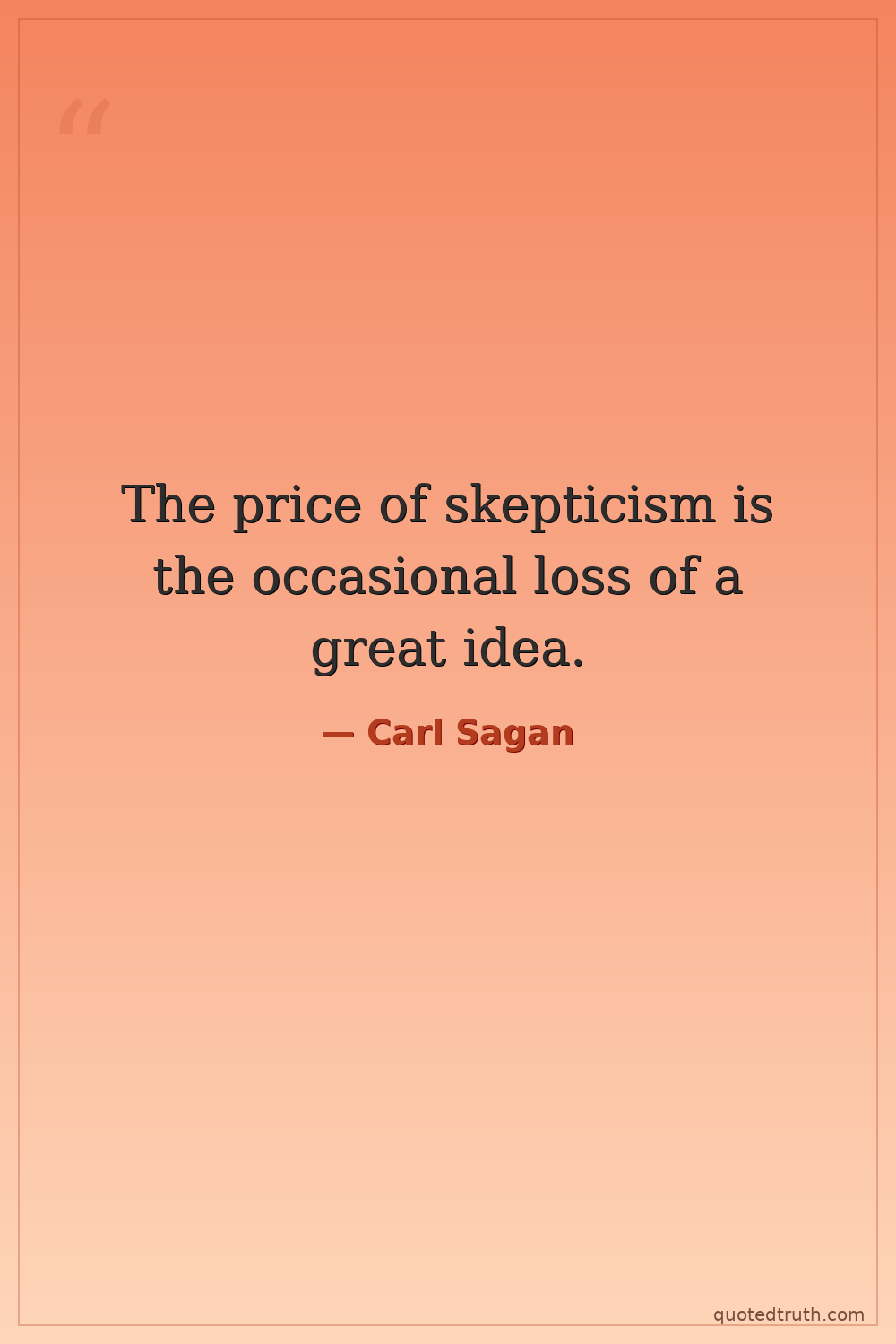
Carl Sagan — "The price of skepticism is the occasional loss of a great idea."
The price of skepticism is the occasional loss of a great idea.
The price of skepticism is the occasional loss of a great idea.
Click any product to generate a realistic preview. Up to 3 at a time.
* Initial load can take up to 90 seconds — revising the preview in another color is nearly instant.
"We live in a society exquisitely dependent on science and technology, in which hardly anyone knows anything about science and technology."
"...that it is better to understand the universe as it is than to pretend that it is something it is not."
"The total number of stars in the Universe is larger than all the grains of sand on all the beaches of the planet Earth."
"The universe is a machine for the making of gods."
"Our loyalties are to the species and to the planet. We speak for Earth."
Found in 1 providers: grok
1 source checked
Skepticism requires evidence before accepting ideas. Sometimes a genuinely correct insight gets dismissed or delayed because proof hasn't caught up yet — that's the unavoidable cost of rigorous thinking. Occasionally real breakthroughs are rejected. But Sagan argues this trade-off is worthwhile: accepting claims without scrutiny causes far more damage through false beliefs than skepticism causes by occasionally missing a true one.
Sagan spent decades battling pseudoscience — astrology, creationism, UFO conspiracy claims — while simultaneously championing speculative ideas like extraterrestrial intelligence through SETI. He knew the tension personally. His book The Demon-Haunted World argued for a precise balance between openness and scrutiny. He acknowledged that demanding evidence could delay acceptance of genuine breakthroughs, yet considered that delay far preferable to the harm caused by uncritical belief.
During Sagan's career — roughly the 1960s through 1996 — the New Age movement, UFO cults, astrology columns, and faith healing competed with genuine scientific revolutions in biology and physics for public attention. Cold War anxieties made both paranoid belief and reflexive dismissal tempting. Sagan became America's most prominent voice arguing that science required holding two things simultaneously: disciplined skepticism and genuine wonder at ideas that might eventually prove true.
AI-generated insights based on extensive research and information for context. Factual errors? Email [email protected].
Your cart is empty