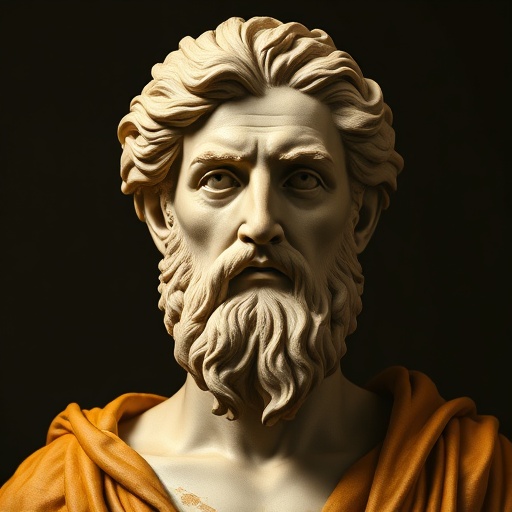
Archimedes — "The proportion of any sphere to the cylinder circumscribing it is as 2 to 3."
The proportion of any sphere to the cylinder circumscribing it is as 2 to 3.
The proportion of any sphere to the cylinder circumscribing it is as 2 to 3.
Click any product to generate a realistic preview. Up to 3 at a time.
* Initial load can take up to 90 seconds — revising the preview in another color is nearly instant.
"Take the case of a cube and a sphere, and see which is the more beautiful body."
"Any solid lighter than a fluid will, if placed in the fluid, be immersed in it to such an extent that the weight of the solid will be equal to the weight of the fluid displaced."
"The center of gravity of any triangle is the point of intersection of its medians."
"Every solid body immersed in a fluid is buoyed up by a force equal to the weight of the fluid displaced by the body."
"Mathematics reveals its secrets only to those who approach it with pure love, for its own beauty."
A discovery he was most proud of, requesting it be inscribed on his tomb. As told by Cicero.
Date: c. 250 BCE
GeneralFound in 1 providers: grok
1 source checked
If you enclose a sphere perfectly inside a cylinder — same diameter, same height — the sphere occupies exactly two-thirds of the cylinder's volume and surface area. A clean, whole-number ratio linking two fundamental shapes. It means geometry hides precise, discoverable order: complex curved forms relate to simpler straight-edged ones through exact proportions, not messy approximations. Nature's mathematics resolves neatly when examined with sufficient rigor.
Archimedes prized this proof so deeply he requested a sphere-inside-cylinder diagram carved on his tombstone — a wish Cicero confirmed when he found the grave in 75 BC. Proved in On the Sphere and Cylinder using exhaustion methods anticipating integral calculus by 1,800 years, it represents his self-declared greatest achievement. For a man who unified physical intuition with strict geometric proof, this perfect ratio was the pinnacle of a lifetime's work.
In third-century BC Syracuse, Greek mathematicians treated geometry as philosophy — exact proportions were glimpses of cosmic order reflecting Platonic ideal forms. Archimedes worked while Syracuse was caught between Roman and Carthaginian ambitions, yet produced mathematics that took nearly two millennia to surpass. Demonstrating that a sphere relates to its circumscribing cylinder by a precise 2:3 ratio was philosophically radical: it confirmed the universe's structure was rational, whole, and fully knowable by human reason.
AI-generated insights based on extensive research and information for context. Factual errors? Email [email protected].
Your cart is empty