Niels Bohr — "The purpose of science is not to answer ultimate questions, but to make progress…"
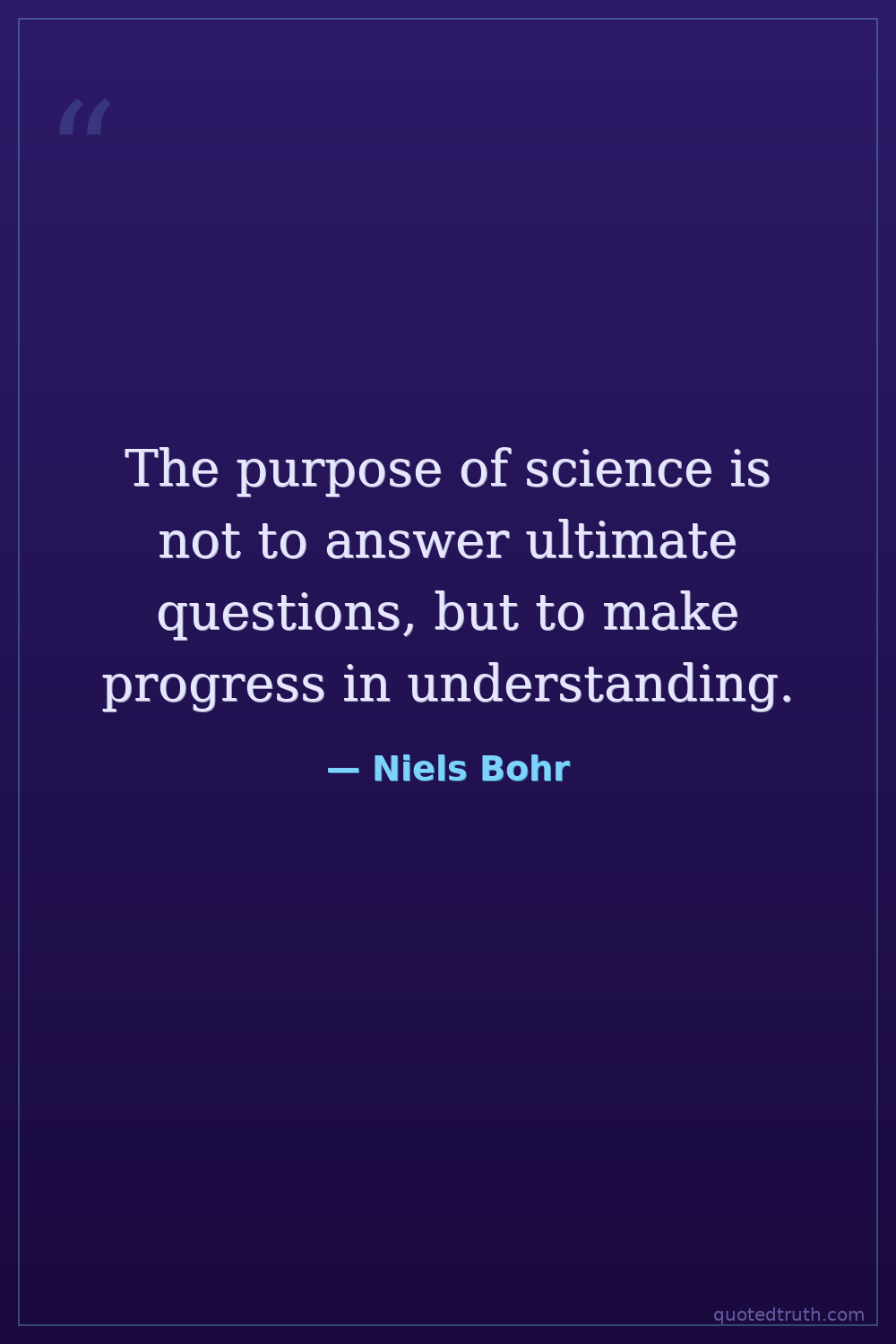
The purpose of science is not to answer ultimate questions, but to make progress in understanding.
The purpose of science is not to answer ultimate questions, but to make progress in understanding.
Click any product to generate a realistic preview. Up to 3 at a time.
* Initial load can take up to 90 seconds — revising the preview in another color is nearly instant.
"Accuracy and clarity of expression are a matter of degree."
"We are trapped by language to such a degree that every attempt to make progress in our understanding of the universe must also be an attempt to perfect our language."
"The task is not so much to see what no one has yet seen, but to think what nobody has yet thought, about that which everybody sees."
"Anyone who is not shocked by quantum theory has not understood it."
"The meaning of life does not consist in the mere fact of existing, but in the power of perceiving and making known our existence, and that of others."
Found in 1 providers: grok
1 source checked
Science is not about solving the biggest mysteries of existence once and for all. Instead, it is a steady, incremental process of building better understanding of how the world works. Researchers should measure success not by whether they have delivered final truths, but by whether they have moved knowledge forward. Each experiment, theory, or correction that deepens comprehension counts as real achievement, even when the deepest philosophical questions remain open.
Bohr spent his career advancing atomic theory without claiming final answers. His 1913 model of the atom was later refined by quantum mechanics, which he helped shape through the Copenhagen interpretation. He embraced complementarity, accepting that reality resists single tidy descriptions. Famous debates with Einstein showed his comfort with unresolved deep questions. For Bohr, progress in understanding mattered more than absolute certainty, reflecting his humility and patience as a physicist.
Bohr worked during the early twentieth century, when classical physics was breaking down and quantum theory was being born. Relativity, radioactivity, and atomic structure overturned long-held certainties. Two world wars, the Manhattan Project, and the atomic bomb forced scientists to reckon with limits and ethics. Philosophers and physicists debated whether science could ever reveal ultimate reality. In that unsettled climate, Bohr championed a pragmatic, humble view of science as ongoing inquiry rather than final revelation.
AI-generated insights based on extensive research and information for context. Factual errors? Email [email protected].
Your cart is empty