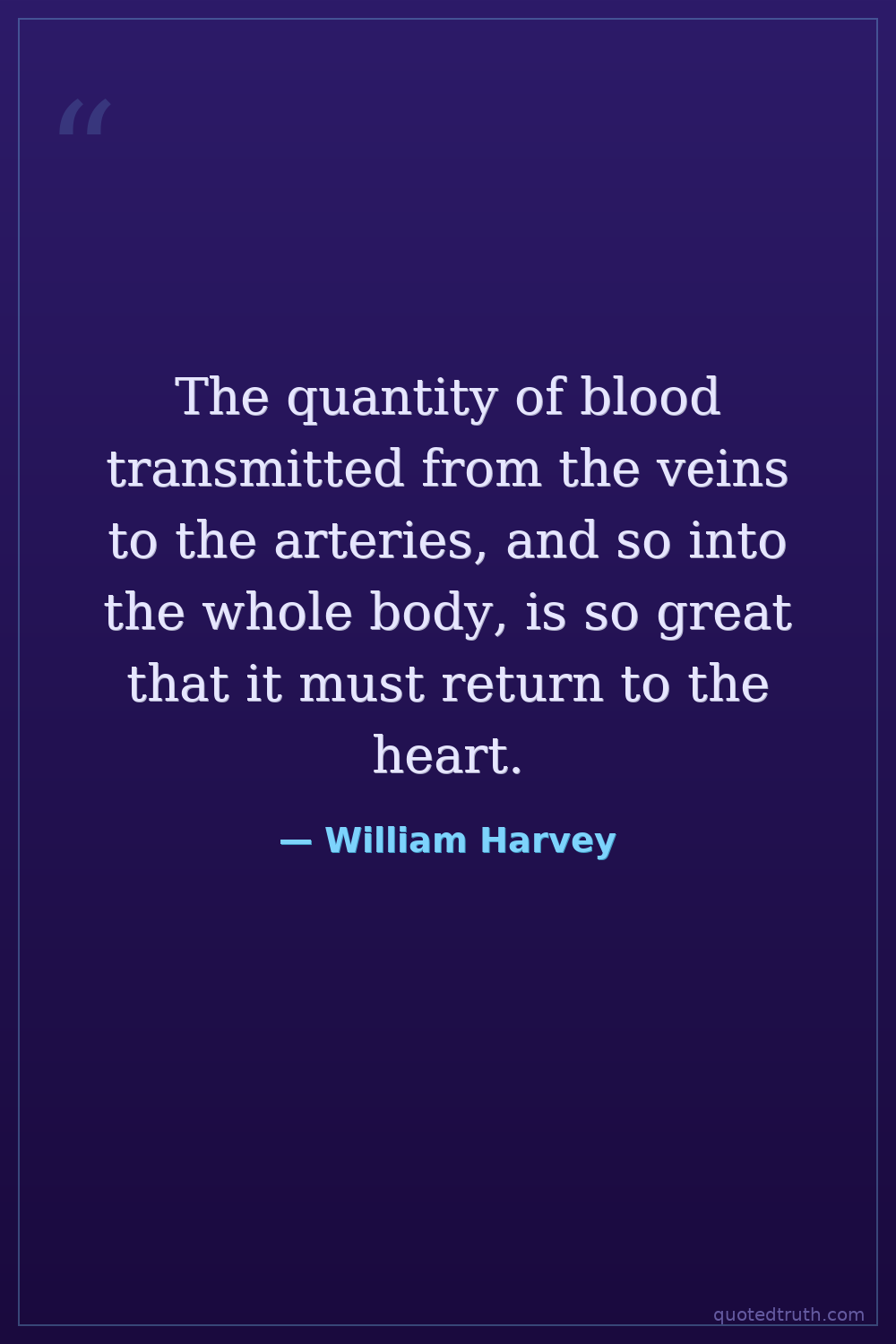
William Harvey — "The quantity of blood transmitted from the veins to the arteries, and so into th…"
The quantity of blood transmitted from the veins to the arteries, and so into the whole body, is so great that it must return to the heart.
The quantity of blood transmitted from the veins to the arteries, and so into the whole body, is so great that it must return to the heart.
Click any product to generate a realistic preview. Up to 3 at a time.
* Initial load can take up to 90 seconds — revising the preview in another color is nearly instant.
"Nature is nowhere accustomed more openly to display her secret mysteries than in cases where she shows traces of her workings apart from the beaten path."
"The heart is the beginning of life; the sun of the microcosm."
"The blood in the arteries is of a more florid colour than that in the veins."
"Without the circulation of the blood, there can be no true life."
"The more accurately we observe, the more clearly we understand."
English physician whose On the Motion of the Heart and Blood in Animals (1628) demonstrated blood circulation, overturning 1,400 years of Galenic medicine. Closely associated with Francis Bacon (his contemporary in the new English empiricism). For an intellectual contrast, see Galenic medicine, the 2nd-century Greek medical tradition (humors, blood-as-consumed-fuel) — Harvey calculated that the heart pumps more blood per hour than the body could possibly produce as fuel — a single quantitative observation that demolished the entire Galenic-Aristotelian medical worldview. The cleanest example in medical history of arithmetic disproving 14 centuries of authority.
Found in 1 providers: grok
1 source checked
The body contains a fixed, finite amount of blood, and the sheer volume pumped through the heart every hour far exceeds what food could produce. Therefore blood cannot simply be created and consumed — it must be cycling continuously through the body in a closed loop, returning to the heart to be pumped again.
Harvey spent years measuring blood volume and heart output, calculating that the heart pumps roughly the body's entire blood supply every few minutes. This quantitative, mathematical approach defined his 1628 discovery of circulation — he didn't just theorize, he measured, making him a founding figure of experimental physiology.
In the early 17th century, Galenic medicine — 1,400 years old — held that the liver continuously manufactured new blood consumed by the body's tissues. Harvey's measurement-based argument directly contradicted this orthodoxy. The Scientific Revolution was demanding evidence over authority, and Harvey's De Motu Cordis exemplified that shift, facing fierce resistance from physicians trained in classical doctrine.
AI-generated insights based on extensive research and information for context. Factual errors? Email [email protected].
Your cart is empty