William Harvey — "Without the circulation of the blood, there can be no true life."
Without the circulation of the blood, there can be no true life.
Without the circulation of the blood, there can be no true life.
Click any product to generate a realistic preview. Up to 3 at a time.
* Initial load can take up to 90 seconds — revising the preview in another color is nearly instant.
"Nature is nowhere accustomed more openly to display her secret mysteries than in cases where she shows traces of her workings apart from the beaten path."
"Only by understanding the wisdom of natural foods and their effects on the body, shall we attain mastery of disease and pain, which shall enable us to relieve the burden of mankind."
"All we know is still infinitely less than all that still remains unknown."
"The circulation of the blood is a miracle of nature."
"The animal body is a commonwealth, in which every member is a subject to the whole."
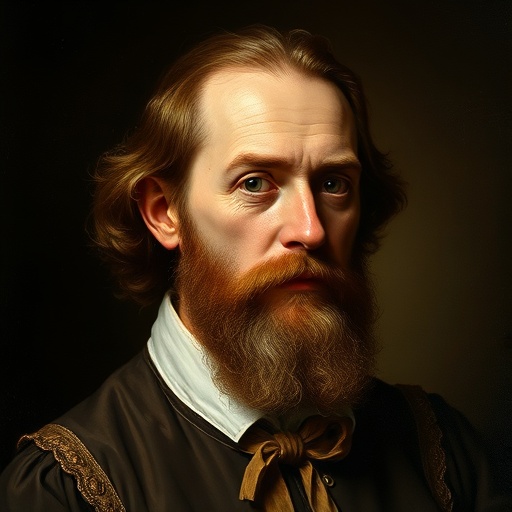
English physician whose On the Motion of the Heart and Blood in Animals (1628) demonstrated blood circulation, overturning 1,400 years of Galenic medicine. Closely associated with Francis Bacon (his contemporary in the new English empiricism). For an intellectual contrast, see Galenic medicine, the 2nd-century Greek medical tradition (humors, blood-as-consumed-fuel) — Harvey calculated that the heart pumps more blood per hour than the body could possibly produce as fuel — a single quantitative observation that demolished the entire Galenic-Aristotelian medical worldview. The cleanest example in medical history of arithmetic disproving 14 centuries of authority.
A direct and profound consequence of his discovery, highlighting the essential nature of blood flow.
Date: 1628
PhilosophicalFound in 1 providers: gemini
1 source checked
Blood circulation is the fundamental mechanism that sustains life itself. Without blood continuously moving through the body—delivering oxygen and nutrients while removing waste—organs fail and life ceases. Harvey argues that life isn't simply breathing or having a heartbeat, but the active, uninterrupted movement of blood through vessels. Circulation is not incidental to life; it is the core physical process that defines and maintains it.
Harvey spent decades dissecting animals and observing beating hearts to prove blood circulates continuously—a direct refutation of Galen's 1,400-year-old doctrine that blood was produced and consumed. His 1628 masterwork, De Motu Cordis, demonstrated the heart functions as a mechanical pump. This quote distills his life's central conviction: circulation was not anatomical trivia but existence itself, a belief he defended against fierce opposition from the medical establishment.
Harvey worked in early 17th-century Europe when Galenic medicine, unchanged since ancient Greece, still governed every physician's training. The Scientific Revolution was dismantling dogma in astronomy and physics; Harvey extended that empirical revolt into the body. Scholars of his era linked blood to vital spirits and the soul, so framing circulation as a mechanical process was simultaneously a scientific claim and a philosophical provocation that threatened both academic and religious authority.
AI-generated insights based on extensive research and information for context. Factual errors? Email [email protected].
Your cart is empty