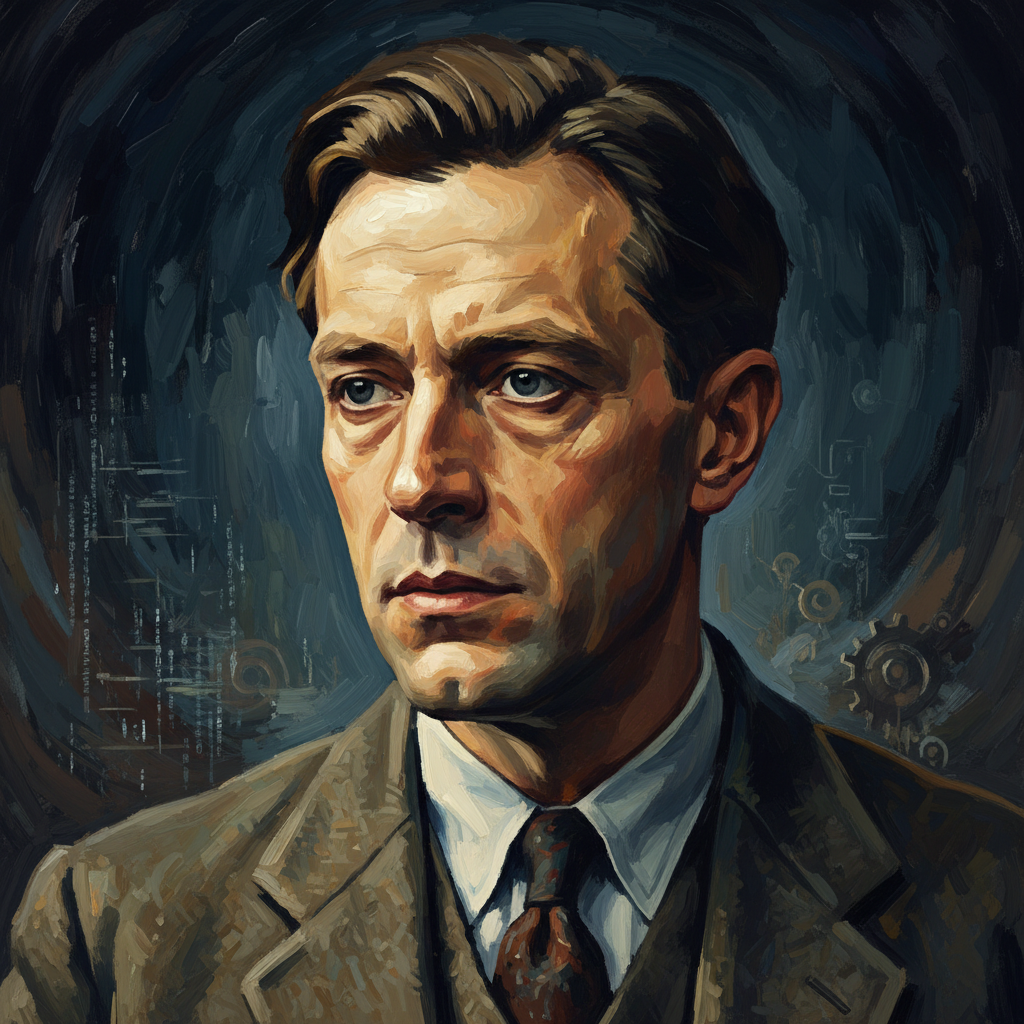
Alan Turing — "The question of whether machines can think is a philosophical one, not a scienti…"
The question of whether machines can think is a philosophical one, not a scientific one.
The question of whether machines can think is a philosophical one, not a scientific one.
Click any product to generate a realistic preview. Up to 3 at a time.
* Initial load can take up to 90 seconds — revising the preview in another color is nearly instant.
"We are building a brain."
"The popular view that the brain is a 'digital computer' is a profound oversimplification."
"The human intellect is a very powerful thing, but it has its limitations."
"The computer is a universal machine."
"The idea behind digital computers may be explained by saying that these machines are intended to carry out any operations which could be done by a human computer."
Attributed, general implication from his writings, but exact quote is elusive.
Date: Approx. 1950
ShockingFound in 1 providers: grok
1 source checked
Whether machines can think depends entirely on what 'think' means — and that's a definitional dispute, not something experiments can settle. Science measures behavior, speed, and pattern recognition, but cannot determine whether any process constitutes genuine thought versus sophisticated mimicry. That distinction belongs to philosophy of mind, where competing definitions of consciousness, intentionality, and cognition remain unresolved. No instrument can answer a question whose terms aren't agreed upon.
Turing confronted this directly in his landmark 1950 paper 'Computing Machinery and Intelligence,' immediately sidestepping 'Can machines think?' as ill-defined and replacing it with the behavioral Imitation Game. His wartime codebreaking at Bletchley Park showed him machines executing complex tasks; his computability theory revealed their formal limits. He trusted rigorous framing over vague intuition — precise enough to distinguish which questions science could answer from those it structurally cannot.
The early 1950s marked computing's birth as a public phenomenon. ENIAC (1945), the Manchester Baby (1948), and stored-program architectures made 'thinking machines' a live cultural question. Cold War pressures accelerated automation research while philosophers — Ryle's 'The Concept of Mind' (1949), Wittgenstein's later work — actively dismantled naive mental concepts. Society urgently debated whether machines threatened human uniqueness, making the boundary between mechanical computation and genuine thought a central anxiety of the age.
AI-generated insights based on extensive research and information for context. Factual errors? Email [email protected].
Your cart is empty