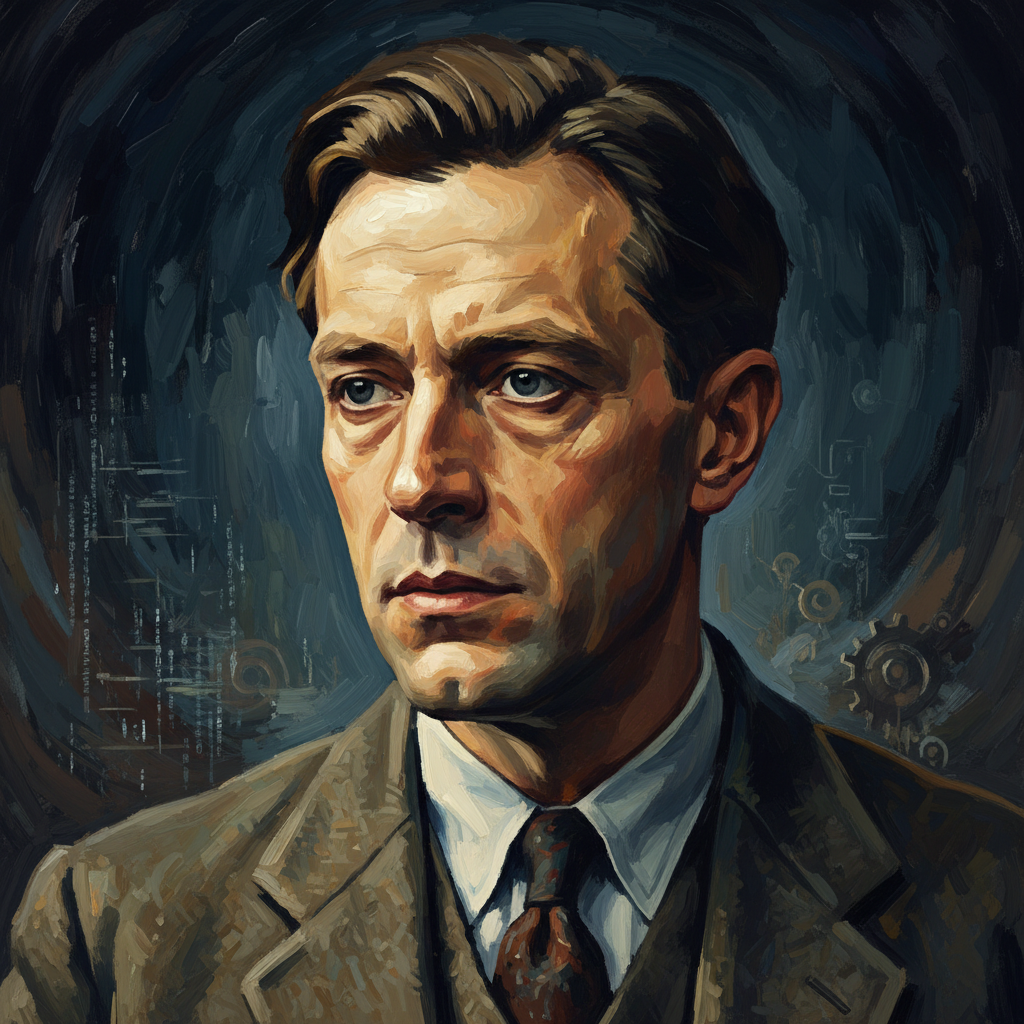
Alan Turing — "The computer is a universal machine."
The computer is a universal machine.
The computer is a universal machine.
Click any product to generate a realistic preview. Up to 3 at a time.
* Initial load can take up to 90 seconds — revising the preview in another color is nearly instant.
"The only real valuable thing is intuition."
"I am not very impressed with theological arguments whatever they may be used to support. Such arguments have often been found unsatisfactory in the past. In the time of Galileo it was argued that the …"
"I propose to consider the question, 'Can machines think?' This should begin with definitions of the meaning of the terms 'machine' and 'think.'"
"I am not interested in whether a machine can think, but in whether it can make me think."
"The future of computing lies in the development of intelligent machines."
Found in 1 providers: grok
1 source checked
Any single device loaded with the right instructions can perform any task another machine could perform. A computer isn't built for one job—it's infinitely reconfigurable through software. What makes it 'universal' is that it can simulate any other machine, from a calculator to a chess engine to an entire operating system. This idea is the theoretical bedrock of every laptop, smartphone, and server running today.
Turing's 1936 paper 'On Computable Numbers' introduced the Universal Turing Machine—a theoretical device that could execute any algorithm by reading instructions from a tape. This wasn't abstract to him: at Bletchley Park he built Bombe machines to crack Enigma by simulating cipher configurations. His later ACE and Manchester computer designs were direct attempts to physically realize the universal machine he had mathematically proven possible a decade earlier.
In the 1940s and 50s, computers were either specialized electromechanical devices built for narrow tasks or rooms full of human clerks doing arithmetic. Each new problem required new hardware. Against the backdrop of World War II code-breaking urgency and the postwar Cold War arms race, Turing's claim that one reprogrammable machine could replace all others wasn't just elegant theory—it redefined what technology could be and set the architecture of the digital age.
AI-generated insights based on extensive research and information for context. Factual errors? Email [email protected].
Your cart is empty