Laozi — "The sage puts his person last, and it comes first. He treats his person as an ou…"
The sage puts his person last, and it comes first. He treats his person as an outsider, and it is preserved.
The sage puts his person last, and it comes first. He treats his person as an outsider, and it is preserved.
Click any product to generate a realistic preview. Up to 3 at a time.
* Initial load can take up to 90 seconds — revising the preview in another color is nearly instant.
"The five colors blind the eye. The five notes deafen the ear. The five tastes dull the palate."
"Fame or integrity: which is more important? Money or happiness: which is more precious?"
"Therefore the sage manages affairs without doing anything, and conveys his instructions without the use of speech."
"One who makes promises rashly rarely keeps good faith; One who is in the habit of considering things easy meets with frequent difficulties."
"Governing a large country is like cooking a small fish. You spoil it with too much poking."
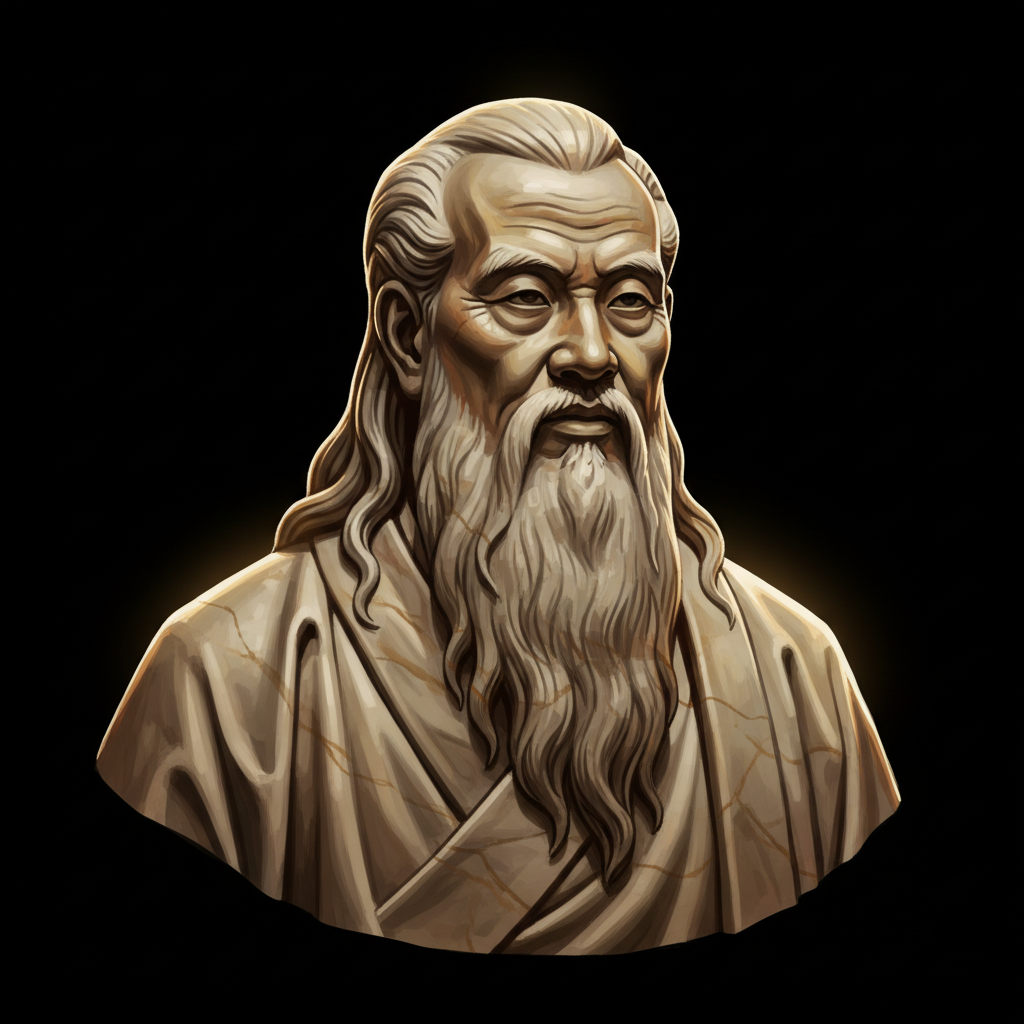
Reputed founder of Taoism and author of the Tao Te Ching, whose wu wei (effortless action) shaped East Asian philosophy. Closely associated with Zhuangzi (later Taoist who extended Laozi's framework). For an intellectual contrast, see Confucius, near-contemporary Chinese sage of social ritual and duty — Confucius systematized social order through ritual and hierarchy; Laozi argued that all such systems were the disease, not the cure — the two founding poles of Chinese moral philosophy.
Found in 1 providers: gemini
1 source checked
Putting yourself last paradoxically moves you ahead. When you stop grasping for status, credit, or self-preservation, people trust you, protect you, and naturally give you a leading role. By treating your ego as something external rather than clinging to it, the real you endures. Self-interest pursued directly defeats itself; self-interest released is the only kind that actually lasts. Step back and you rise.
Laozi reportedly served as an archivist in the Zhou royal court, a quiet keeper of records rather than a power-seeker, and legend says he left office unnoticed, riding west on an ox. That personal retreat from rank embodies this line. His core teaching of wu wei, non-forcing action, rests on exactly this inversion: the sage who refuses to push himself forward ends up carried forward by the Tao.
Laozi lived during the late Zhou dynasty, around the 6th century BCE, as feudal lords fought endlessly and ambitious ministers schemed for position in the lead-up to the Warring States period. Court life rewarded self-promotion and ruthlessness, and many perished from it. Against that backdrop, a teaching that survival and influence come from humility and stepping back was radical, offering an alternative path to the Confucian emphasis on active public duty.
AI-generated insights based on extensive research and information for context. Factual errors? Email [email protected].
Your cart is empty