What it means
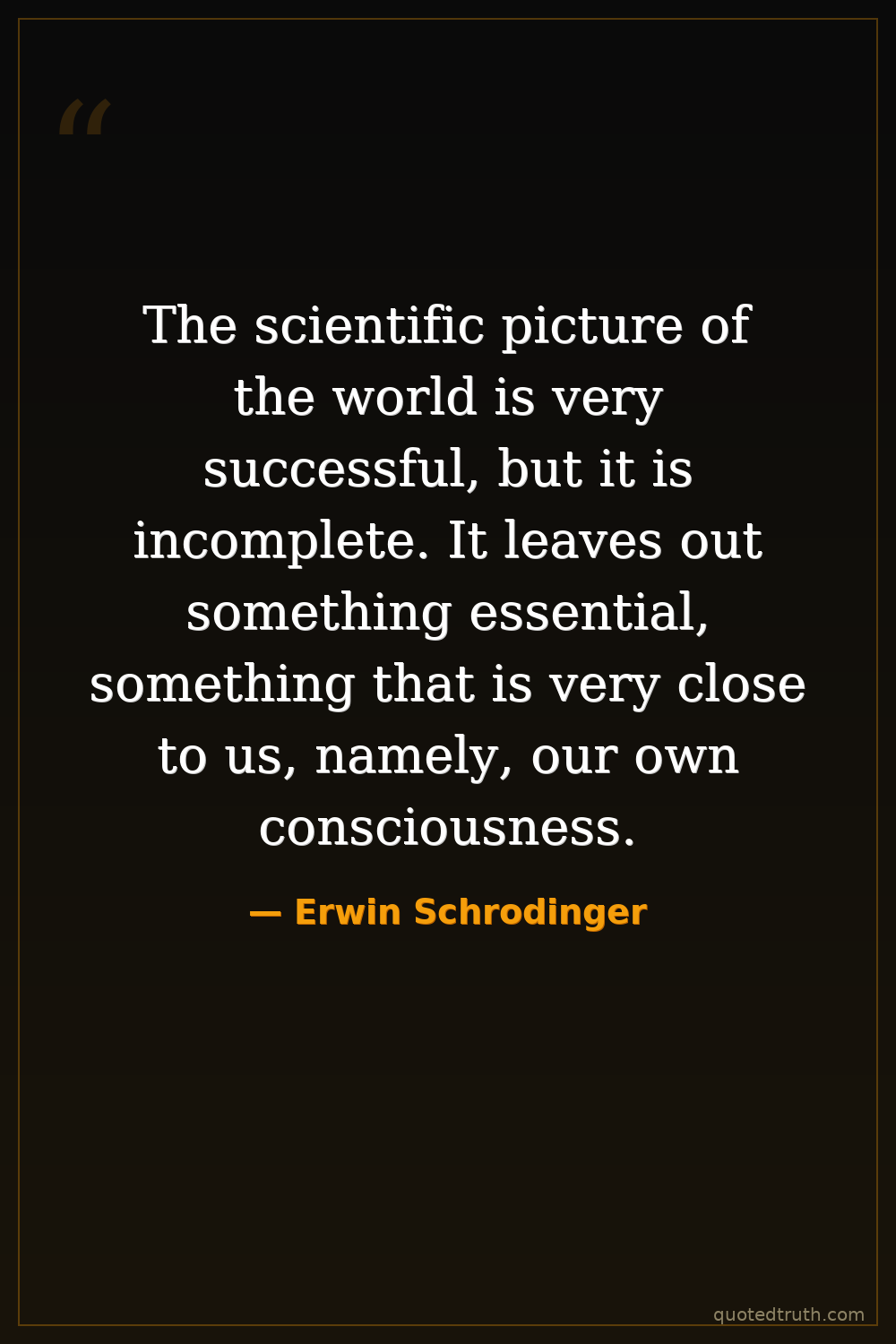
Science excels at measuring, predicting, and describing the external world—from quantum particles to galaxies. But all those equations and observations exist only because someone is aware of them. Consciousness—the felt, first-person experience of being alive—is absent from every scientific model. Schrödinger argues this isn't a minor oversight; it's a fundamental incompleteness, since the very instrument doing the science is the mind science cannot fully account for.
Relevance to Erwin Schrodinger
Schrödinger formulated the wave equation governing quantum systems, yet spent decades troubled by what quantum mechanics implies about the observer. His books "What Is Life?" and "Mind and Matter" show a physicist genuinely wrestling with consciousness. He studied Vedanta philosophy and believed the multiplicity of minds might be an illusion of one universal consciousness. For him, omitting awareness from physics wasn't academic—it was the central unresolved problem of his intellectual life.
The era
In the 1940s–1950s, quantum mechanics had just dismantled classical determinism, leaving physicists arguing about what observation and measurement actually mean. Logical positivism dominated philosophy, insisting only empirically verifiable statements mattered—threatening to make consciousness philosophically unspeakable. Meanwhile, Turing was asking whether machines could think. The tension between physics' extraordinary success and its complete silence on inner experience was becoming impossible for reflective scientists like Schrödinger to ignore.
AI-generated insights based on extensive research and information for context. Factual errors? Email [email protected].