What it means
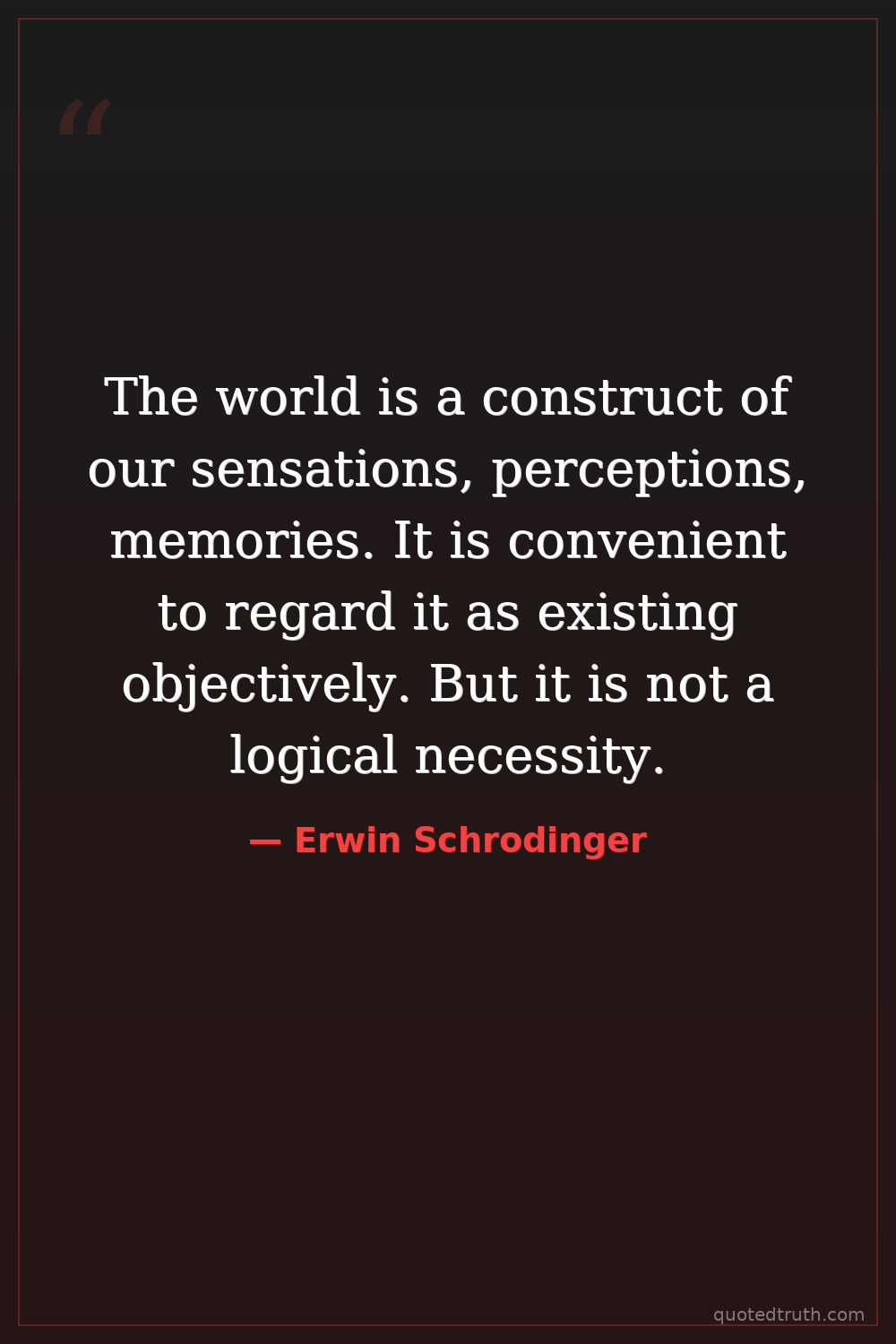
Reality as we know it is built from what our senses detect, what we remember, and how we perceive things. Treating the world as an objective fact independent of us is useful and practical, but it is not something logic actually demands. The external world could be a shared mental construction rather than a guaranteed independent reality.
Relevance to Erwin Schrodinger
Schrödinger developed wave mechanics, describing particles as probability waves rather than definite objects—directly challenging classical notions of objective reality. His famous cat paradox exposed how quantum systems resist definite states until observed. This quote reflects his deep engagement with consciousness and measurement, shaped by his reading of Vedantic philosophy and Mach's empiricism throughout his career.
The era
Schrödinger worked during quantum mechanics' founding decades, when Einstein, Bohr, and Heisenberg dismantled classical certainties. The Copenhagen interpretation made observation central to physical reality, sparking fierce debates about objectivity in science. Simultaneously, logical positivism in philosophy questioned unverifiable metaphysical claims, making Schrödinger's skepticism about mind-independent reality both scientifically grounded and culturally resonant.
AI-generated insights based on extensive research and information for context. Factual errors? Email [email protected].