What it means
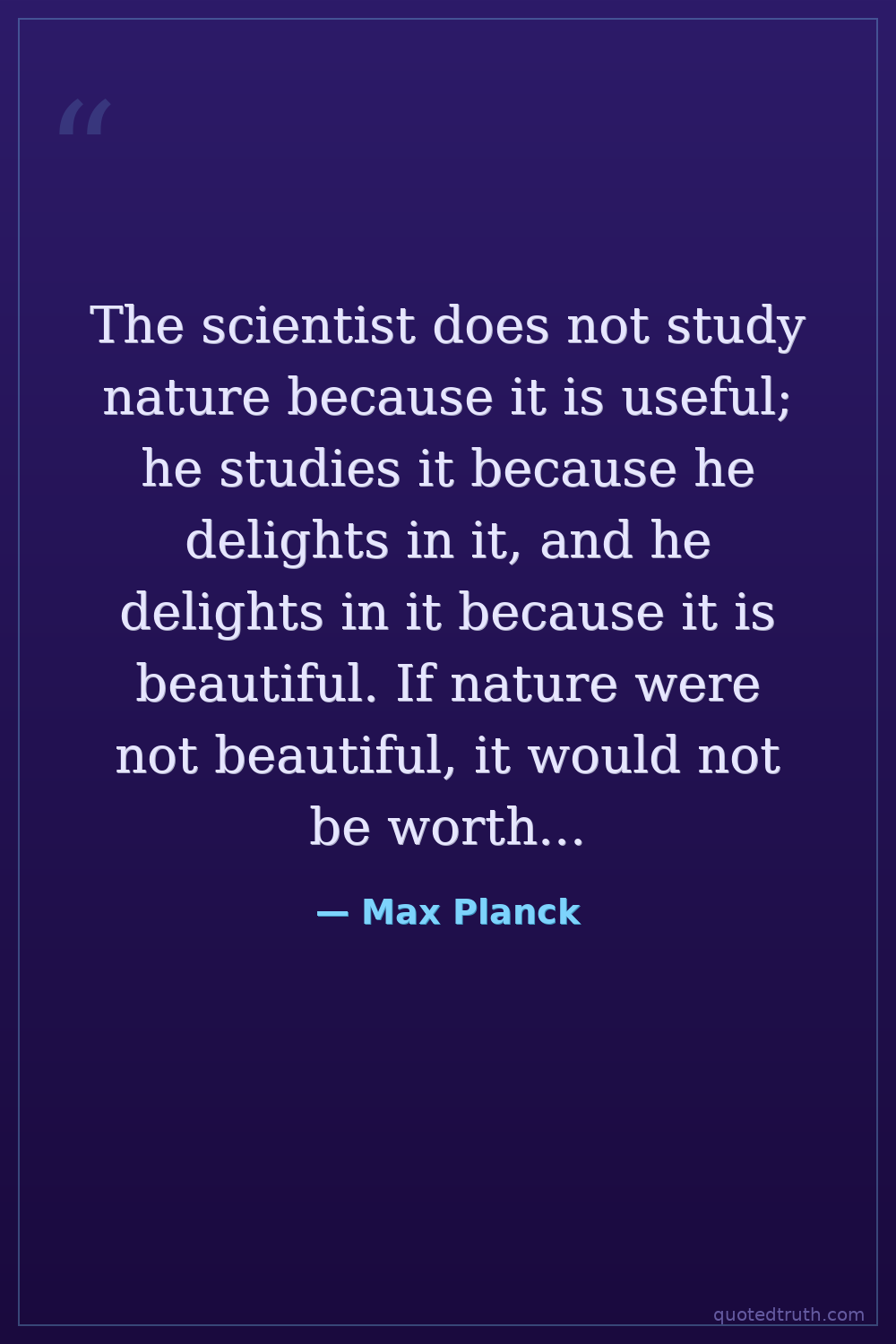
Real scientific motivation comes from wonder and aesthetic pleasure, not practical payoff. Researchers pursue understanding because the patterns and order they uncover are genuinely beautiful, and that beauty is what makes knowledge worth chasing. Strip away the beauty and curiosity collapses, taking with it much of what gives existence meaning. Usefulness is a byproduct; delight in nature's elegance is the real engine driving inquiry and, more broadly, a life worth living.
Relevance to Max Planck
Planck spent decades on thermodynamics and blackbody radiation with no applied goal, driven by what he called an inner need to grasp nature's harmony. His 1900 quantum hypothesis emerged from stubborn aesthetic discomfort with ugly theoretical gaps, not industrial demand. Deeply influenced by Kant and devout in faith, he saw physics as uncovering a lawful, beautiful order behind appearances. This quote mirrors his lifelong conviction that truth-seeking, not utility, justifies science.
The era
Planck worked as physics industrialized around him: electrification, radio, chemical industries, and eventually Nazi pressure to prove science's national usefulness. German universities increasingly faced demands to justify research economically and militarily, especially after WWI reparations and during Weimar austerity. Simultaneously, quantum mechanics and relativity were overturning classical certainties. Planck, who lost a son to Nazi execution, insisted publicly that pure science defended by disinterested beauty was civilization's core, pushing back against both crude utilitarianism and ideological corruption of knowledge.
AI-generated insights based on extensive research and information for context. Factual errors? Email [email protected].