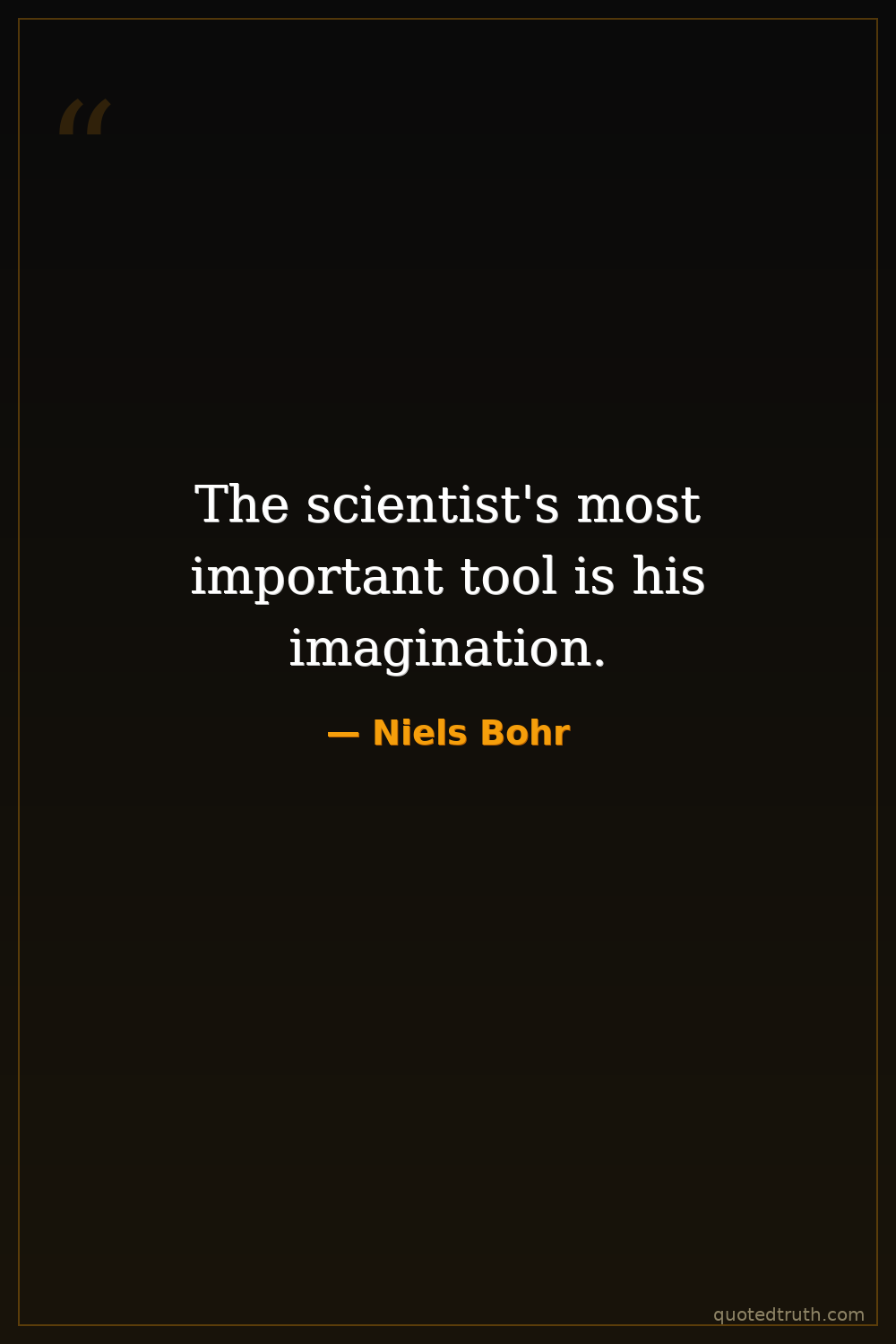
Niels Bohr — "The scientist's most important tool is his imagination."
The scientist's most important tool is his imagination.
The scientist's most important tool is his imagination.
Click any product to generate a realistic preview. Up to 3 at a time.
* Initial load can take up to 90 seconds — revising the preview in another color is nearly instant.
"The task is not so much to see what no one has yet seen, but to think what nobody has yet thought, about that which everybody sees."
"The aim of science is to purify our notions, not to increase the number of facts."
"The very nature of our subject, quantum physics, forces us to realize that we are suspended in language."
"The fundamental problem of all science is the description of the world."
"The meaning of our words depends on the context in which they are uttered."
Found in 1 providers: grok
1 source checked
Scientific progress isn't just about data and equations — it requires envisioning what hasn't been proven yet. A researcher must mentally construct possibilities beyond current evidence, then test them. Pure logic alone cannot leap into the unknown; imagination is what generates hypotheses worth pursuing. Without it, science becomes mere cataloguing rather than discovery.
Bohr revolutionized physics not through brute calculation but through conceptual leaps — imagining electrons occupying discrete energy levels, a model that defied classical intuition entirely. His Copenhagen interpretation of quantum mechanics required embracing paradox and uncertainty as real features of nature. Bohr famously encouraged wild speculation among his Copenhagen Institute colleagues, believing unconventional mental models were the engine of theoretical physics.
The early 20th century saw physics shatter centuries of Newtonian certainty. Quantum mechanics, relativity, and wave-particle duality overturned intuitive reality entirely. Scientists could no longer rely on mechanical analogies from everyday experience — atoms behaved nothing like billiard balls. In this revolutionary climate, imagination wasn't a soft supplement to rigor; it was literally required to conceive phenomena no human had ever directly observed.
AI-generated insights based on extensive research and information for context. Factual errors? Email [email protected].
Your cart is empty